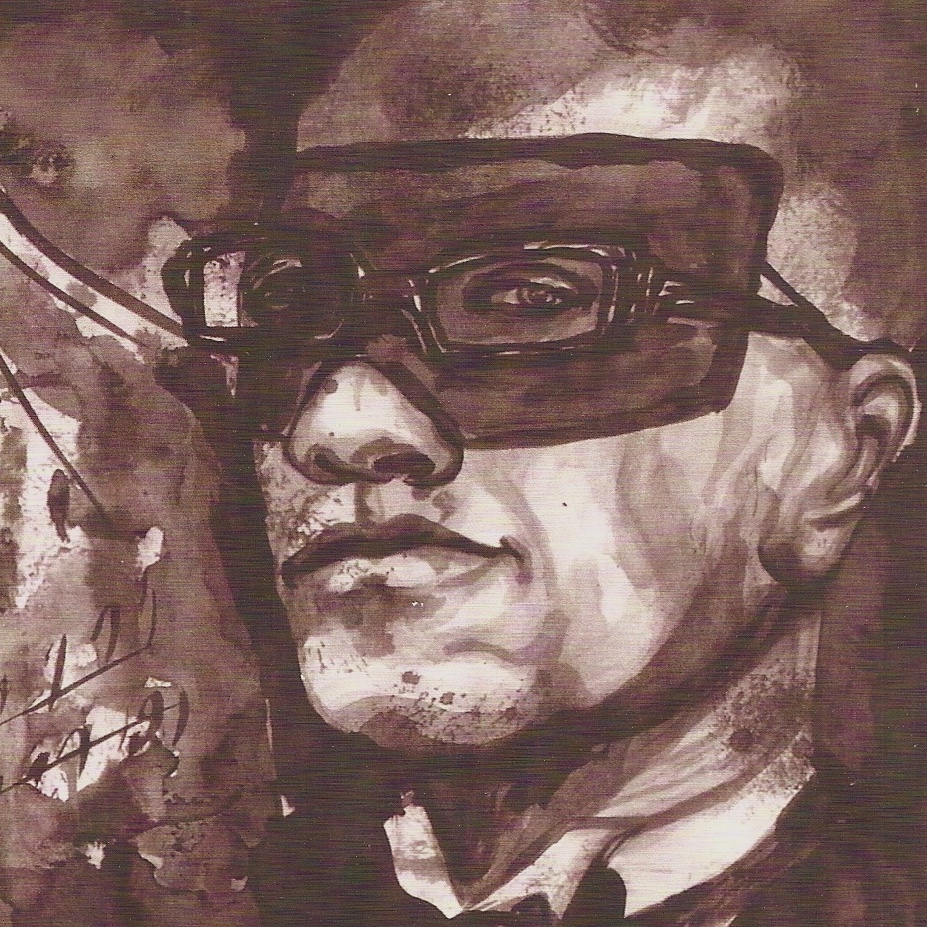
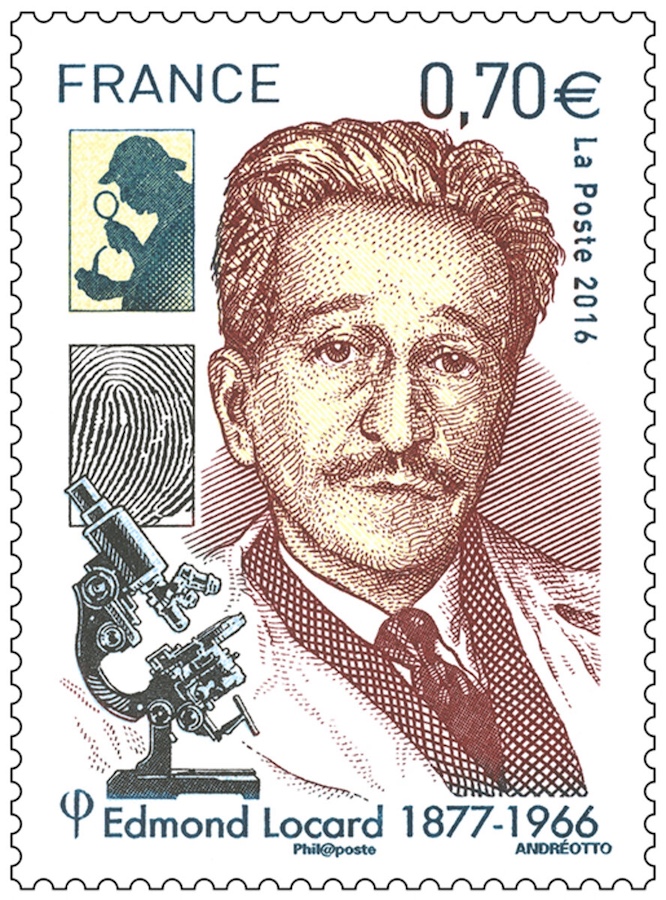
Commemorative postage stamp for criminologist Edmond Locard. Engraving by Claude Andréotto. Communiqué de Presse, February 2016: La Poste.
Dr. Edmond Locard is the most renowned French criminologist of twentieth century. He founded the police forensics laboratory in Lyon and was a prolific author of true crime books. In the nineteenth century, retired Paris Police Prefects and Sûreté detectives regularly published memoirs, often casting themselves in heroic roles. What is most notable about Locard’s contribution to the genre is the longevity of his true crime publication record, from 1903 to 1967, and the proximity between fact and sensationalism that remained a constant throughout his crime-writing career.
In Policiers de roman et de laboratoire (“Fictional and Forensic Detectives,” 1923), Locard argued that detective fiction and police science share a common principle: ratiocination. Fictional detectives such as Auguste Dupin by Edgar Allen Poe, Père Tabaret and Monsieur Locoq by Émile Gaboriau, and Sherlock Holmes by Arthur Conan Doyle, methodically gathered and analyzed evidence, recreated crime scenes, and identified culprits through a combination of inductive and deductive logic. Today, Locard asserted, the police is equally methodical in its pursuit of criminal perpetrators.
Locard’s linkage of ratiocination in detective fiction with the rise of procedural police science has a certain merit. The 1920s were, after all, a golden age of classic whodunits and puzzle mysteries.[1] Yet as early detective fiction critic Régis Messac observed in Le “Detective Novel” et l’influence de la pensée scientifique (“The Influence of Scientific Thinking upon the Detective Novel,” 1929), the first major French treatise on the subject, very little detective and crime fiction produced in France to date had involved rational crime solving. On the contrary, some of the most popular French crime and detective series from the previous half-century — Rocambole, Les Habits Noirs, Arsène Lupin, Joseph Rouletabille, Chéri-Bibi, Fantômas — celebrated the exploits of criminals who evaded detectives. From the perspective of the 1920s, Messac concluded, the classic detective novel in France had yet to develop. Even in Locard’s true crime books, the sensationalism of crime stories would remain more compelling than any denouement achieved by police forensics.
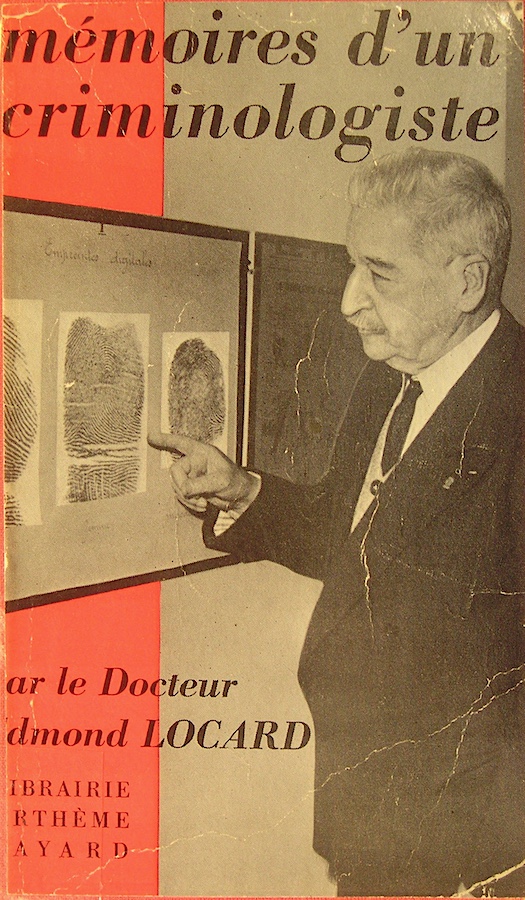
Cover of Mémoires d’un criminologiste by Dr. Edmond Locard. Paris: Librairie Arthème Fayard, 1957.
Not a great deal is known about Edmond Locard’s early years. He was born on December 13, 1877, in the Auvergne-Rhône-Alpes region of eastern France. He attended lycée in Lyon and received a baccalauréat in letters and sciences before continuing at university to earn a doctorate in medicine and a law license. In addition to his native French, Locard boasted fluency in German, Italian, Spanish, and English, with a reading knowledge of eleven other languages.
As a medical student, he was the personal secretary of bone surgeon Léopold Ollier at the Hôtel-Dieu Hospital in Lyon. Following Ollier’s death in 1900, Locard continued his studies under Alexandre Lacassagne, France’s most renown criminal anthropologist of the era and the director of the international journal Archives d’Anthropolgie Criminelle. Remembering Lacassagne as a “workaholic” (un bourreau de travail) and an imperious “bigwig” (pontife),[2] under his guidance Locard earned a doctorate in medicine in 1902 for a thesis on medical forensics during the reign of Sun King Louis XIV.
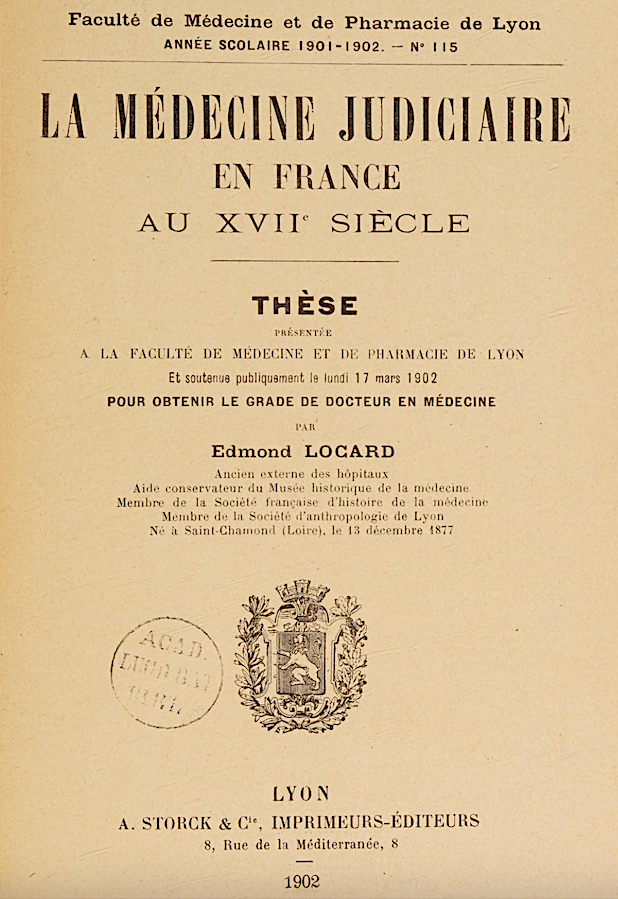
Locard’s published doctoral thesis, Le Médecine judiciaire en France au XVIIe siècle (“Medical Forensics in Seventeenth-Century France”). Lyon: Storck, 1902. Google Books: Harvard University Library.
The following year, Locard published an abridged version for the general public, Les Crimes de sang et les crimes d’amour au XVIIe siècle (“Crimes of Blood and Passion in the Seventeenth-Century,” 1903). The excerpted chapters whisked through legal and medical cases of murders, suicides, duels, poisonings, sexual crimes, sexual perversions, witchcraft, and practices to prevent conception and obtain an abortion. In both academic and lowbrow versions, a collection of anecdotes gathered by Locard passed as scholarly inquiry.
Encouraged by Lacassagne to fashion a niche for himself in the field of criminology, Locard pursued recidivist identification. He learned the portrait parlé anthropometric system from Alphonse Bertillon, consulted with eminent European criminologists Cesare Lombroso and R. A. Reiss, and toured police laboratories in Germany, England, Italy, Belgium, and the United States. He developed a particular passion for fingerprinting and pioneered methods for the laboratory analysis of glandular secretions, blood stains, and other forms of trace evidence. He was also drawn to more exotic criminal realms, such as the detection of forgeries, cryptography, underworld argot, and prisoner tattoos.
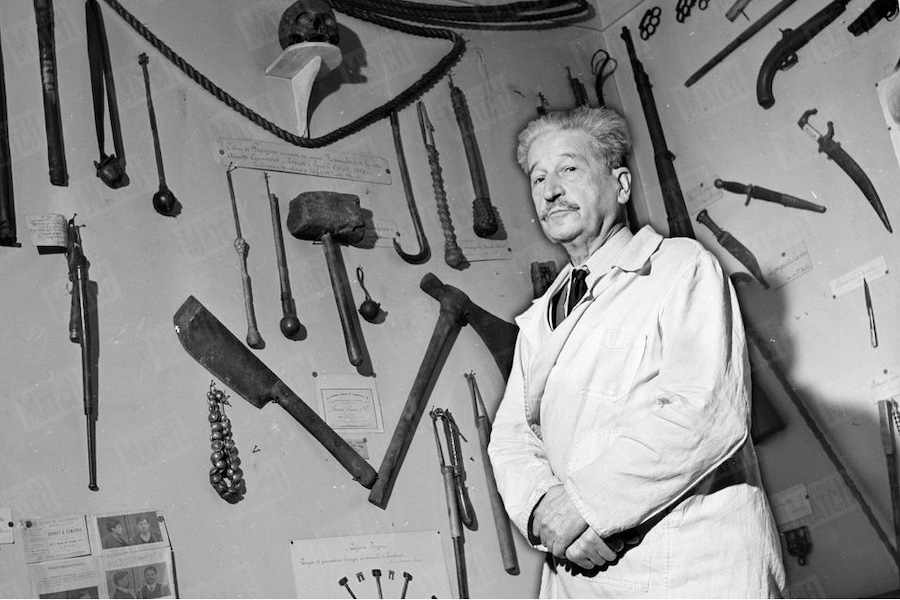
“In the Palace of Justice in Lyon, Dr. Edmond Locard has assembled various instruments used by criminals.” Photograph by Maurice Jarnoux. Paris Match, no. 99, February 10, 1951. Online: Archives of Paris Match.
In January 1910, Locard installed a police forensics laboratory on the top floor of the Palais de Justice in Lyon. After the lab was relocated, his Musée du Crime took its place.[3] The crime museum contained a multitude of items collected from thieves and murders, including burglar toolkits, deadly knives, poisoned arrows, aboriginal boomerangs, and papier mâché decapitated heads. Historical curiosities were put on display as well, such as an original manuscript by the poet-assassin Lacenaire, a letter by the anarchist Ravachol, the skull of the mass-murderer Pranzini, and the bullet fired from the pistol of Madame Caillaux that killed Le Figaro editor Gaston Calmette.[4]
Within a decade, Locard’s expertise in police laboratory science established his reputation as a criminologist in France and internationally. Locard’s logic in forensic analysis was straightforward: anything that a criminal touches yields a reciprocal transfer of the criminal’s imprint upon the substance and a material residue on the criminal. Match them, and a culprit has been identified.
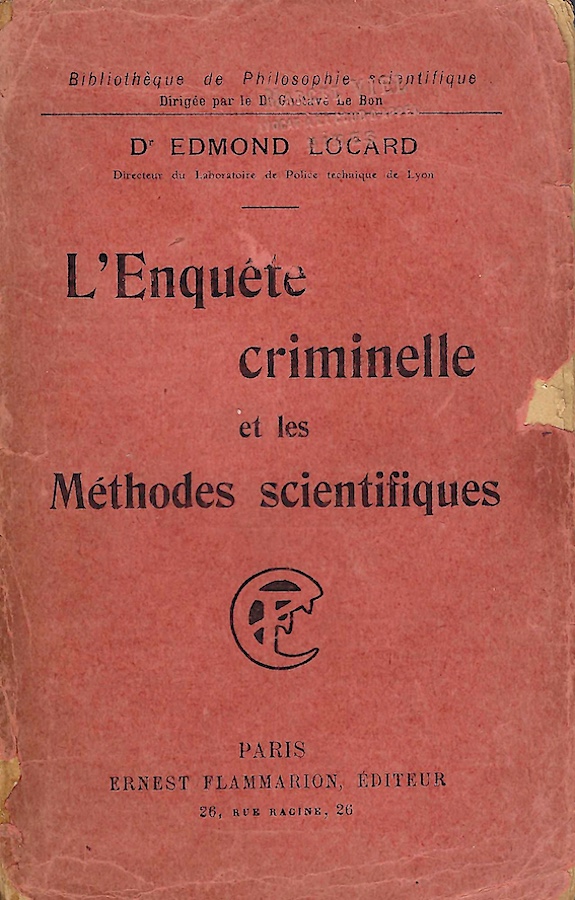
L’Enquête criminelle et les Méthodes scientifiques by Dr. Édmond Locard. Paris: Ernest Flammarion, 1920. Author’s Collection.
Locard first book on the application of police laboratory forensics was L’Enquête criminelle et les méthodes scientifiques (“Criminal Investigation and Scientific Methods,” 1920). This was soon followed by the photo-illustrated Manuel de technique policière (“Technical Police Manual,” 1923), which was translated into Greek, Flemish, Italian, and German, and widely used by criminologists throughout Europe. Although he wrote multiple books on police forensics, the content of each was essentially the same.
Typically, Locard opened with a chapter on how to set up a one’s laboratory and the procedures to follow when gathering evidence. Next, a substantial portion of the book was dedicated to fingerprinting methods and classification systems. The following sections covered the analysis of trace materials (footprints, tooth imprints, fingernail scratches, substances left upon clothes, powders, tire tracks) and stains (blood, sperm, menstrual fluids, urine, fecal matter, grease, paint, cigarette ashes). Later chapters focused on handwriting analysis, deciphering cryptograms, detecting forged documents and counterfeited money, and the identification of small arms, explosives, and contraband drugs. His crowning achievement was the seven-volume Traité de Criminalistique (“Treatise on Criminalistics, 1931-1940).[5] A single-volume compendium, La Criminalistique, “for use by high society and authors of detective novels,” was marketed to non-professionals interested in criminology.
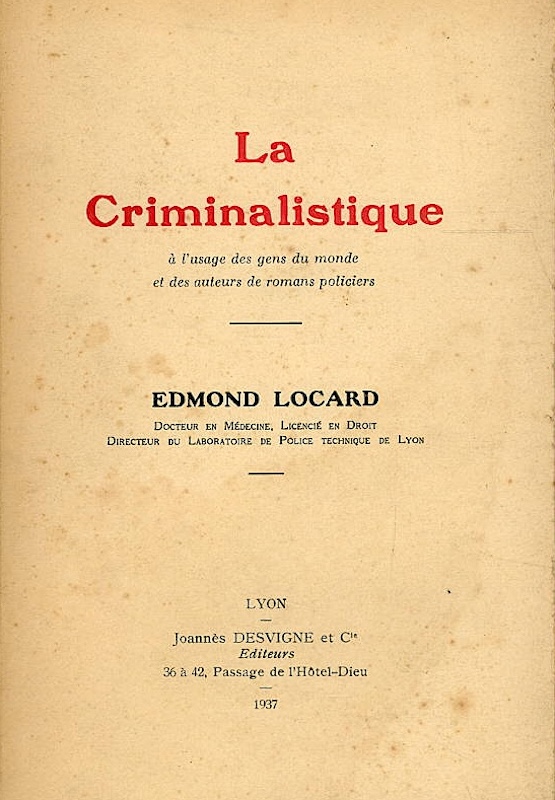
La Criminalistique, à l’usage des gens du monde et des auteurs de romans policiers by Edmond Locard. Lyon: Joannès Desvigne, 1937. Collection: Bibliothèque des littératures policières, Paris.
Yet forensics was a technical and tedious subject, boring even for those outside the profession. To garner public attention, a mystique of crime and detection was required. As a follow up to the Manuel technique, in 1924 Locard published Policiers de roman et de laboratoire (“Fictional and Forensic Detectives”), marketed for a general audience.
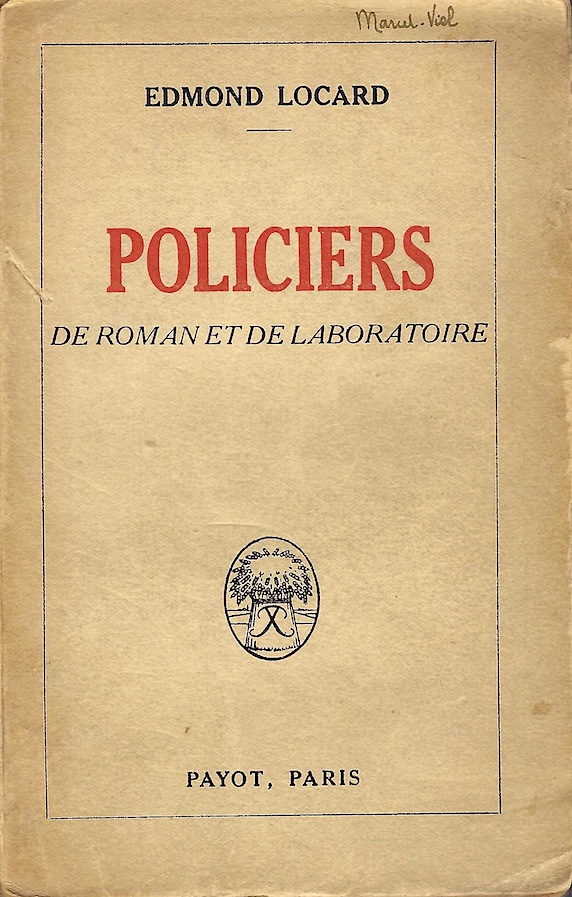
Cover of Policiers de roman et de laboratoire by Edmond Locard. Paris: Payot, 1924. Author’s Collection.
The publicity flyer issued by the publisher read:
Heroes of detective novels fascinate the masses. What adolescent hasn’t dreamed of matching wits with Monsieur Lecoq, Sherlock Holmes, or Edgar Poe’s Dupin? Dr. Edmond Locard, founder of the Lyon Laboratory of police science, has researched the procedures employed by these marvelous detectives. He has studied their logical methods and their specific techniques. Above all, he demonstrates how these fictional detectives figured out how to analyze trace evidence and to make brilliant deductions from circumstantial evidence.
Might it also be possible in real life to achieve the same success as the imaginary detectives invented by these clever novelists? Perhaps so. This is precisely the goal of police laboratories today. In the second half of the book, Dr. Locard recounts a series of curious stories in which true-life adventures — though the analysis of fingerprints, footprints, tooth marks, fingernail scratches, and powders left on clothing by suspects, deciphering secret codes, exposing forged documents, and the identification of the writers of anonymous letters — become as colorful as the most ingenious fictional tales.[6]
Locard’s claims in the book’s preface were no less grandiose (likely he penned them both). The Vidocq syndrome of the nineteenth century is over, he declared, when Sûreté detectives were drawn from the criminal element and relied upon brute physical strength to overpower adversaries. Police investigations today are altogether different: “the shadow of illegality has been removed and precision marks the quality of their work.”[7] Despite the current vogue for the gentleman burglar Arsène Lupin, public enthusiasm for magnanimous rogues and bandit avengers was on the wane: “It’s been a long time since Mr. Punch gave the Chief Detective a good thrashing.”[8] In the future, Locard predicted, the achievements of police laboratory science would surpass the ingenuity of fictional detectives.
It didn’t pan out that way. Even in Policiers de roman et de laboratoire, summaries of the exploits of Poe’s Dupin, Gaboriau’s Lecoq, and Conan Doyle’s Holmes were more compelling than the application of forensics to solve the crimes recounted in the book’s second half. While police laboratory science was methodical and reliable, sensational crime stories stimulated greater excitement in the imaginations of readers.
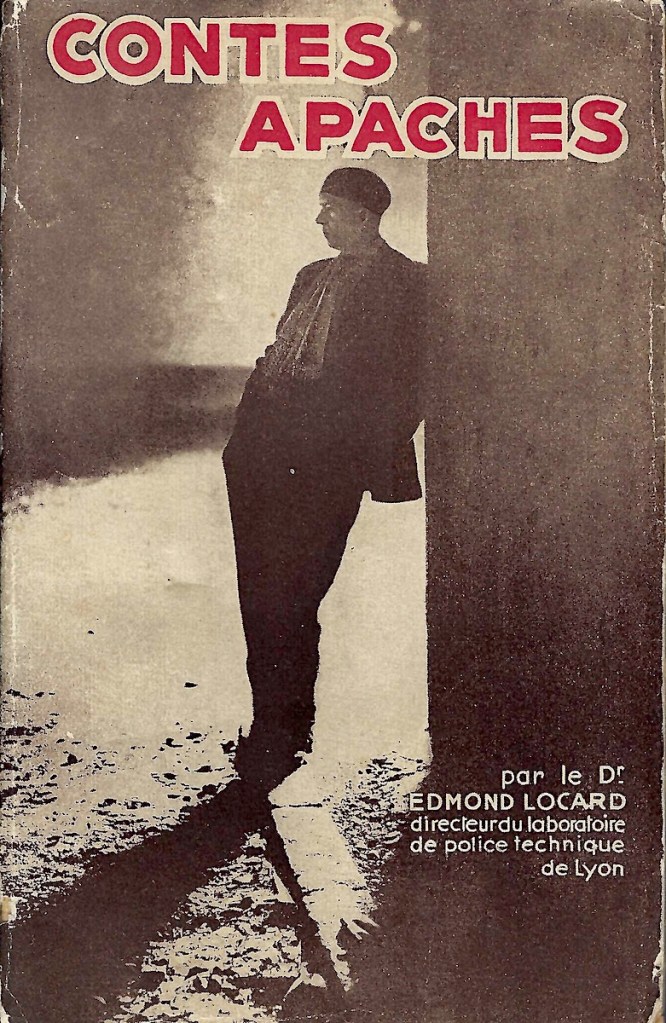
The cover of Contes apaches by Dr. Edmond Locard. Lyon: Lugdunun, 1933. Author’s collection.
In subsequent books, Locard devoted more ink to narrating crimes than to their technical solution. Contes apaches (“Paris Thug Tales,” 1933) is a collection of fourteen stories purportedly based upon Locard’s personal experiences with the criminal milieu. Each story opens with a crime mystery (although some events turn out to be accidental), and all employ forensic investigation techniques to solve the cases. But the bulk of each story invoked mysteries, evoked seedy ambiance, and sketched portraits of despicable criminals, with only a fraction of the episode devoted to forensic methods.
The book’s title and cover conjured up the image of apaches, violent Parisian street thugs with the supposed atavistic attributes of North American Apaches. Yet the suspicious man depicted in the photo wears contemporary clothing of the 1930s, while the era of the apaches had concluded two decades earlier and now lived on only in the cultural imagination.[9] An emphasis upon embellished criminal storytelling over the banalities of police work persisted in Locard’s autobiographical works as well, Confidences, souvenirs d’un policier (“Off-the-Record: A Policeman’s Memories,” 1942) and Mémoires d’un criminologiste (“A Criminologist’s Memoirs,” 1957).[10]
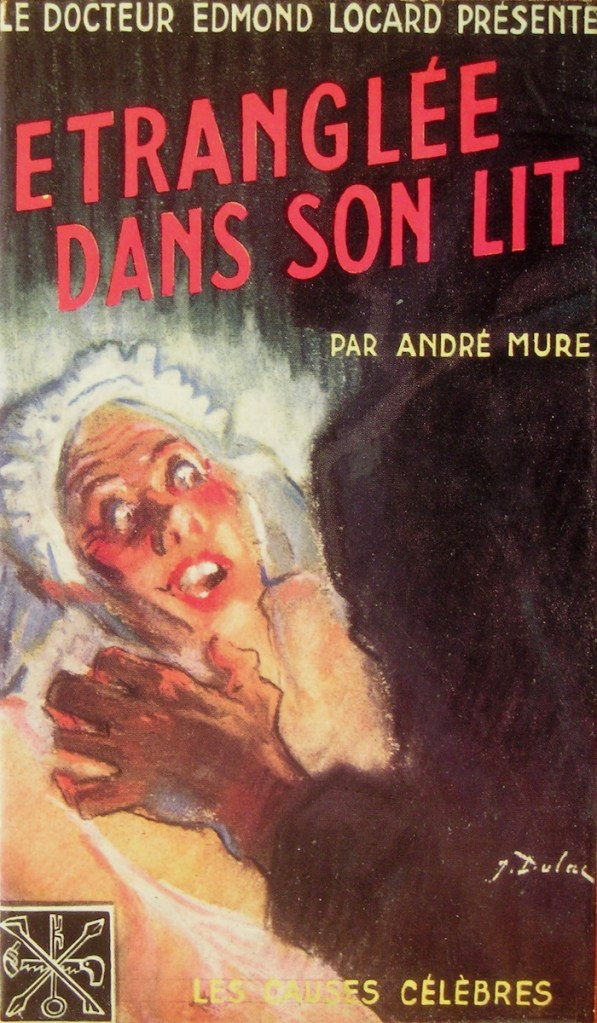
Cover of “Le Docteur Locard présente,” Étranglée dans son lit (“Strangled in Her Bed”) by André Mure. Series “Les Causes Célébres.” Paris: Éditions de la Flamme d’or, 1955. Collection: Bibliothèque des littératures policières, Paris. In 1898, burglar Barthélémy-Auguste Gayte was convicted of strangling the sixty-eight-year-old widow Demarès de Vaucrose in her bed.
In retirement, Locard devoted his publication efforts entirely to recounting sensationalist crime stories, most energetically as chief editor of “Les Causes célèbres” true crime series (1954-55). Each of the fourteen books in the series recounted famous criminal cases, ranging from mass murderers Lacenaire and Pranzini in the nineteenth century to the international spies Mata-Hari and the Rosenbergs in the twentieth.[11] His final book, Mystères de Lyon (“Lyon Mysteries,” 1967), about spiritualist scams and other swindles, was published posthumously.
In France, Édmond Locard was and remains the foundational figure of laboratory police science. Yet his prediction that public enthusiasm for forensics would supersede the exploits of fictional criminals and detectives never came to pass. Actual forensic work advances through reliable science, standardized methods, and routine technical procedures. Reader fascination with crime stories is stimulated by sensationalism and mystery. In both true crime books and fictional police procedural novels, forensics constitutes only one of multiple elements that may be employed to weave and disentangle mysteries of imagined criminality.
NOTES
[1] Canonical fictional detectives from the 1920s who rationally solved whodunits and puzzle mysteries, translated from English into French, include Father Brown by G. K. Chesterton, Hercule Poirot by Agatha Christie, and Philo Vance by S. S. Van Dine.
[2] Edmond Locard, Mémoires d’un criminologiste, p. 10. Throughout this post, translations from the French are by the author.
[3] “Un musée unique au monde,” in Mémoires, pp. 43-52. While Locard’s crime museum was permanently closed during the renovation of the Lyon Palais de Justice in 2008, the curious visitor can still frequent Le musée de la préfecture de Police (“Prefecture of Police Museum”) in the 5th arrondissement of Paris, which contains a vast assortment of artifacts collected by Paris Police Prefect Gustave Macé (1835-1904) and Paris Police Commissioner Charles Péchard (1856-1932).
[4] See previous posts: “Lacenaire: The Elegant Criminal” and “The Belle Époque of Crime.”
[5] Locard, Traité de Criminalistique, 7 vols. (Lyon: Joannès Desvigne et cie., 1931-1940).
[6] Payot publicity flyer for Policiers du roman et de la laboratoire [1924]. Author’s collection.
[7] Locard Policiers, p. 9.
[8] Locard, p. 17.
[9] See Dominique Kalifa, “Archéologie de l’ « apachisme » : barbares et Peux-Rouges au XIXe siècle,” in Crime et culture au XIXe siècle (Paris : Perrin, 2005).
[10] Locard, Confidences, souvenirs d’un policier (Lyon: Lugdunum, 1942).
[11] Dr. Edmond Locard, series editor, “Les Causes célèbres” (Paris: Éditions de la Flamme d’or, 1954-1955). While some individual titles were credited to André Mure or Marc Dubu, most of the series was ghostwritten. In order of publication: Le magistrat assassiné (affaire Fualdès); La malle sanglante (affaire Eyraud), par André Mure; A-t-elle empoisonné son mari? (affair Lafarge); Trahison atomique (affaires May, Fuchs, Rosenberg); Mata-Hari; La maison des horreurs (affaire Christie); Le fiancé de la guillotine (Lacenaire); La piqûre mortelle (affaire Bougrat), par André Mure; Le crime inutile (affaire Caserio); Etranglée dans son lit (affaire Gayte), par André Mure; La Vipère (les lettres anonymes meutrières), par Marc Dubu; Le monstre (affaire Vacher), par André Mure; La machine infernale (affaire Olsini); La courtisane assassinée (affaire Pranzini).
SOURCES
Edmond Locard, Les Crimes de sang et les crimes d’amour au XVIIe siècle (Lyon and Paris: Storck, 1903).
_____. L’Enquête criminelle et les méthodes scientifiques (Paris: Ernest Flammarion, 1920).
_____. Manuel de technique policière (enquête criminelle), 43 figures (Paris: Payot, 1923).
_____. Policiers de roman et policiers de laboratoire (Paris: Payot, 1924).
_____. Contes apaches (Lyon: Lugdunum, 1933).
_____. Mémoires d’un criminologiste, recueillis par Robert Corvol (Paris: Librairie Arthème Fayard, 1957).
Régis Messac, Le “Detective Novel” et l’influence de la pensée scientifique (Paris: Honré Champion, 1929; reissued and annotated edition, Paris : Encrage/Les Belles Lettres, 2011).
Updated: September 11, 2026
Robin Walz © 2026


Leave a Reply