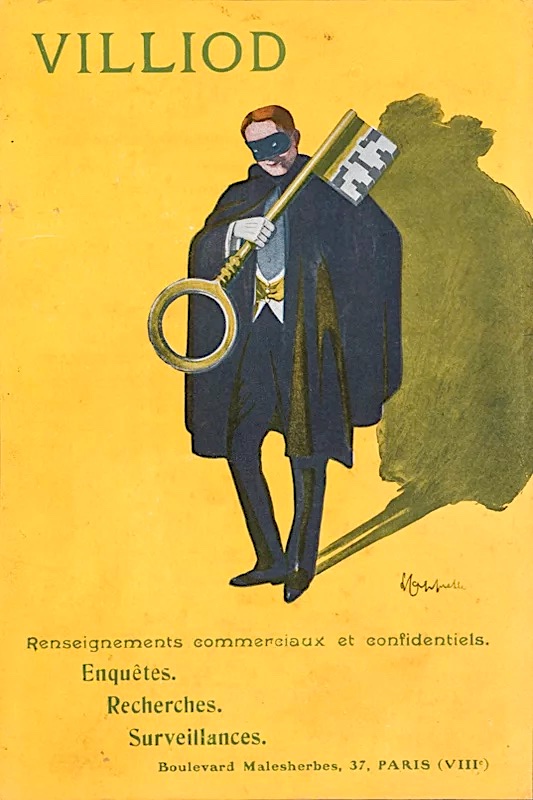
“Villiod, Commercial and Confidential Information Services: Inquiries, Research, Surveillance.” Poster by Leonetto Cappiello, 1909. Image Source: Capiello’s Posters.
While Eugène Villiod energetically promoted his detective agency by offering diverse services and publishing multiple books on criminal activities and gambling, his entrepreneurial efforts failed to generate substantial revenues. Then, Dame Fortune smiled upon him. One of his clients, Dr. Robin of the pharmaceutical company Les Laboratoires Robin, hired Villiod to conduct surveillance on his wife to obtain a divorce. Not only did Villiod provide Dr. Robin with sufficient evidence to secure the separation, immediately afterward the private detective married the now ex-Madame Robin and gained access to her wealth, valued at several million francs. Benefitting from the windfall, Villiod redoubled his efforts at self-promotion, this time to spectacular success.
In 1909, Villiod commissioned the celebrated Belle Époque poster artist Leonetto Cappiello to design an agency logo. The result was l’homme à la clef, a masked man in a tuxedo and cape who brandished a gigantic key. The advertising image quickly became ubiquitous across Paris, widely reproduced in newspapers and magazines such as Je Sais Tout (which carried Maurice Leblanc’s “Arsène Lupin, Gentleman Burglar” stories), L’Illustration, and the Bottin Mondain Paris telephone directory.
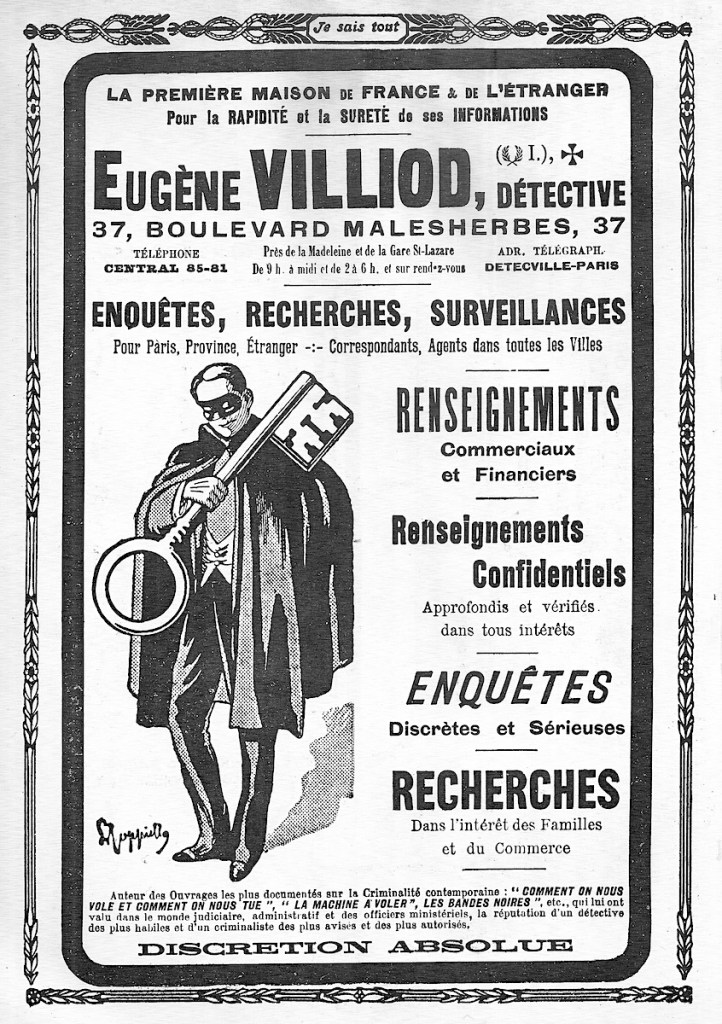
“Eugène Villiod, Détective.” Full-page advertisement on the back cover of Je sais tout no. 152, July 15, 1918. Gallica: Bibliothèque nationale de France.
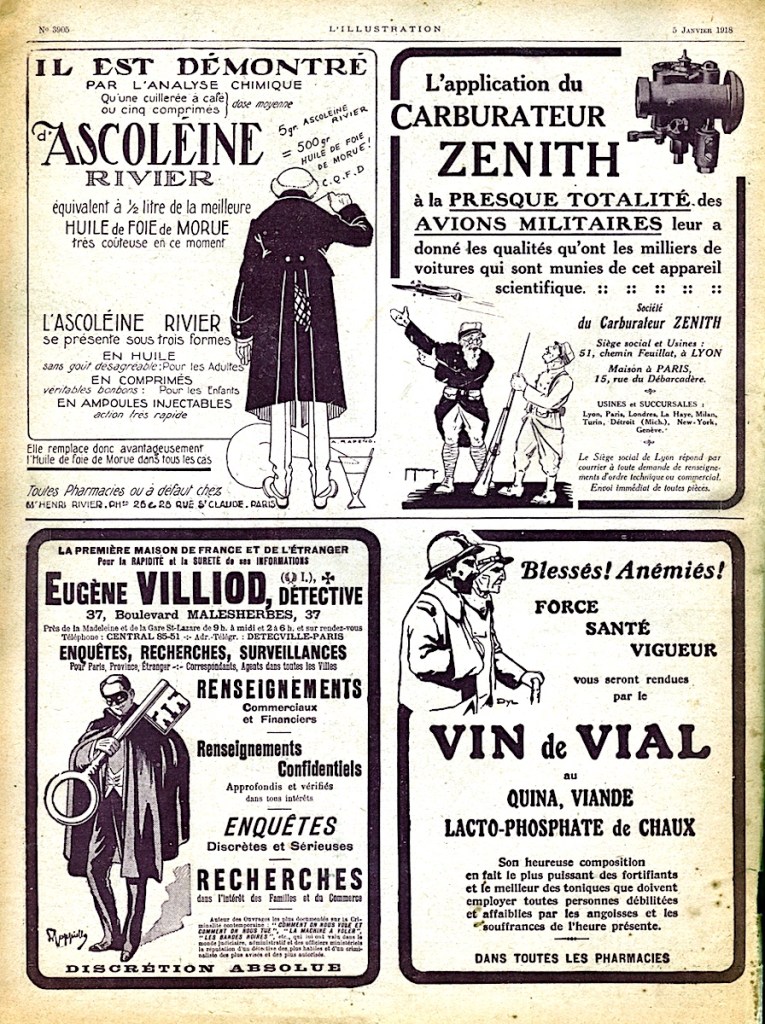
Advertisements on the back cover L’Illustration no. 3905, January 5, 1918. Clockwise from upper-left: Ascoléine Rivier (cod liver oil), Zenith Carburetors, Vin de Vial (liquid vitamin supplements), and Villiod’s l’homme à la clef. Public Domain: Wikimedia Commons.
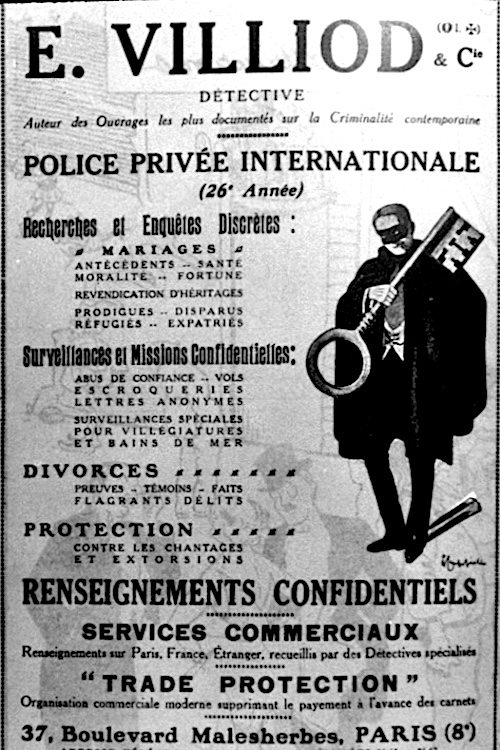
“E. Villiod, International Private Police.” L’homme à la clef center-page advertisement in the Bottin Mondain Paris telephone directory, 1923. Note the high society clientele in the transparency background. Author’s photograph: Bibliothèque Historique de la Ville de Paris.
L’homme à la clef enhanced Villiod’s reputation as a private detective as well. In 1911, publishing firm Garnier Frères commissioned him to write the preface to a new edition of Vidocq’s Mémoires. Founded in 1833, Librairie Garnier Frères had published works by some of France’s most renowned nineteenth-century literary figures, including Chateaubriand, Lamartine, Alfred de Musset, Théophile Gautier, and George Sand. Moving into the popular literature market in the early twentieth century, Garnier Frères banked on the widespread recognition of Villiod’s detective agency and l’homme à la clef to help sell their reissue of Vidocq’s exploits.[1]
In the preface, Villiod deplored Vidocq’s life of crime before becoming chef de la police de sûreté (“security police chief”). He also questioned the morality of employing former criminals and agent provocateurs in his security squad. Yet despite Vidocq’s dissolute life as a criminal and convict, dubious career as a policeman, lack of commercial success, and dying in penury, Villiod insisted the detective possessed an iron will against the criminal element and vigorously fought back in the “struggle for life.”[2] In Villiod’s estimation, the indefatigable detective always triumphed over criminals, even if his methods were questionable. On the heels of the Garnier Frères edition of Vidocq’s Mémoires, Villiod issued a second printing of Comment on nous vole, comment on nous tue (1912) with a new preface that emphasized threats posed to society by apaches (underworld ruffians) and organized crime.[3]
Villiod found other publishers for his works as well. In 1921, Éditions Jules Tallandier issued the Mémoires de Villiod, Détective privé under its “Livre National” imprint. Advertised as rigorously true, in fact the memoir episodes were fictional short stories that featured Villiod as a master detective. Twenty installments in small-format fascicules were issued bi-weekly, and subsequently sold in a collected two-volume set as Mémoires de Villiod: Aventures et histoires de police (“Adventure and Police Stories”) the following year.[4]
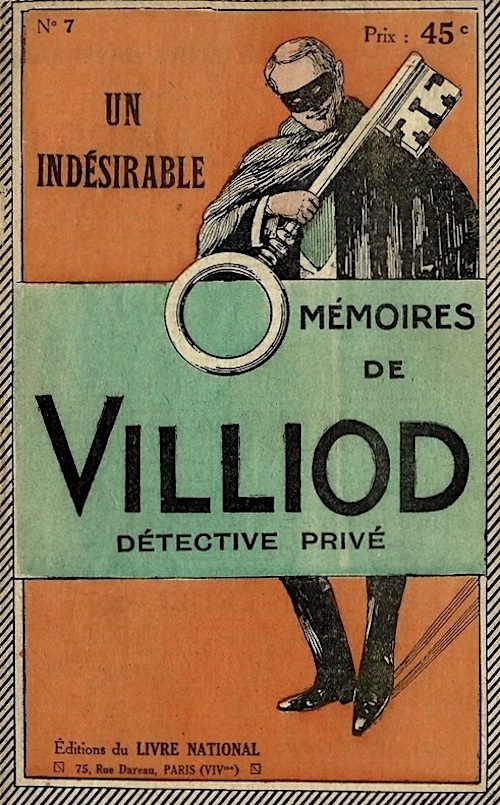
“An Undesirable.” Memoires of Villiod, Détective privé, no. 7. Paris: Éditions du Livre National (Tallandier), 1921. Image Source: Librairie Victor Sevilla, Paris.
Tallandier also reissued Comment on nous vole, comment on nous tue for a third time, nearly two decades after its original publication. Illustrations in the upper corners of the book’s cover were updated to include drive-by shootings from automobiles, although the lower images were taken from photo illustrations in the 1905 edition. Despite a new preface about threats posed to society by a modern criminalité scientifique (“scientifically-organized crime”), and the inability of the police to counter it, the book’s content remained unchanged.
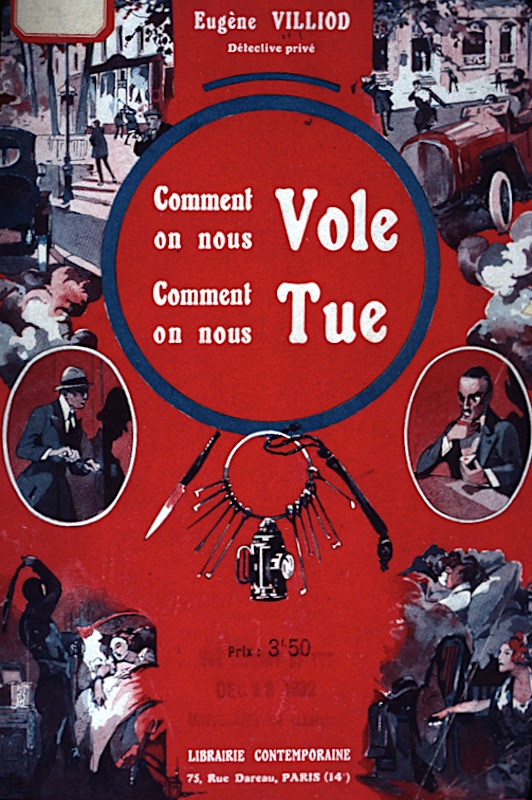
The cover of Comment on nous vole, Comment on nous tue, 3rd edition. Paris: Librairie Contemporaine (Tallander), 1922. Author’s photograph: University of Illinois Library.
But it didn’t really matter. As always, Villiod was motivated more by commercial ambitions than veracity. A full-page advertisement on the back cover of Tallandier’s reissue of Comment on nous vole paired the Mémoires de Villiod: Aventures et histoires de police with Femme de proie (“The Preyed Upon Woman”), a serialized romance and crime novel by Fantômas co-author Marcel Allain. The fantasies that drew together “true” and fictional crime were more lucrative commercially than the banalities of actual detective work.
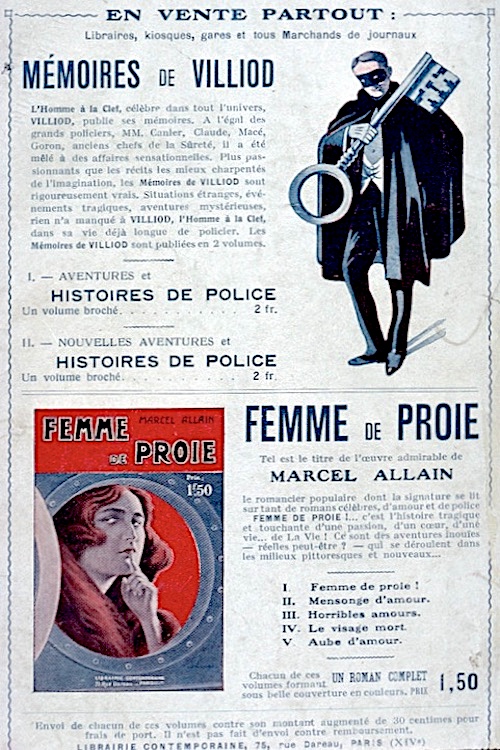
“On Sale Everywhere: Bookstores, Kiosks, Train Stations, and Newspaper Stands.” Full-Page advertisement for Mémoires de Villiod and Femme de proie on the back cover of Comment on nous vole, 3rd edition, 1922. Author’s photograph: University of Illinois Library.
Although Villiod and his detective agency faded into obscurity in the 1930s, l’homme à la clef remained an iconic image in the culture at large. In 1924, the leftist daily newspaper L’Intransigeant carried a photograph of a fortune teller dressed as l’homme à la clef, peddling his trade in the working-class Paris neighborhood of Villette.
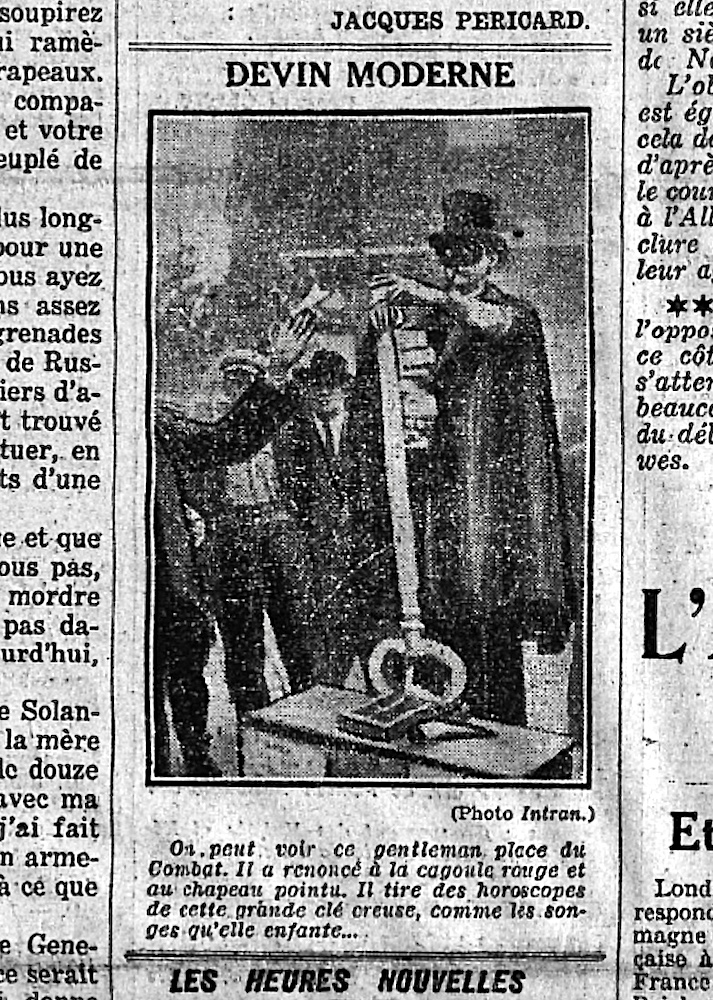
“Modern Fortune Teller.” L’Intransigeant, September 22, 1924. Gallica: Bibliothèque nationale de France.
The caption satirically commented:
“One can see this gentleman on the Place du Combat. He has renounced the red robe and pointed hat of the Inquisition. Instead, he pulls horoscopes out of this large hollow key, giving birth to dreams as empty…”[5]
Like Villiod’s private detective, this l’homme à la clef was a commercial clairvoyant whose delusional promises played upon the hopes and fears of a gullible buying public.
Under the Nazi Occupation during the World War II, l’homme à la clef became the logo for the “Police-Privée Bibliothèque” (“Private Police Library,” 1942-1945) collection of twelve detective novels published in Lille on France’s border with Belgium.
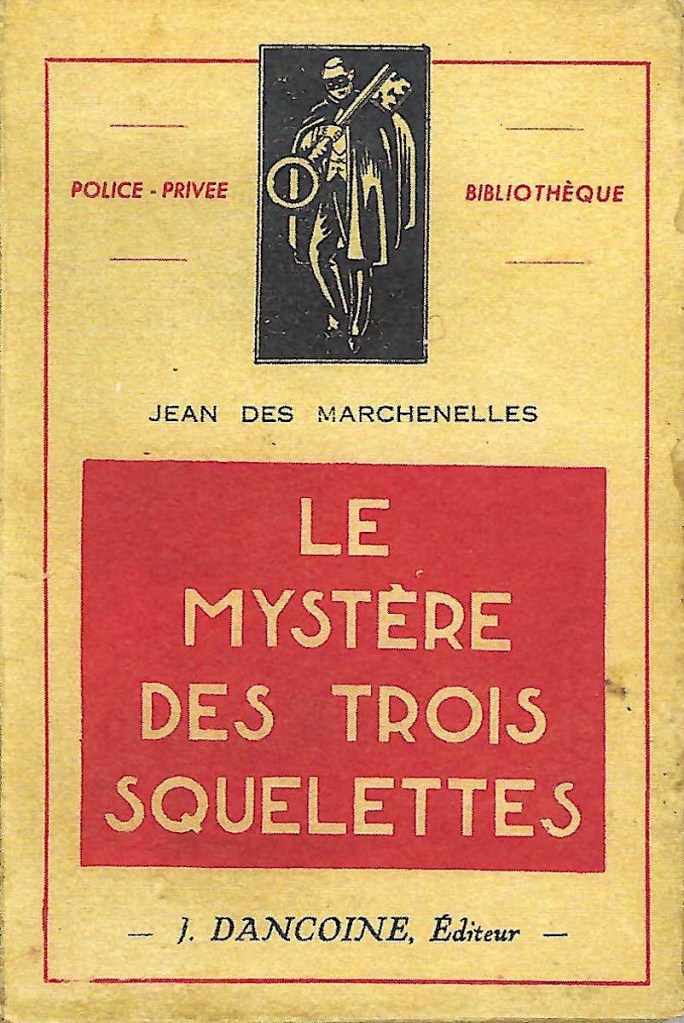
Le Mystère des trois squelettes (“The Three Skeletons Mystery”) by Jean des Marchenelles. Lille: J. Dancoine, 1942. The “Police-Privée Bibliothèque” collection featured l’homme à la clef on its covers. Image Source: Kalifa, Célérité et discrétion.
Series editor Jean des Marchenelles (pseudo. Jean Dancoine) wrote the first novel in the collection, Le Mystère des trois squelettes (“The Three Skeletons Mystery”), which featured the masked private detective Francis Bayard, known as “The Sphinx.” In “Les Aventures du Détective Francis Bayard,” a series of small-format fascicules, des Marchenelles penned ten additional Sphinx short stories. Instead of l’homme à la clef, the full-color covers featured a logo portrait of Detective Bayard wearing a ball mask.
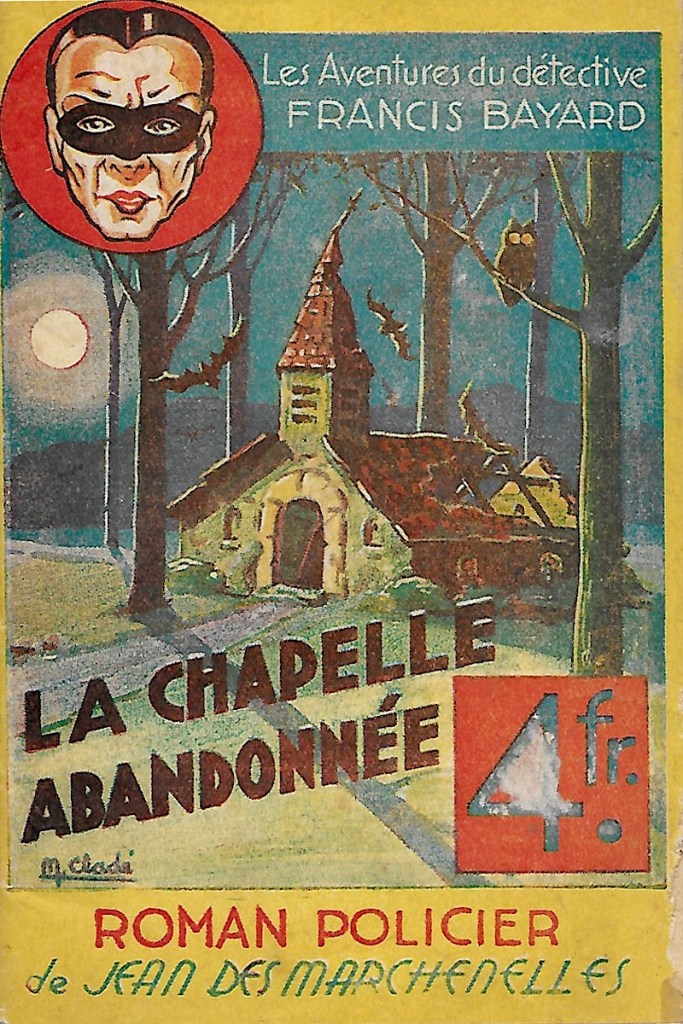
La chapelle abandonée (“The Abandoned Chapel”) by Jean des Marchenelles. “Les Aventures du Détective Francis Bayard,” no. 10. Cover illustration by M. Cladé. Lille: Éditions Jean des Marchenelles, n.d. [1944]. Image Source: Compère, “Jean des Marchenelles.”
Elsewhere in Occupied France, anarchist and surrealist Léo Malet started writing detective fiction to earn a living after his release from a Nazi P.O.W. camp in 1942. As a child, Malet had been fascinated by advertisements for Villiod’s detective agency and its l’homme à la clef trademark. In one of his early detective novels, Malet’s dur-à-cuire (“leather-hard” or hardboiled) private investigator Nestor Burma made it clear that he and Villiod were not cut from the same mold:
My client found himself in the presence of some nameless guy, dressed in a trench coat, knickerbockers, bowler hat, and, to top it off, sporting a mustache. I think it was the mustache that tickled his fancy, for I looked more like a run-of-the-mill investigator than an elegant private detective of the Villiod mold, with his cape, ball mask, and other sexy features, all the while holding that enormous key in his arms. [6]
In the twilight of the Belle Époque, private detective Eugène Villiod had divided society into opposing categories of gens honnêtes (“honest people”) and malfaiteurs (“evil doers”), disingenuously claiming for commercial gain that only private police agencies like his could provide protection from the criminal element. In the murky postwar years following Nazi Occupation and French Collaboration, by contrast, Léo Malet remained resolutely antiestablishment.
Through the character of Nestor Burma, détective de choc (“shock detective”), Malet transmuted his anarchist politics and surrealist sensibilities into popular fiction. Burma is an independent operator who disdains the status quo and frequently ferrets out unscrupulous businessmen and corrupt politicians as the culprits in the course of his investigations. Malet’s néo-noir detective solves murders, neither is justice achieved nor society improved as a result.
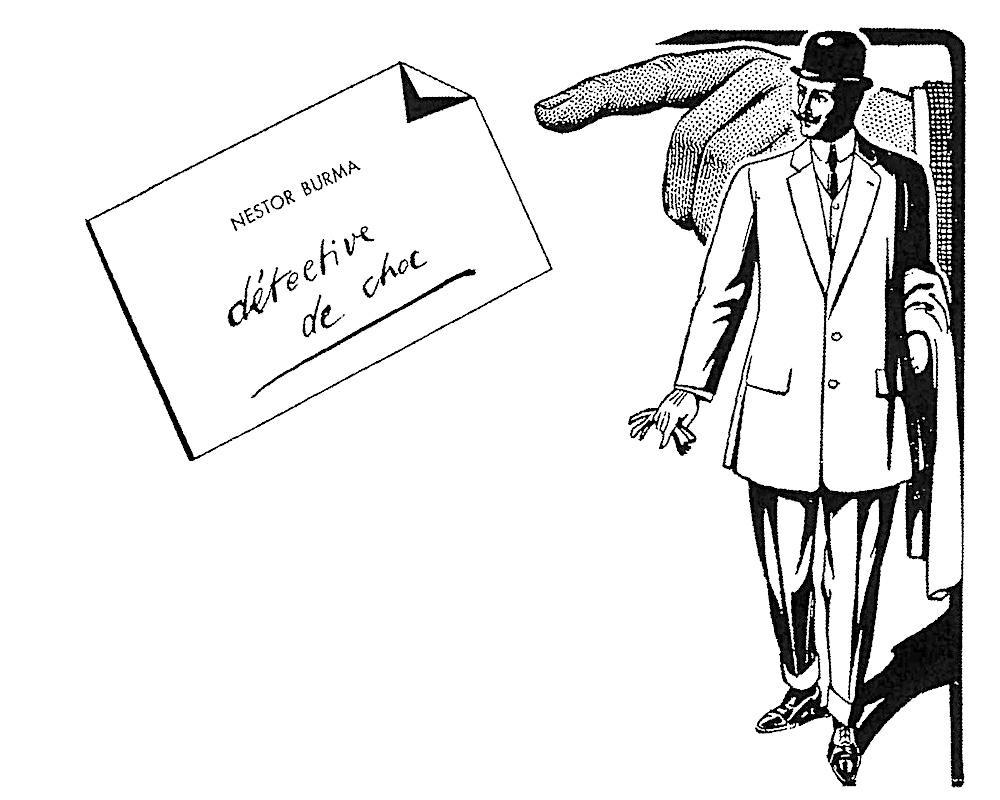
“Nestor Burma, Shock Detective.” One of Léo Malet’s carte de visite calling cards. Image Source: Léo Malet, La Vache enragée (Paris: Éditions Hoëbeke, 1988).
NOTES
[1] Eugène-François Vidocq, Mémoires, annotés par Eugène Villiod, 2 vols. (Paris: Garnier Frères, 1911).
[2] Villiod, “Préface,” in Vidocq, Mémoires, p. xi. The italicized English phrase “struggle for lifer” [sic.] appears in Villiod’s French text.
[3] Eugène Villiod, Comment on nous vole, comment on nous tue, 2nd ed. (Paris: Maison d’Édition, 1912).
[4] Mémoires de Villiod, détective privé, 20 issues (Paris: Livre National/Tallandier, 1921), and Mémoires de Villiod: Aventures et histoires de police, 2 vols. (Paris: Librarie Contemporaine/Tallandier, 1922).
[5] “Devin Modern,” L’Intransigeant, September 22, 1924.
[6] Léo Malet, Le cinquième procédé (1947), in Les enquêtes de Nestor Burma et Les Nouveaux mystères de Paris, “Bouquins,” vol. 1 (Paris : Robert Laffont, 1985), p. 268.
SOURCES
Daniel Compère, “Jean des Marchenelles, auteur et éditeur lillois,” Nord’ no. 75 (June 2020) : 139-145.
François Ducos, “Eugène Villiod, détective,” Le Petit Détective no. 4, September 1986.
Dominique Kalifa, Célérité et discrétion: Les détectives privés en France, de Vidocq à Burma (Paris: Paris bibliothèques, 2004). Exhibition catalogue, Bibliothèque des littératures policières, Paris, May 28-October 16, 2004.
_____. Histoire des détectives privés en France (1832-1942), 2nd ed. (Paris: Nouveau Monde, 2007).
Eugène Villiod, Comment on nous vole, comment on nous tue, 3rd ed. (Paris: Librairie Contemporaine/Tallandier, 1922).
Updated: August 5, 2026
Robin Walz © 2026


Leave a comment