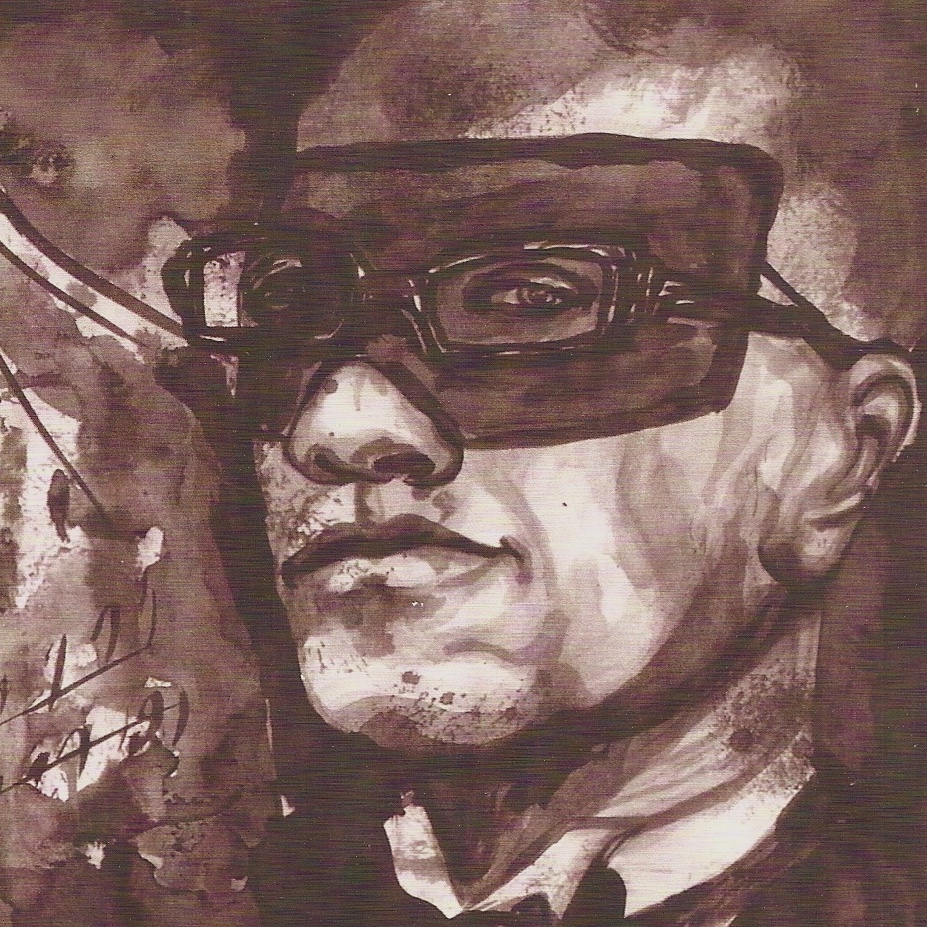
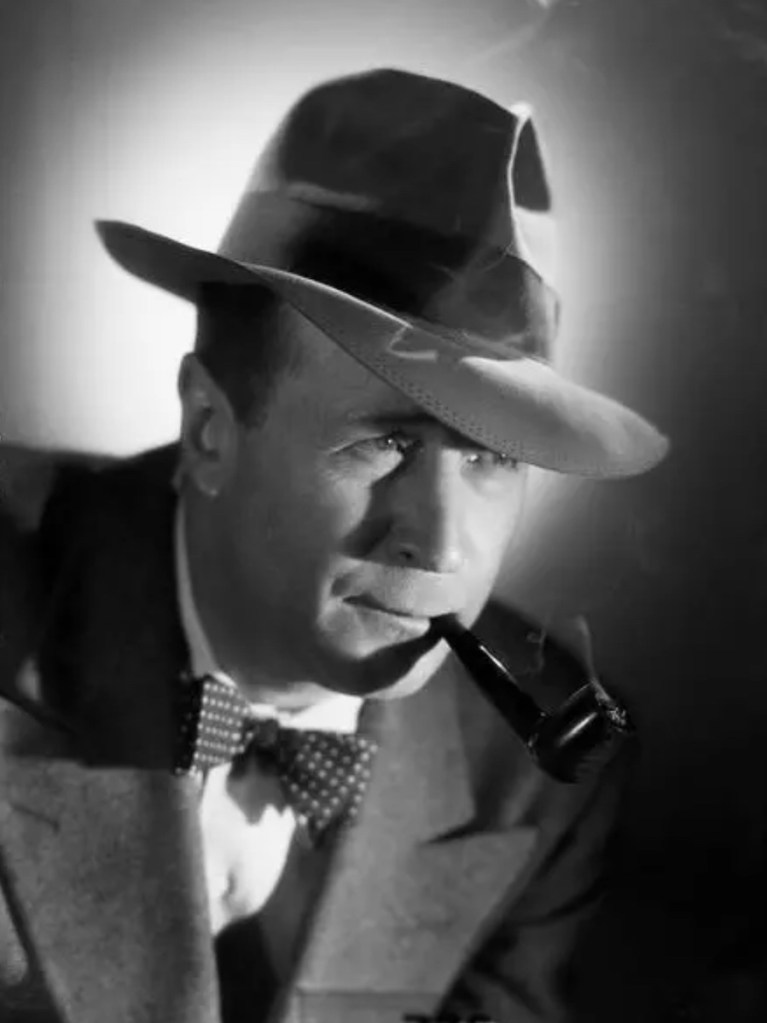
Portrait of Georges Simenon as Chief Inspector Maigret. Harcourt Studio, Paris, 1952. Wikimedia Commons: Médiathèque du patrimoine et de la photographie (MPP).
At midnight on February 20, 1931, a bal anthropométrique “gala for criminal recidivists” got underway at La Boule Blanche nightclub in Montparnasse. The event was sponsored by Parisian publisher Arthème Fayard to launch a forthcoming series of detective novels by Georges Simenon featuring Commissaire (“Chief Inspector”) Maigret. A Belgian journalist, Simenon arrived in Paris eight years earlier and had been writing articles and short stories for Le Matin newspaper and Détective magazine, as well as authoring dozens of adventure and romance novels under the pseudonyms Christian Brulls and Georges Sim.
The previous year, Fayard had serialized Simenon’s first Chief Inspector Maigret novel, Pietr-le-Letton (“Latvian Peter”), in his weekly magazine Ric et Rac.[1] Positively received, Fayard speculated that an entire series of Maigret novels could rival, and hopefully surpass, the publisher’s most successful crime and detective series to date, Fantômas. Not only was Simenon game for the challenge, he contributed to the wager by splitting the cost of the gala with Fayard.
Simenon sent out handwritten invitations on fiche anthropométrique criminal identification cards. The one to Paul Colin, illustrator of Josephine Baker lithographs, read (image below): “We are honored to invite you to the Anthropometric Ball, which will take place at the Boule Blanche, 32 rue Vavin, on February 20 at midnight. Formal evening wear not required. During the gala, Georges Simenon will have the pleasure of signing two novels for you, Monsieur Gallet, Deceased and The Hanged Man of St. Pholien.”
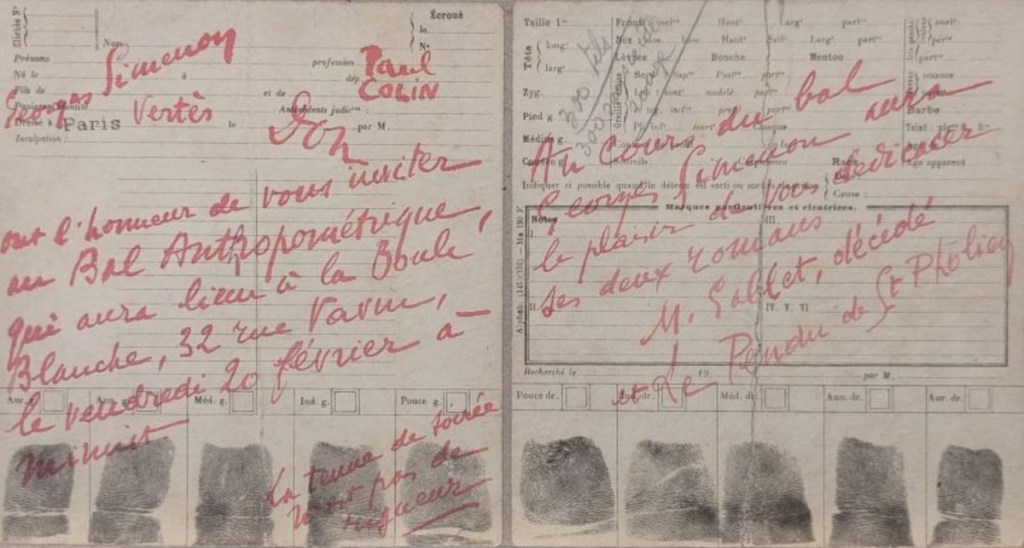
Simenon’s handwritten invitation to Paul Colin. Image Source: Estampes Originales, Le Coin des Arts, Paris.
Guests were encouraged to arrive at the nightclub costumed as their favorite underworld character. After presenting their identification cards, they were fingerprinted at the door. Some 400 celebrities attended, including renowned author Colette, popular entertainers Damia and Kiki of Montparnasse, and dozens of artists, writers, and socialites. By all accounts, everyone had a fabulous time.
The gamble paid off handsomely. Fayard issued seventeen Maigret novels over the next two years, exceeding expectations for both publisher and author.[2] Writing Maigret detective novels was easy money for Simenon, who could could knock out a new title in two or three days. It meant he no longer needed to hustle for an income and provided him ample time to devote himself to more serious writing endeavors. He was commercially savvy as well, safeguarding complete copyright control over his writing in French, foreign translations, and film adaptations. Chief Inspector Maigret made Simenon rich.
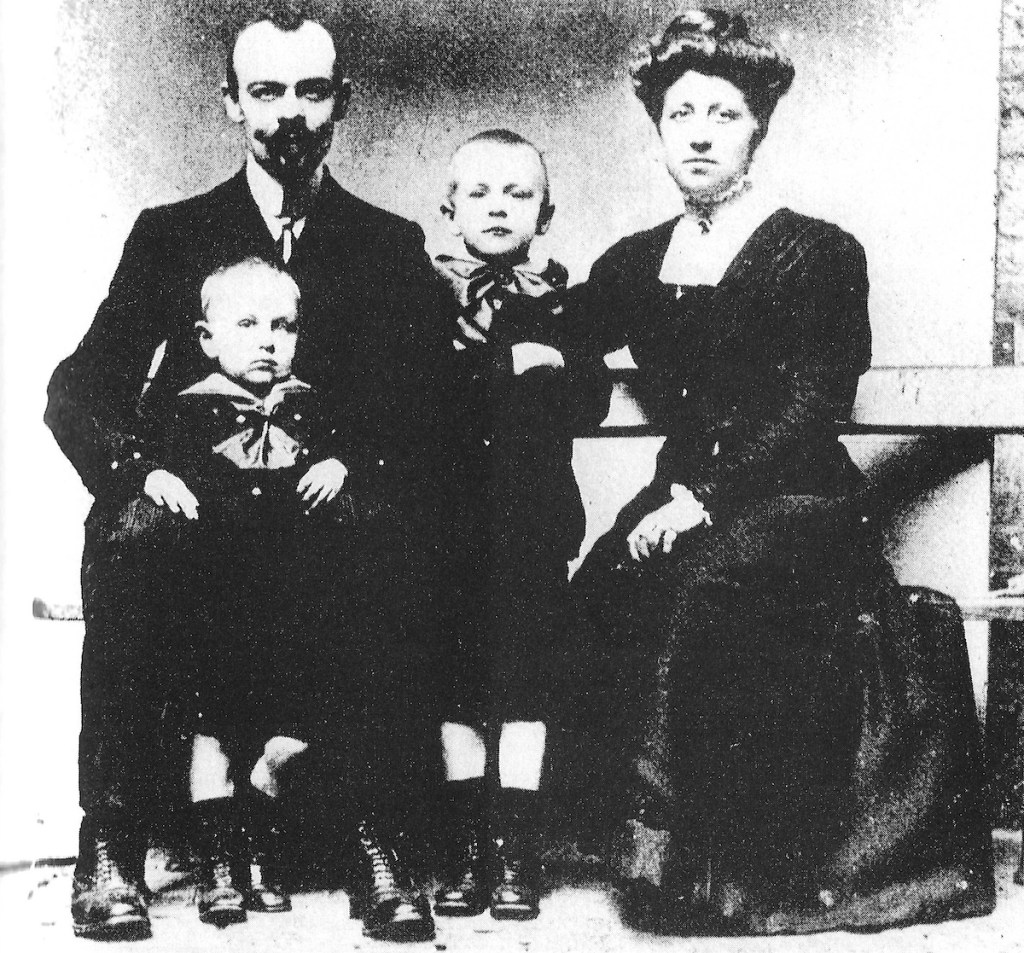
Simenon Family Portrait, 1910. From left to right: Désiré, Christian (below), Georges, and Henriette. Image Source: Centre d’Etudes Georges Simenon, Université de Liège. In Markham, The Man Who Wasn’t Maigret: Author’s Collection.
Born in Liège, Belgium, on September 12, 1903, Georges was the eldest son of Désiré Simenon, a fire insurance agent and a homebody, and Henriette (née Brüll), an anxious mother and fervent Catholic from a Walloon farming family. His younger brother Christian was added to the family three years later, Henriette’s favorite much to Georges’s chagrin. A bright child, Georges attended primary and secondary Catholic schools and dreamed of joining the priesthood. After discovering sex with young woman as a teenager, he lost enthusiasm for the Church and grew weary of formal education. Cycling through three different colleges (middle schools), Georges failed his qualifying examinations to enter lycée and quit schooling altogether.
Forced into the workaday world at age sixteen, Georges embarked briefly upon an apprenticeship in a bakery, and worked for a while in a bookstore, before landing an entry-level position as a fait-divers (“crime-blotter”) reporter for the ultraconservative newspaper, La Gazette de Liège. Within a few years, he was writing a periodic column on “the Jewish peril” under the pseudonym “le petit Sim” (“Little Sim”), articles that combined traditional Catholic antisemitic tirades about Jews as Christ killers with politically virulent and imaginary diatribes against an international Jewish cabal. In 1921, by advance subscription he published his first novel, Au Pont des Arches (“At the Arches Bridge”). The same year, he became engaged to bohemian fine arts student Régine Renchon, whom he nicknamed “Tigy” (and married two years later). In November, his father Désiré, whom he dearly loved, died from a cardiac arrest. The following year, Georges and Tigy left Liège and moved to Paris.
Upon arrival in the capital city, Simenon threw himself into writing. In the 1920s, the roman policier (“detective novel”) emerged as a distinct genre in France. In contrast to the massive romans populaires (“popular novels”) of the Belle Époque, which ran several hundred pages each, romans policiers were quick reads at 250 pages or less. While established popular book publishers such as Fayard, Ferenczi, and Tallandier quickly adapted to the genre, they were seriously challenged by upstart firms, most notably the Librairie des Champs-Élysées. Its readily identifiable Le Masque collection of detective novels uniformly displayed a ball mask and quill pen logo on each of its dust jackets and spine, as well as on the soft cover inside. Over the course of the 1930s, rival French publishers churned out hundreds of detective novel series and thousands of individual titles.[3]
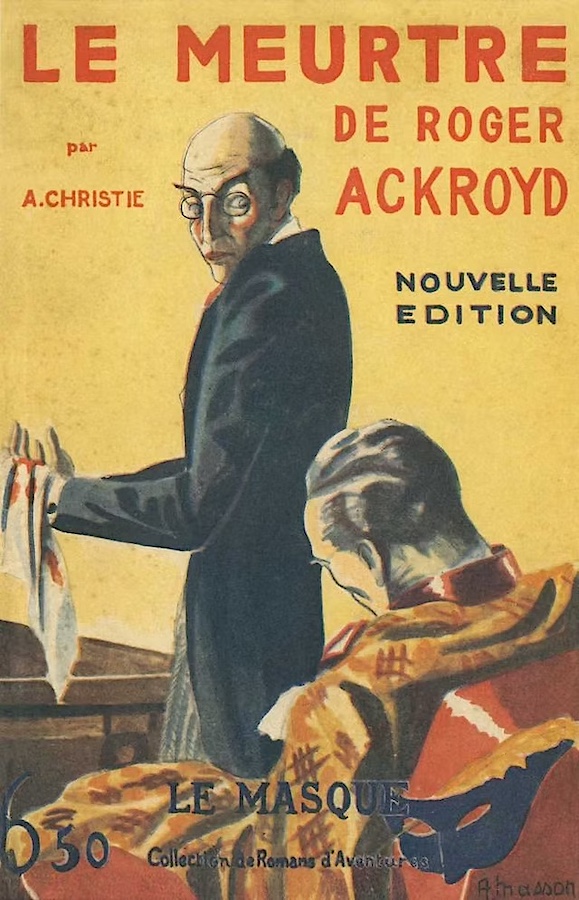
Second printing dust jacket for The Murder of Roger Ackroyd by Agatha Christie in French translation. Collection “Le Masque,” no. 1. Paris: Librairie des Champs-Élysées, 1927. Illustration by M. Vauxelle. Image Source: Collecting Christie.
The immediate challenge for Simenon was to create an immediately recognizable detective within this burgeoning marketplace. Along the way, he experimented with several characters. First was a rogue ex-policeman turned private detective named Anselme Torres, who first appeared in the novel, Nox l’insaisissable (“The Ever-Elusive Nox,” 1926), written under the pseudonym Christian Brulls.[4] Next came Yves Jarry, a handsome, stylish, and cosmopolitan thirty-five-year-old “gentleman-burglar” detective along the lines of an updated Arsène Lupin, published in Arthème Fayard’s “Le Livre Populaire” collection under the pseudonym Georges Sim.[5] Both detectives were more action and romance heroes than crime mystery solvers.
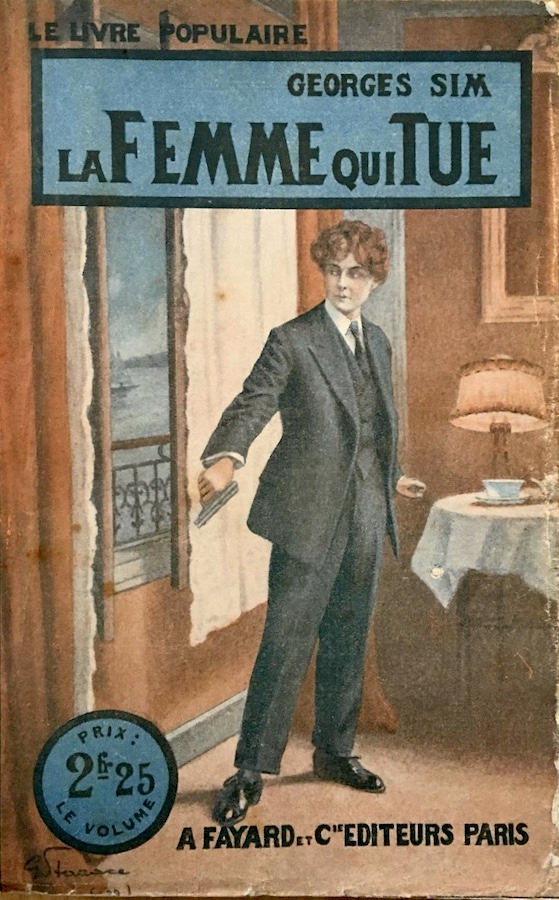
Cover of the detective Yves Jarry adventure and romance novel La Femme qui tue (“The Woman Murderer”) by Georges Sim. Collection “Le Livre Populaire.” Paris: A. Fayard et Cie., 1929. Cover Illustration by Gino Starace. Image Source: Wikimedia Commons.
Simenon’s first unalloyed detective character was Sûreté Inspector Jean-Joseph Sancette, alias G7. In the recently launched Détective, Le grand hebdomadaire des fait-divers (“the foremost weekly of sensationalist news,” 1928-1940), G7 conducted inquiries into a series of crimes entitled “Les 13 Énigmes” (“Thirteen Enigmas”).[6] Written as Georges Sim, over thirteen consecutive weeks the brainy G7 investigated puzzle mysteries in single-page short stories. To generate excitement for the series, the solution to each episode was withheld and became the basis for a cash-awarding concours (“readers’ contest”).
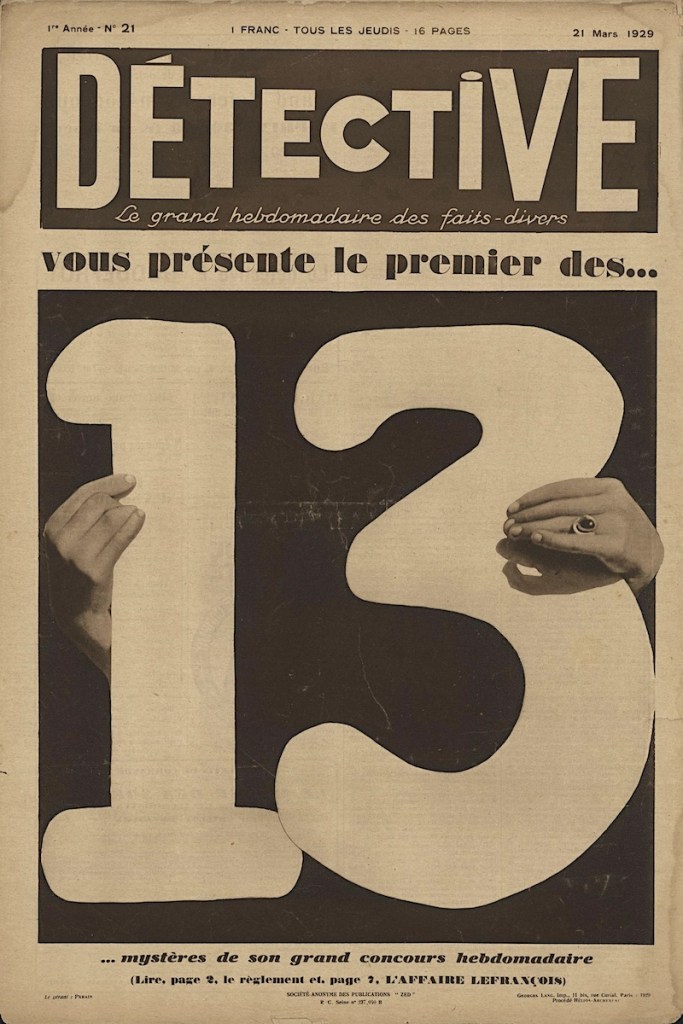
Full-page annoucement for “Les 13 Énigmes” puzzle mystery contest on the back cover of Détective magazine, no. 21, March 21, 1929. Criminocorpus: Bibliothèque des littératures policières, Paris.
Readers were given one week to answer a set of questions posed at the end of each story and submit their responses.[7] Two weeks following each puzzle mystery, George Sim’s conclusion was published along with the number of readers who had correctly answered the required questions for that episode. At the end of the concours, a grand prize of 500 francs was awarded to one of the readers who had correctly answered questions for all thirteen enigmas, with an additional 5,000 francs distributed proportionately among other readers according to their number of correct answers.
It was his fourth detective character, however, Sûreté Chief Inspector Jules Maigret, that brought Simenon spectacular financial and popular success. Maigret is a policier nez, a detective who “follows his nose” to track down criminal perpetrators. Neither particularly brainy nor methodical, Maigret prefers to ruminate over cases with a beer or glass of white wine in a bar, preferably in the company of his criminal suspect.
Central to Maigret’s investigative method is the notion of l’homme nu (“the man stripped bare”), the idea that once a criminal’s social proprieties are peeled away there is some defective trait that resides at his core. The concept was based upon outmoded notions of biological and social degeneration still adhered to by many criminal anthropologists, medical doctors, and psychiatrists of the era.[8] According to these experts, reciprocal influences of biological atavism and social degradation within individuals activated criminality, as well as tendencies towards suicide and sexual perversity. Whatever one’s social position or professional aspirations, a degenerate biological and social inheritance brought out the criminal personality.
Beyond collecting evidence and sorting through it, Chief Inspector Maigret relied upon intuition and patience for l’homme nu to make his appearance:
A crime is committed, but by whom? The conflict begins with a given set of more or less objective circumstances. It’s a matter of reason to choose between one or another set of unknowns.
Maigret begins more or less like anyone other investigator, employing the remarkable techniques developed by Bertillon, Reiss, and Locard, which in the hands of the police have truly become a science.
But unlike the others, he seeks, waits, and watches for the all-important moment of “fissure.” That is, the moment when, from behind the performer, the man appears as he is. [8]
Maigret simply outlasts his suspect until the criminal breaks down and confesses. The culprit may keep up appearances for a while, but eventually reveals his true self.
Maigret’s method of l’homme nu was evident in the series from the start, beginning with the two novels published following the anthropometric ball gala, M. Gallet, décédé (“Monsieur Gallet, Deceased”) and Le pendu de Saint-Pholien (“The Hanged Man of Saint-Pholien”). In the first, Maigret suspects that businessman Émile Gallet has been embezzling money from his employer. After being hounded relentlessly by Maigret, Gallet confesses, “I have a degenerate biological inheritance!” He commits suicide shortly after.[10]
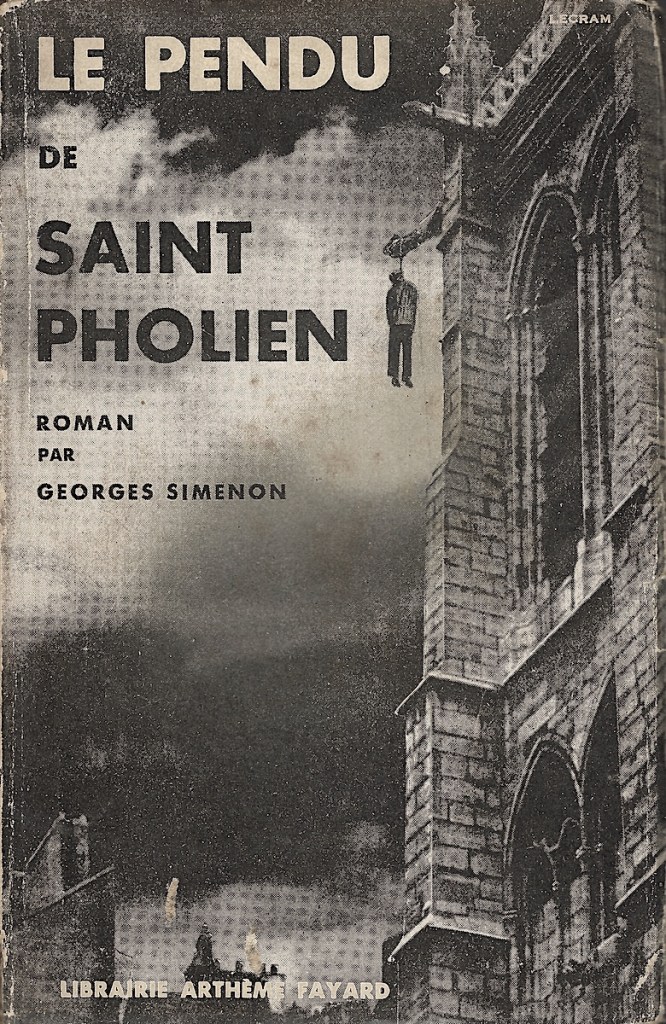
Black and white photomontage cover of Le Pendu de Saint Pholien (“The Hanged Man of Saint Pholien”) by Georges Simenon. Paris: Arthème Fayard, 1931. Author’s collection.
In Le pendu de Saint-Pholien, Maigret travels to Liège to investigate the mysterious death of a young man by hanging. He learns that the victim had belonged to a group of former lycée students who called themselves Les Compagnons de l’Apocalypse (“The Brotherhood of the Apocalypse”). Inspired by Baudelaire, they imagined themselves a secret society of latter-day bohemian artists and writers, who would gather in cheap hotels to drink to excess, abandon themselves to drug-induced reveries, and have sex with prostitutes.
As the Brotherhood’s members passed into adulthood, however, each assumed his “naturally established” place in society. Those from well-to-do bourgeois families became successful businessmen. Those of modest means struggled against life’s circumstances and barely provided for their large families. Those who had sought to rise out of poverty through education ended up as blackmailers and suicide victims. By renderings criminal characters as biologically and socially doomed, Simenon was unremarkably in line with contemporary medical, psychological, and juridical conceptions of the criminal as a degenerate.
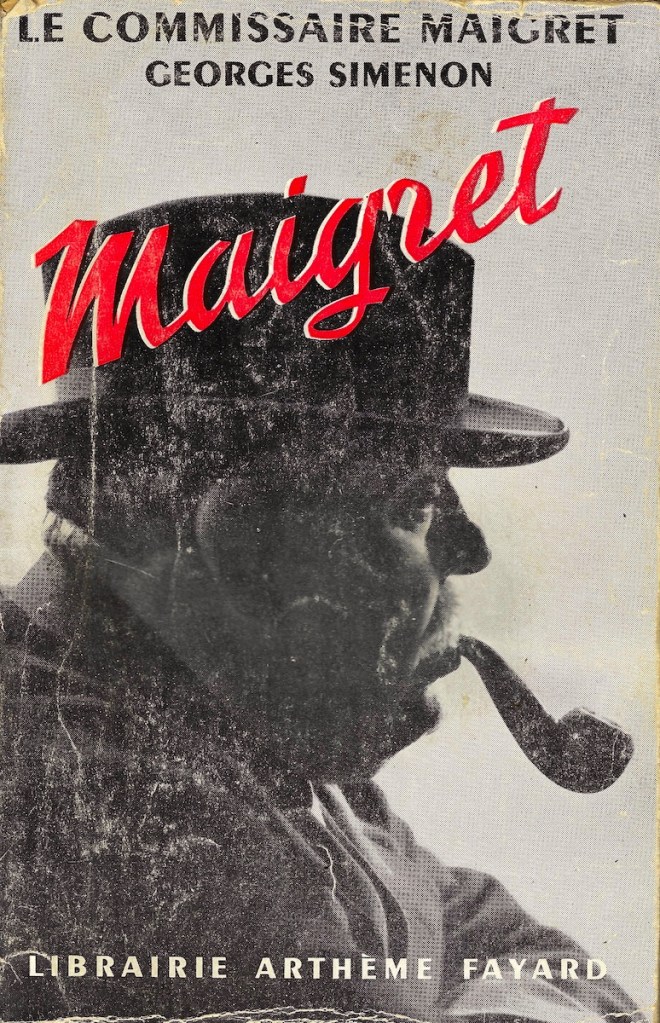
Cover of Maigret by Georges Simenon. Paris: Arthème Fayard, 1932; reprint, 1955. Author’s collection.
As necessitated by his investigations, Maigret traverses and inhabits criminal realms, yet he remains unaffected by them. No matter what the circumstance, he adheres to established social order and authority because he is constitutionally solid, épais (“thick”) in body and intelligence. In Le pendu de Saint-Pholien, Maigret sits in a bar opposite his suspects and fixedly observes them:
Maigret was tall, broad, thick, and above all solid. His clothes showed no trace of style at all, there being something completely plebeian about his attire. He had a dull face, with the wide-eyed, fixed stare of an ox.
He was like someone who haunts children’s nightmares, a monstrously enormous figure without expression, relentlessly advancing towards the dreamer as he prepares to crush him.
There was something implacable, inhuman even, emanating from this pachyderm, lumbering towards his goal, and a sense that absolutely nothing could possibly stop him from getting there.
He drank, smoked his pipe, and watched the wall clock with satisfaction as the hand marked off each minute with a sharp metallic click. The clock face turned pallid! [11]
Here, the patience of Maigret is formidable and terrifying in his very being. Yet he remains just this side of degeneration, because he is by nature a stalwart police functionary, committed to upholding law and order. At the Paris Prefecture of Police, his paternal authority is expressed through his relationship to the men under his command, who call him patron (“boss”). At home, he is a traditional husband and a benevolent lord over Madame Maigret.
As in the pages of Détective magazine, many of the criminals in Simenon’s early Maigret novels come from la pègre, the “lazy class” of common criminals and prostitutes who inhabit squalid neighborhoods and bars. Simenon also kept abreast of the activities of la pègre internationale, criminal organizations of bootleggers and gangsters in America, underworld columns in Germany, master-thieves in England, Italian mafias, and Marseilles drug-smugglers.[12] In Simenon’s early Maigret novels, criminal culprits are often foreigners, from aimless English aristocrats and prohibition-fleeing Americans seeking a good time in Paris, to a host of shifty characters from various European countries.
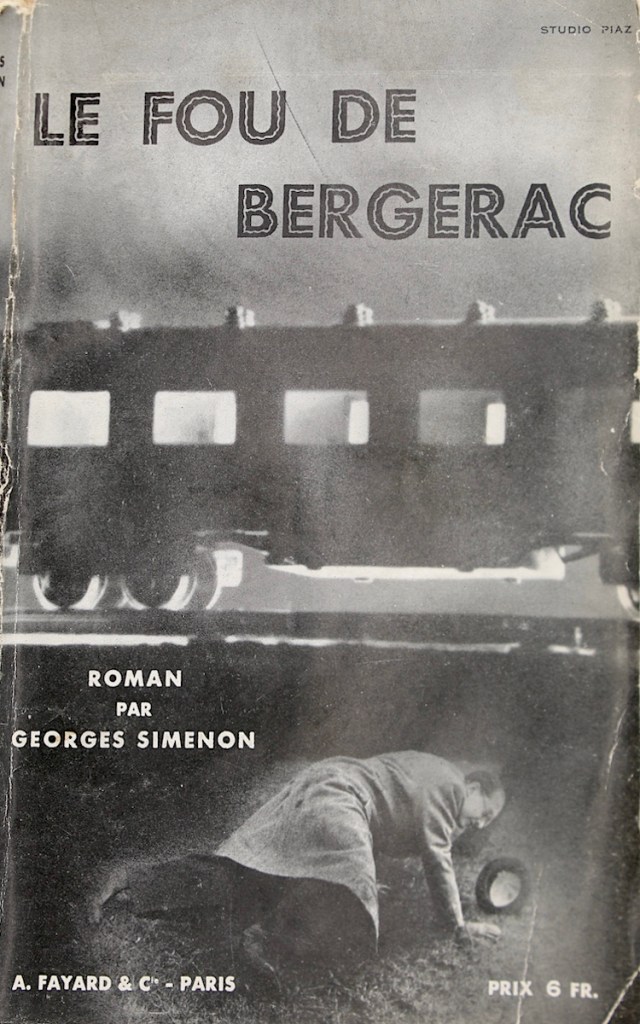
Black and white photomontage cover of Le Fou de Bergerac (“The Madman of Bergerac”) by Georges Simenon. Paris: Arthème Fayard, 1932. Image Source: Librairie Le Feu Follet, Paris.
Jewish criminals and accomplices appear in one-quarter of the Maigret titles published by Fayard in the 1930s. Simenon makes imaginary connections between Jews and criminality explicit in Le fou de Bergerac (“The Madman of Bergerac”). In this episode, Maigret receives a gunshot wound from a would-be assassin and is recovering at the Hôtel d’Angleterre. He begins to suspect that the doctor in attendance, Jacques Rivaud, is the son of his at-large murder suspect, Samuel Meyer, the madman of Bergerac. As Dr. Rivaud replaces Maigret’s wound dressing, the detective remarks, “Your Jewish features are not readily discernable!”[13] Later, the doctor murders his own father.
During his recuperation, Maigret ruminates about “men like Samuel,” and how they constitute an “altogether different species from ordinary humans.”[14] One finds them, he muses, among barmen in Scandinavia, gangsters in America, gambling den owners in Holland, theater directors in Germany, and merchants in North Africa. From Central and Eastern Europe, he continues, thousands upon thousands of Jews are emigrating, throughout France and to America. These “Samuels” are everywhere, Maigret bemoans, seeking out all corners of the world. They speak ten different languages and multiple dialects, hide their true activities behind commercial business facades, and traffic women into prostitution. Such imaginary antisemitic and xenophobic traits attached to criminal characters are common in many of Simenon’s early Maigret novels of the 1930s.
For Commissaire Maigret, the criminal is “not French.” Criminals with international origins are literally not French. By extension, no matter how long they reside in France, their foreignness remains, particularly among Jews. Those French who occupy les dessous, “the gutters” of society, are also considered susceptible to criminality, due to their degeneration and the sordid environments they inhabit. In Simenon’s post-WWII Maigret novels, such assertions are ameliorated somewhat, as culprits from established and ordinary French families appear more frequently. Nonetheless, the association of criminality with deviant personality persists. Over time in the series, being pas Français (“not French”) becomes generalized to mean anyone who does not follow the pas français (the “French path”) of middle-class routines and habits.
English readers of Simenon’s post-WWII novels, and viewers of any number of TV series, may feel somewhat unsettled by the overbearing image and prejudices of Chief Inspector Maigret that Simenon wrote into the early Fayard novels. Yet the basic attributes of his character as a police functionary, petit-bourgeois husband, and paternalistic authority persist, even as his personality softens (to be continued…).
NOTES
[1] Georges Simenon, “Pietr-le-Letton,” Ric et Rac, nos. 71-83, July 19-October 11, 1930. The novel’s title could also be translated as “The Latvian Clown,” as during an interview with the suspect Maigret tells Pietr that his Latvian name sounds like pitre, “clown” or “buffoon,” in French (Simenon, Pietr-le-Letton [Paris: Pocket, 1999], p. 126).
[2] The initial run of Simenon’s Maigret novels published by Fayard (Paris): M. Gallet, décédé (“Monsieur Gallet, Deceased,” 1931); Le pendu de St Pholien (“The Hanged Man of Saint Pholien,” 1931); Le charretier de ‘La Providence’ (“The ‘Providence’ Barge Pilot,” 1931); Le chien jaune (“The Yellow Dog,” 1931); Pietr-le-Letton (“Latvian Peter,” 1931); Le nuit du carrefour (“The Crossroads Night,” 1931); Un crime en Hollande (“A Crime in Holland,” 1931); Au rendez-vous de Terre-Neuvas (“The Newfoundland Cod Fishermen’s Rendezvous,” 1931); La tête d’un homme (“The Sulking Man,” 1931); La danseuse du Gai-Moulin (The Gai-Moulin Dancer,” 1931); La guingette à deux sous (“The Inexpensive Open-Air Cafe,” 1931); L’ombre chinoise (“The Shadow Puppet,” 1932); L’affaire Saint-Fiacre (“The Saint-Fiacre Case,” 1932); Chez les Flamands (“The Flemish Shop,” 1932); Le fou de Bergerac (“The Madman of Bergerac,” 1932); Le port de brumes (“The Fogged-In Harbor Port,” 1932); ‘Liberty Bar’ (“The Liberty Bar,” 1932); L’écluse no. 1 (“Canal Lock no. 1,” 1933); and, Maigret (1934). Note: Maigret series titles published by Penguin and Harcourt Brace Jovanovich are translated variously into English. Throughout this post, translations from the French are by the author.
[3] For a comprehensive compilation of French detective and crime novels, including those published during the 1930s, see Jacques Bisceglia, Trésors du roman policier, catalogue encyclopédique, 2nd ed. (Paris: Les éditions de l’amateur, 1984).
[4] Christian Brulls (pseudo. Georges Simenon), Nox l’insaisissable (Paris: Ferenzi, 1926). Between 1925 and 1931, publishers Fayard and Ferenzi issued twenty-three of Simenon’s adventure and romance novels under the pseudonym Christian Brulls. S.v. “SIMENON, Georges,” in Dictionnaire des littératures policières, sous la direction de Claude Mesplède, nouvelle édition, 2 vols. (Nantes: Joseph K., 2007).
[5] Fayard published four Yves Jarry adventure and romance novels by Georges Sim (pseudo. Georges Simenon) in the “Livre Populaire” collection (Paris): Chair de beauté (1927), La femme qui tue (1929), La femme 47 (1930), and Katia, acrobate (1931). S.v. “Le Livre Populaire,” in Bisceglia, Trésors du roman policier.
[6] Three readers’ contests were written by Georges Sim in Détective: “Les 13 Énigmes (Series 1): nos. 21-33 (March 21-June 13, 1929; final solution, no. 35, June 27, 1929); “Les 13 Énigmes” (Series 2): nos. 46-58 (September 13-December 5, 1929; final solutions, no. 60, December 19, 1929); “Les 13 Coupables” (Series 3): nos. 72-84 (March 13-June 5, 1930; final solution, no. 86, June 19, 1930). All three series were reissued in book format as Les 13 Mystères, Les 13 Énigmes, and Les 13 Coupables (Paris: Fayard, 1932). For an in-depth treatment of Détective magazine, see Amélie Chabrier and Marie-Ève Thérenty, Détective, fabrique de crimes? (Nantes: Joseph K., 2017).
[7] “Règlement,” Détective no. 21 (March 21, 1929), p. 2.
[8] For a concise compendium of this complex and convoluted terrain, see Susan A. Ashley, “Misfits” in Fin-de-Siecle France and Italy: Anatomies of Difference (London: Bloomsbury, 2017). See also, Robin Walz, “Is Suicide a Solution?” in Pulp Surrealism: Insolent Popular Culture in Early Twentieth-Century Paris (Berkeley: University of California Press, 2000).
[9] Simenon, Pietr-le-Letton, p. 49.
[10] Simenon, M. Gallet, décédé (Paris: Librairie Arthème Fayard, 1947), p. 229.
[11] Simenon, Le pendu de Saint-Pholien (Paris: Fayard/Le Livre de poche, 1972), p. 116.
[12] Based upon Xavier de Hauteclocque, Pègre et policier internationales (Paris: Nouvelle Revue Critique, 1934) and Blaise Cendrars, Panorama de la pègre (Grenoble : B. Arthaud, 1935), in Walz, Pulp Surrealism, pp. 150-155.
[13] Simenon, Le fou de Bergerac (Paris: Presses Pocket, 1978), p. 119.
[14] Le fou de Bergerac, pp. 114-115.
SOURCES
Bernard Alavoine, Les enquêtes de Maigret de Georges Simenon: Lectures des textes (Amiens: Encrage, 1999).
Pierre Assouline, Simenon (Paris: Gallimard, 1996).
Patrick Marnham, The Man Who Wasn’t Maigret: A Portrait of Georges Simenon (New York: Farrar Straus Giroux, 1992).
Dennis Porter, Chapter 10 “The Case of Simenon,” in The Pursuit of Crime: Art and Ideology in Detective Fiction (New Haven: Yale University Press, 1981).
Updated: August 27, 2026
Robin Walz © 2026


Leave a Reply