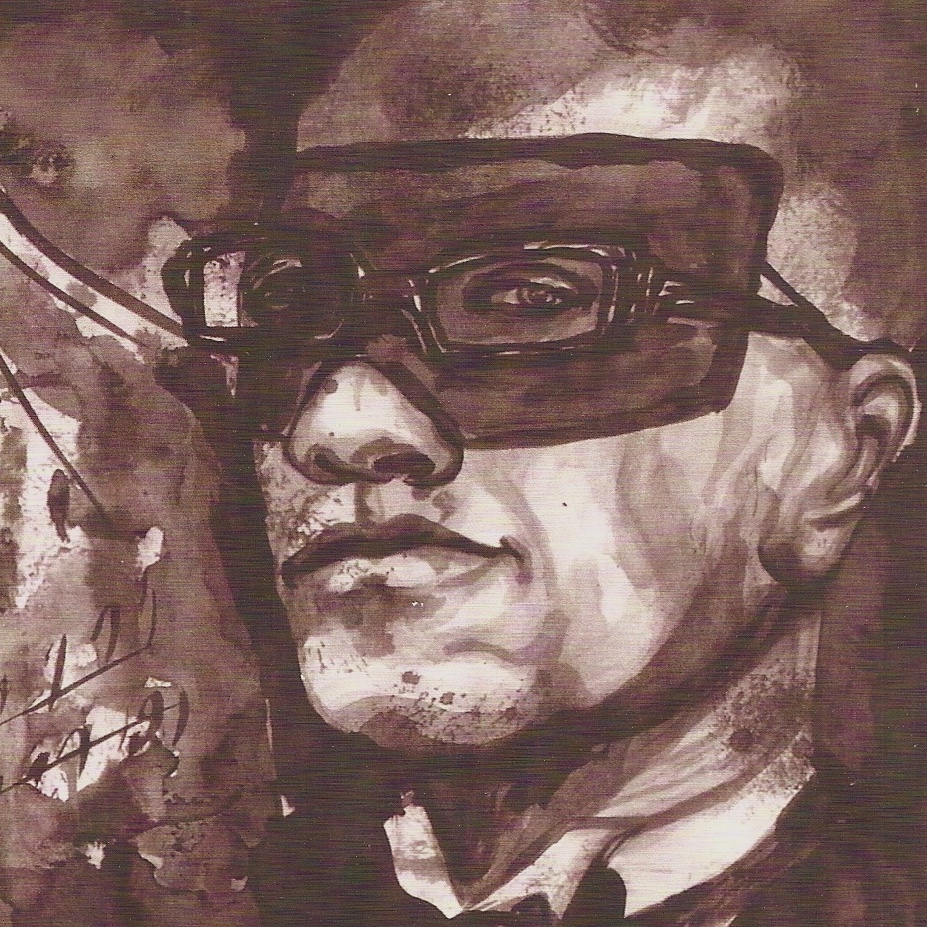
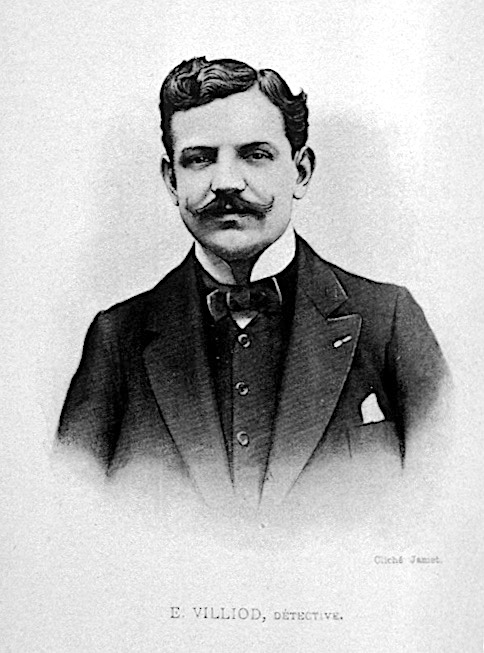
“E. Villiod, Détective.” Frontispiece photo-portrait in Comment on nous vole, comment on nous tue (“How They Rob Us, How They Kill Us”). Paris: Chez l’Auteur, 1905. Author’s collection.
Without a doubt, the most enterprising French private detective of the Belle Époque was Eugène Villiod. From 1899 to the mid-1930s, Villiod operated a private detective agency at 37 Malesherbes Boulevard, located in the fashionable Madeleine district of Paris, open daily from 9:00 a.m. to 12:00 noon, 2:00 to 6:00 p.m., and by appointment. In his advertising, Villiod promised célérite et discretion, “swift results and absolute discretion” in surveillance services for businesses and private investigations for individual clients.
Such a police privée (“private police”) agency was nothing new in France. Vidcoq opened the first in 1832, Le Bureau des reseignements universels (Universal Information Office). Initially offering surveillance and employee background checks for businesses, in short order Vidocq moved into investigating compromising situations for individual clients that usurped the functions of the actual police. Over the course of the nineteenth century, several retired Sûreté directors and officers followed suit by creating their own private investigation agencies. By the eve of the Great War of 1914, there were over fifty confidential information firms in Paris. Villiod surpassed them all, however, through shameless self-promotion.
Initially a Paris transit system civil servant, in 1899 Eugène Villiod paired up with recently retired Sûreté Inspector Servier to conduct research on behalf clients seeking information to divorce their spouses. The following year, Villiod independently opened the Agence policière privée (“Private Police Agency”), diversifying its services to include confidential inquiries into such sensitive matters as family background checks before marriage and investigating blackmail threats. In 1902, he began advertising in newspapers and magazines, adding international branch offices and multilingual translations to the agency’s growing menu of offerings.
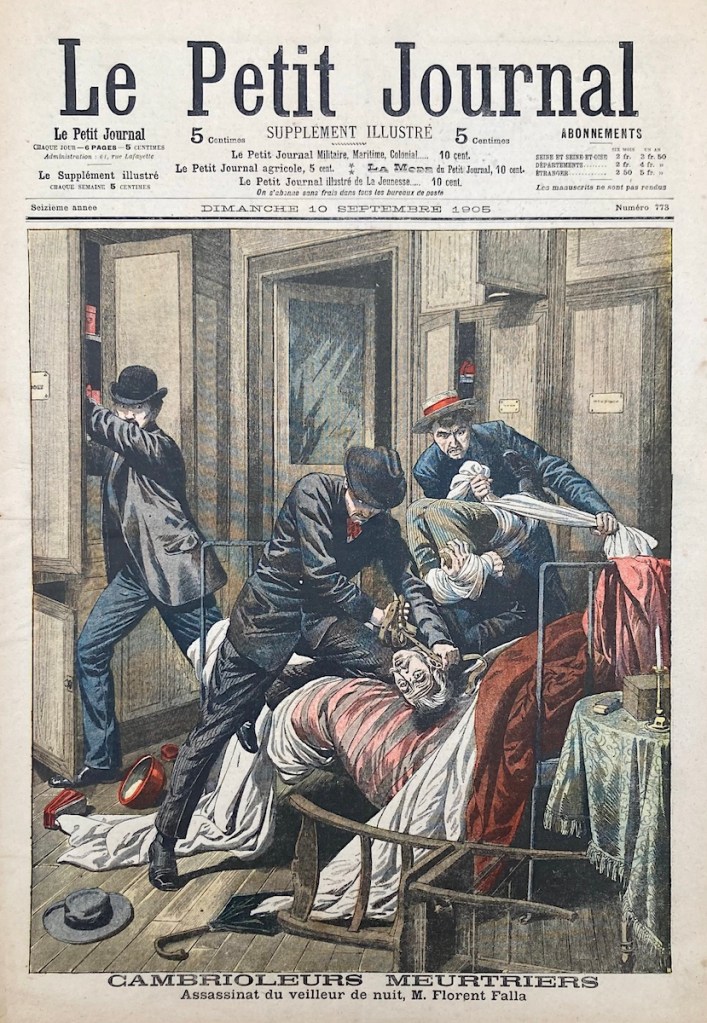
“Deadly Hotel Burglars: The Late-Night Murder of Monsieur Florent Falla.” Le Petit Journal, Supplément Illustré, September 10, 1905. Author’s Collection.
The Belle Époque was an age of anxieties about crime run amok, a grande peur (“great fear”) of crime sensationalism circulated in illustrated weekly newspapers, popular novels, and silent movies, and consumed as popular entertainment.[1] With a finger on the cultural pulse, Villiod rode the wave by presenting himself as a detective with insider knowledge of criminals and their shifty ways in a series of self-published true crime books, Les plaies sociales (“The Social Scourges”), marketed to a select clientele at 3 francs 50 per volume.
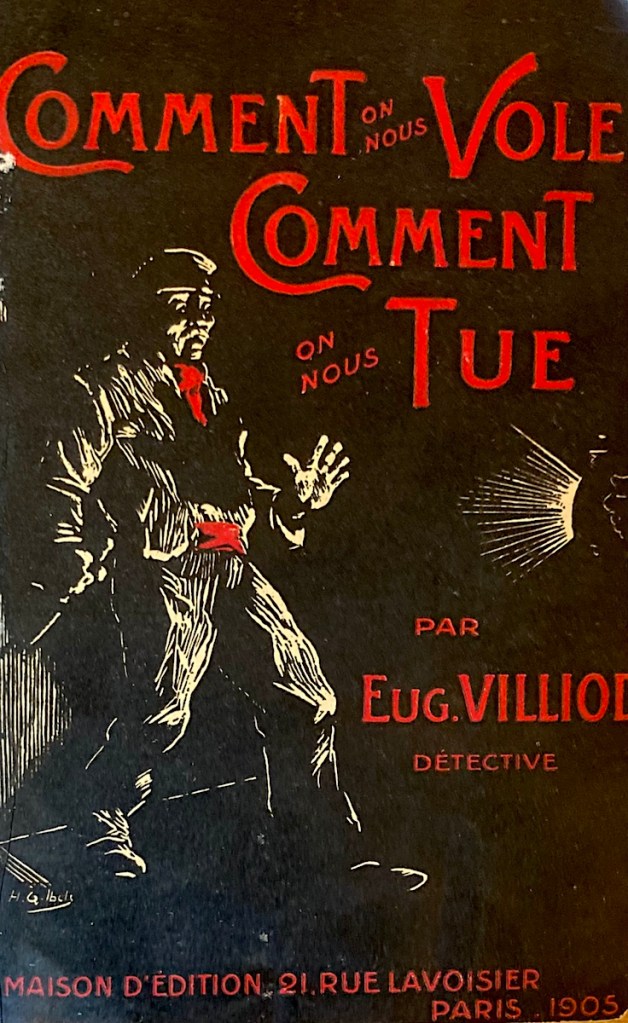
Cover of Comment on nous vole, comment on nous tue by Eugène Villiod, Détective (1905). An electric lantern sheds light upon an apache ruffian from the criminal underworld. Author’s collection.
The first in the series was Comment on nous vole, comment on nous tue (“How They Rob Us, How They Kill Us,” 1905), a veritable catalog of scams and violent crimes awaiting naïve French provincials and international tourists visiting Paris.
In Comment on nous vole, Comment on nous tue, by example we want to instruct all respectable people how to avoid being robbed or killed.[2]
Under the guise of protecting readers against nefarious criminal schemes, in substance Comment on nous vole was a “how-to” manual, replete with photo illustrations of Villiod playing out various criminal roles. Over ninety percent of the book provided detailed instructions on how to cheat at cards, con gullible people, break into hotel rooms, and commit assaults.
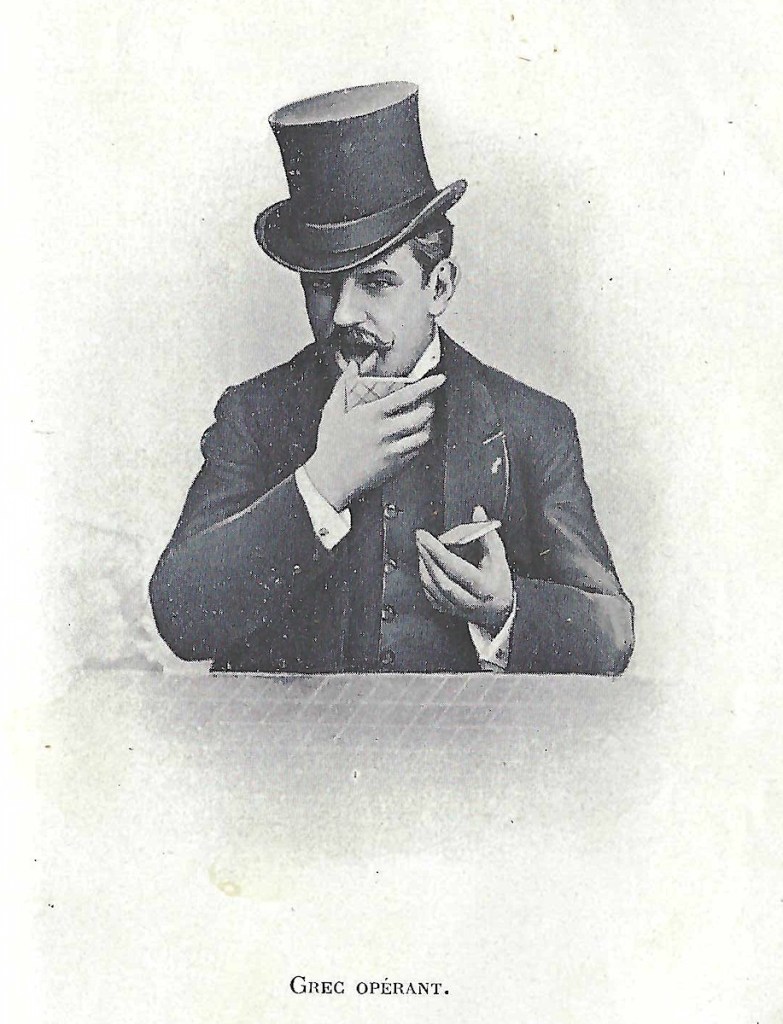
Villiod as a “Greek card shark in action.” The following photo illustrations are all taken from the 1905 edition of Comment on nous vole, comment on nous tue. Author’s collection.
Some of the ruses elucidated by Villiod were everyday occurrences. The short con bonneteau (“three-card monte” or “find the lady”) card trick would be played upon an umbrella for an easy tabletop setup and a quick getaway should a policeman appear. Among assembled onlookers, a plant would encourage a poire (“pear” or unsuspecting mark) to place a bet on a winning card. Due to the dealer’s sleight of hand, the better inevitably lost.
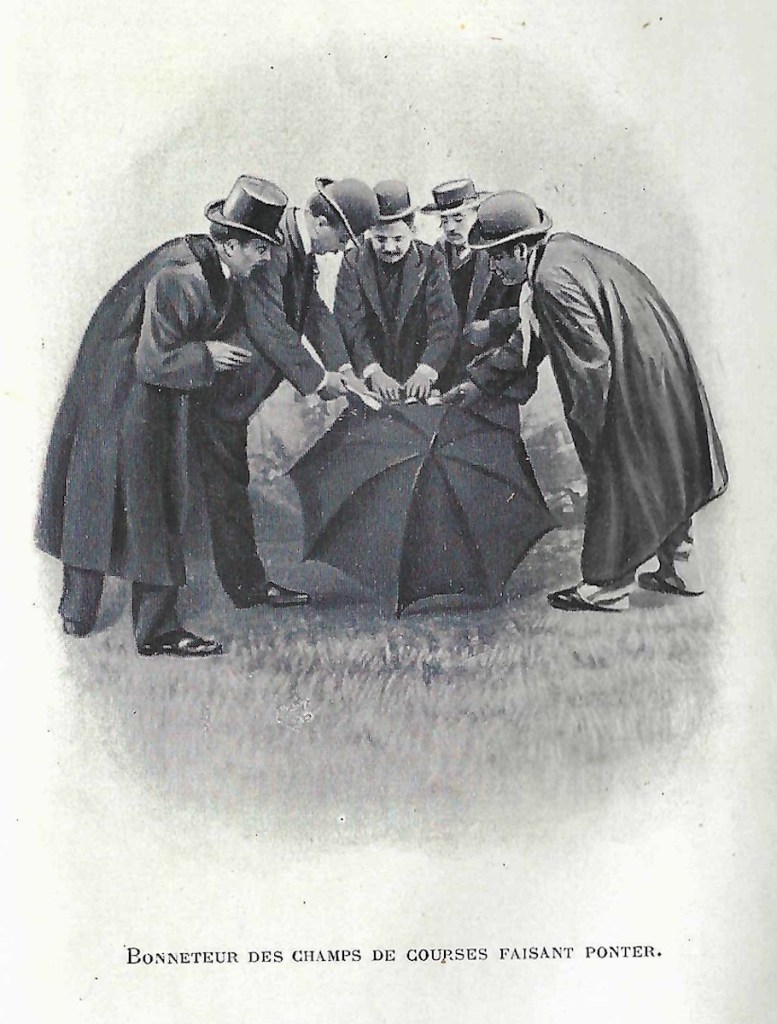
“Confidence man pulling off the three-card scam at the racetrack.”
Other ruses were more complex. In le vol à l’américain, the “like a friendly American” theft, a seasoned con artist targets a French provincial or foreign traveler at a Paris train station and strikes up a conversation.
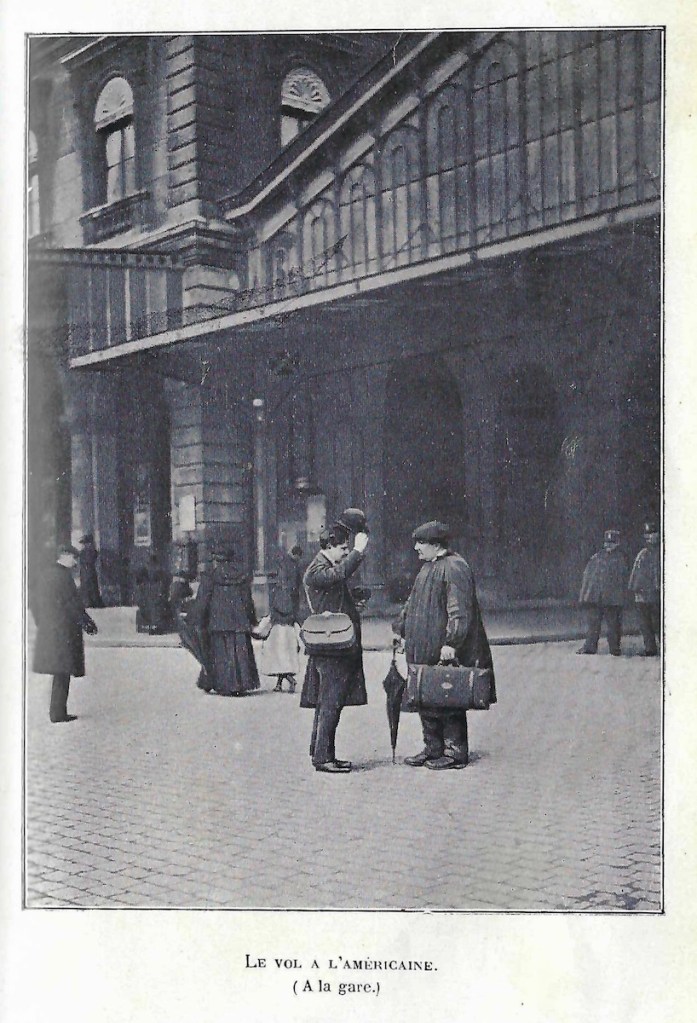
Le vol à l’américain (1): “At the train station.”
Learning the traveler is visiting Paris for the first time, the confidence man offers to be his guide to the city. He leads the tourist to a sidewalk café and generously offers to buy him a drink.
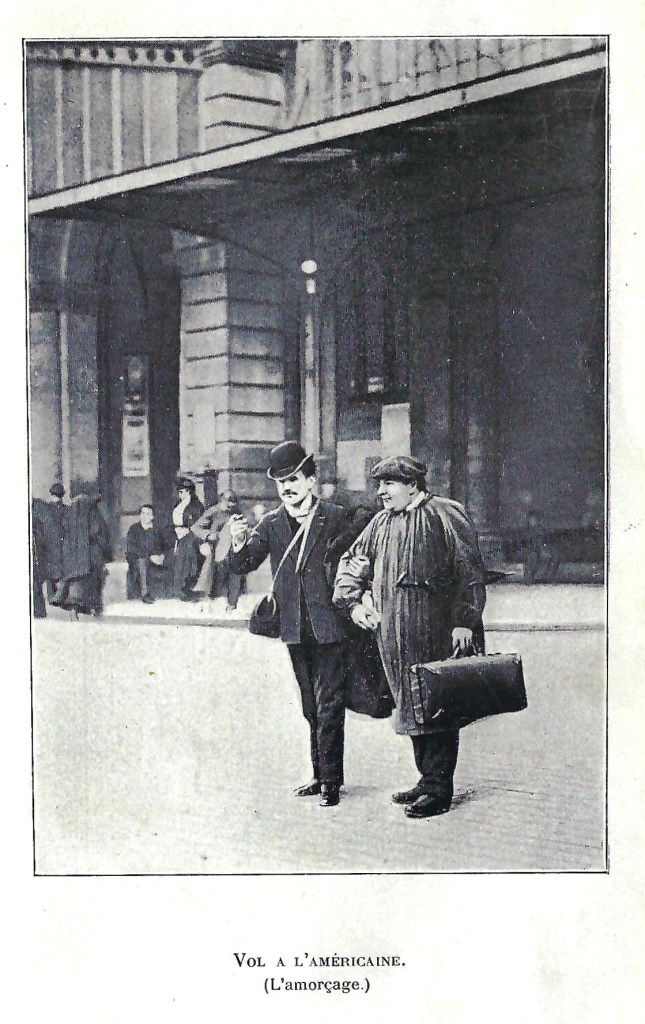
Le vol à l’américain (2): “Setting the bait.”
Since the tourist is carrying cash only, the con man explains to him that promissory banknotes are more secure than hard currency. Familiar with the operations of Paris banks, he offers to exchange the traveler’s money for banknotes, leaving his own wallet behind as security.
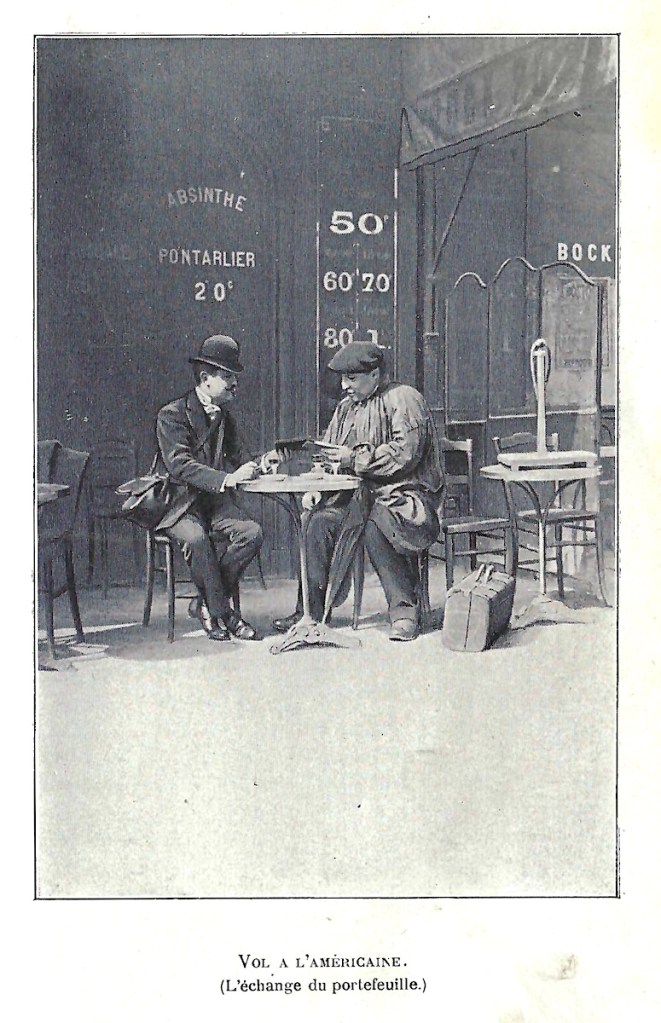
Le vol à l’américain (3): “Exchanging wallets.”
In due course, the con man returns and exchanges the traveler’s wallet for his own. He apologizes for being late for another appointment and quickly departs. The duped traveler excitedly opens his stuffed wallet, only to find it filled with sheaves of newspaper clippings cut down to the size of banknotes.
Villiod recounted more menacing crimes that could befall the naïve Paris visitor as well. The traveler who stays out late at night, believing the well-lit streets of Paris are safe, risks becoming a victim of le coup du Père François (the “Father Francis blow”), a coordinated team assault and theft. First, an assailant approaches an unsuspecting victim, throws a loop around his neck, and hoists him upon his back. Then an accomplice rifles through the suspended victim’s coat pockets and snatches his wallet, watch, and other valuables. Standing guard on the street corner, a confederate makes sure no bystander or police officer is observing the attack.
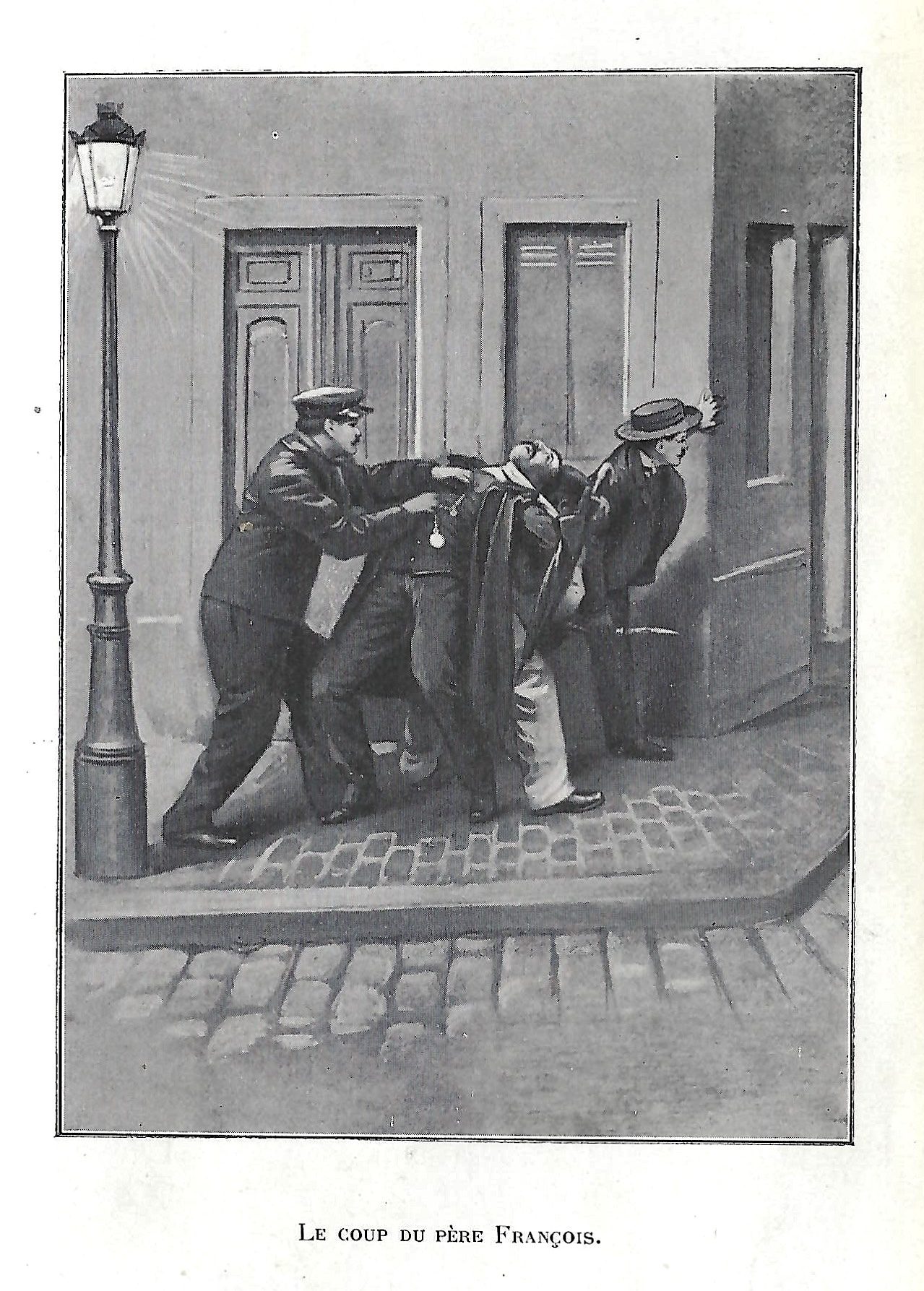
A coup du Père François delivered beneath a street lamp.
Multiple dangers awaited unwary travelers within the presumed security of their hotel rooms as well. Villiod warned readers to be vigilant for burglars such as the monte-en-l’air, who climbs over walls or drops down from the roof and enters your hotel room through the window.
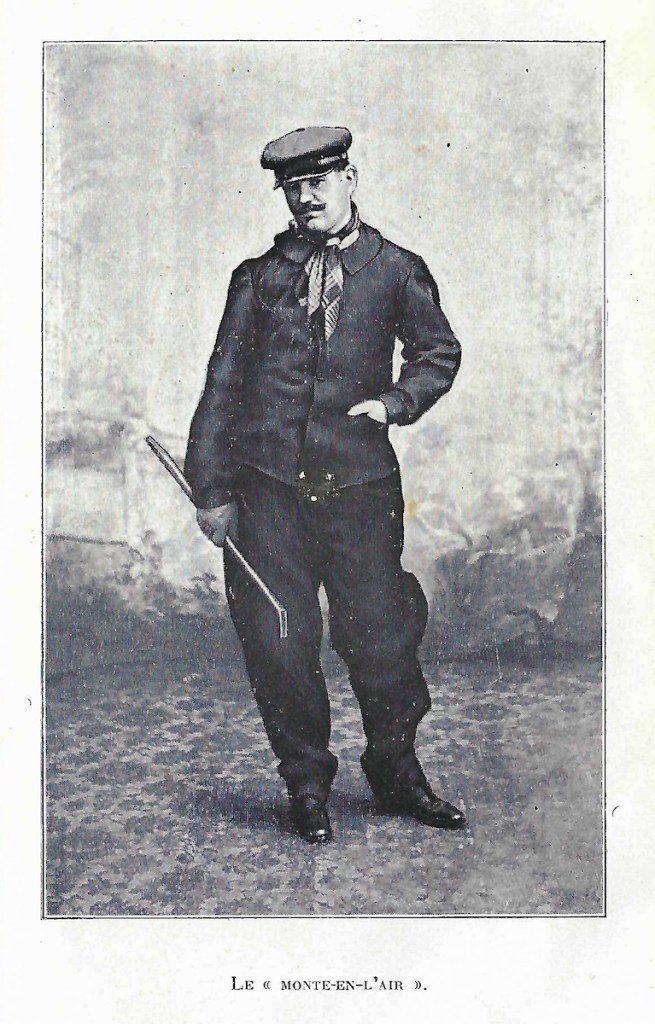
Villiod as a monte-en-l’air cat burglar.
After tucking into bed, a sleeping guest risks being assaulted by a rat d’hôtel (“hotel rat”). Wearing a black body suit, the thief slips into the guest’s room under cover of darkness and steals valuables. Should an unfortunate traveler wake up, the rat d’hotel may be equipped with weapons, such as a sap blackjack and dagger, to subdue the alarmed victim.
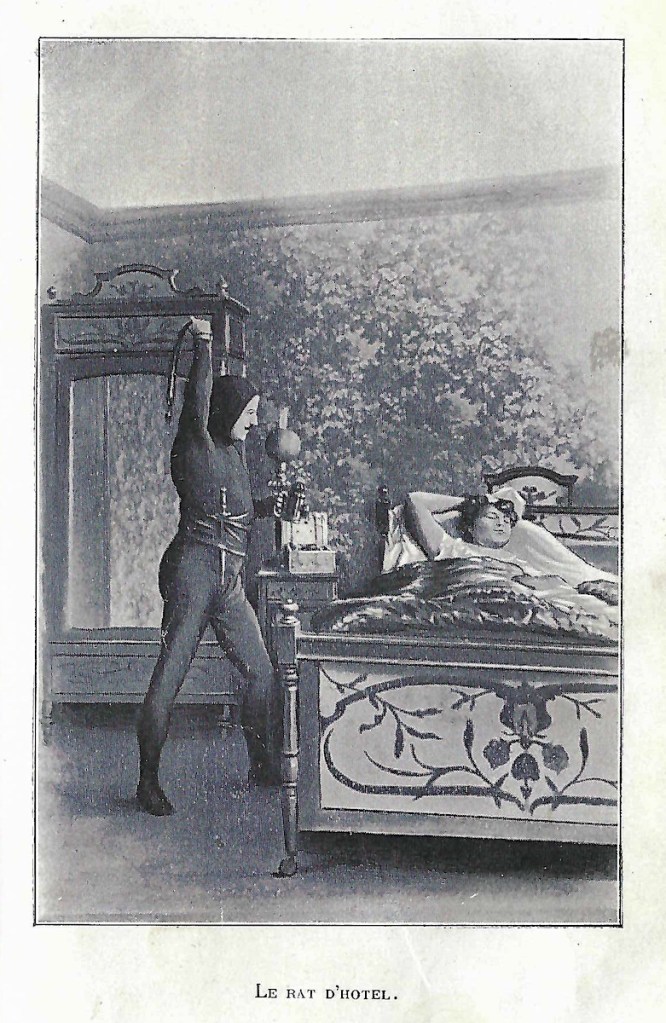
Villiod as a rat hotel ready to assault a sleeping woman.
Another hotel crime is l’entolage, the “under the bed covers” scheme operated by women working in pairs. One woman scopes out the hotel lobby or restaurant for a male client amenable to a sexual solicitation. Accompanying the mark to his hotel room, they crawl into bed together. Meanwhile, her partner sneaks into the room, rifles through his clothes, and steals money and identity papers for a future blackmail.
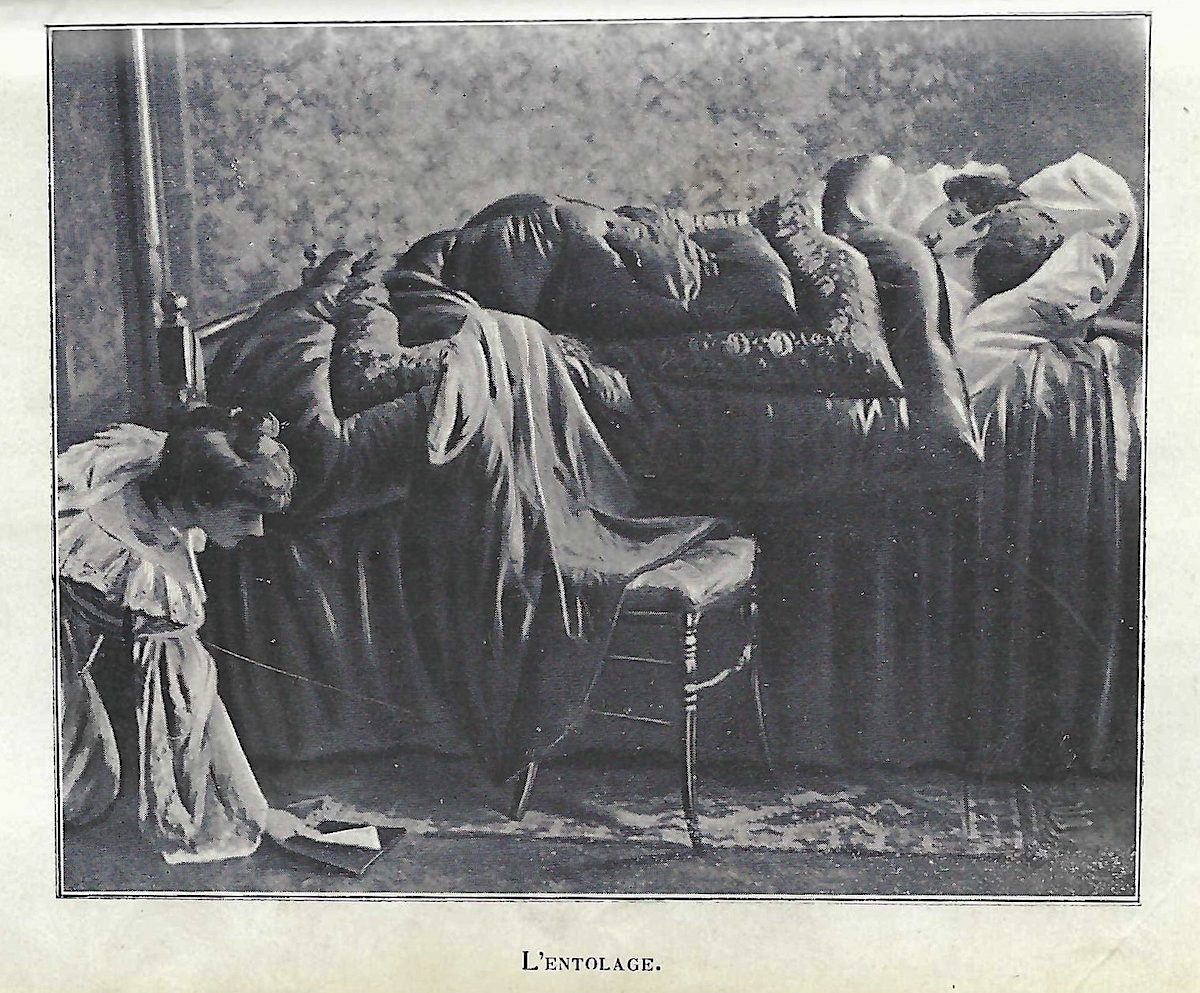
The entolage accomplice rummages through the john’s clothes.
After having abundantly detailed ruses and crimes for over three hundred pages, Villiod wrapped up Comment on nous vole with a short chapter on the problem of crime in society today. Simply arresting individuals, he insisted, is insufficient. Widespread crimes committed against honest people by la pègre, no longer the “lazy criminal underclass” of drifters but now an organized armée du crime (“army of crime”), exceeds the restraints of education, the law, and the police. As a form of self-protection against malefactors, Villiod concluded, it’s best for individuals to avoid such nefarious types by thoroughly digesting the information provided in his book.
Additional titles in the “Social Scourges” series followed. La machine à voler (“The Stealing Machine,” 1906) and Comment on nous vole au jeu (“How They Cheat You at Cards,” 1909) explained how various casino games and card circles are rigged.[3] Villiod embellished the book chapters with humorous stories peppered with criminal argot about fleecing poires, “pears” ripe for the picking. A third, Les bandes noires (“The Black Gangs,” 1908), dealt with fraudulent businesses run by criminal organizations, complete with bogus licensing forms for setting up one’s own operation.
Villiod concluded the “Social Scourges” with La pègre (“The Criminal Underworld,” 1912), a thirty-two-page promotional pamphlet illustrated with photos from Comment on nous vole.
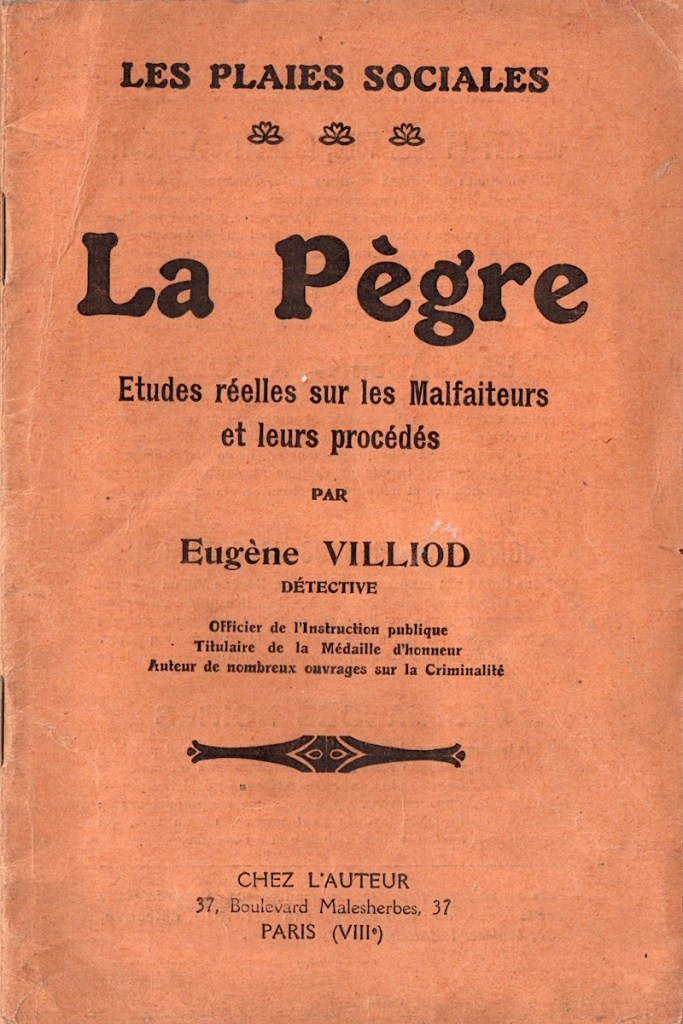
La Pègre, “Real-Life Studies of Malefactors and their Methods” by Eugène Villiod, Détective. Paris: Chez l’Auteur, n.d. [1912]. Image Source: DanyTrick.com.
The front cover boasted Villiod’s invented credentials as a detective, Officier de l’Instruction publique (“Public Instruction Officer”) and Titulaire de la Médaille d’honneur (“Bearer of the Medal of Honor”). As the Auteur de nombreux ouvrages sur la Criminalité (“Author of Multiple Works on Criminality”), Villiod listed his self-published books on the inside cover and advertised the multiple services offered by his detective agency in the end matter.
Overall, the “Social Scourges” series delineated a slippery world of con men and suckers, those who know the tricks of the trade and their gullible victims. Disingenuously packaged as self-protection guides, Villiod hoped his bourgeois readers would employ his agency to make discrete inquiries into personally compromising matters, rather than face social scandal. Yet his publications failed to produce substantial financial returns. That was soon rectified, however. (To be continued…)
NOTES
[1] On la grande peur as Belle Époque entertainment, see: Richard Abel, The Ciné Goes to Town : French Cinema, 1896-1914 (Berkeley and Los Angeles: University of California Press, 1994); Alain Carou et Matthieu Letourneux, Cinéma premiers crimes (Paris: Paris bibliiothèques, 2015); and, Vanessa Schwartz, Spectacular Realities: Early Mass Culture in Fin-de-Siècle France (Berkeley and Los Angeles: University of California Press, 1999).
[2] Eugène Villiod, “Préface,” in Comment on nous vole, comment on nous tue (Paris: Chez l’Auteur, 1905), pp. 3-4. Throughout this post, English translations from the French are by the author.
[3] Villiod’s books on gambling were translated into English by Russell T. Barnhardt for the Gambler’s Book Club Press (Las Vegas): The Stealing Machine (1976); How They Cheat You at Cards, or Mr. Rakeoff in the Provinces (1979); and, Crooks, Con Men and Cheats (1980), an abridgment of Comment on nous vole, comment on nous tue.
SOURCES
Dominique Kalifa, Célérité et discrétion: Les détectives privés en France, de Vidocq à Burma (Paris: Paris bibliothèques, 2004). Exhibition catalogue, Bibliothèque des littératures policières, Paris, May 28-October 16, 2004.
_____. Histoire des détectives privés en France (1832-1942), 2nd ed. (Paris: Nouveau Monde, 2007).
Eugène Villiod, Comment on nous vole, comment on nous tue (Paris: Chez l’Auteur, 1905).
_____. La machine à voler. Étude sur les escroqueries commises dans les cercles et les casinos, “Les Plaies sociales” (Paris: Chez l’Auteur, 1906).
_____. Les bandes noires. Étude sur l’exploitation dans vendeurs, producteurs, négociants, etc., “Les Plaies sociales” (Paris: Chez l’Auteur, 1908).
_____. Comment on nous vole au jeu, ou M. Laratisse en province (Paris: Imprimerie Waltener et cie., 1909).
_____. La Pègre: Études réelles sur les malfaiteurs et leurs procédés, “Les Plaies sociales” (Paris: Chez l’Auteur, n.d. [1912].)
Updated: July 9, 2026
Robin Walz © 2026


Leave a Reply