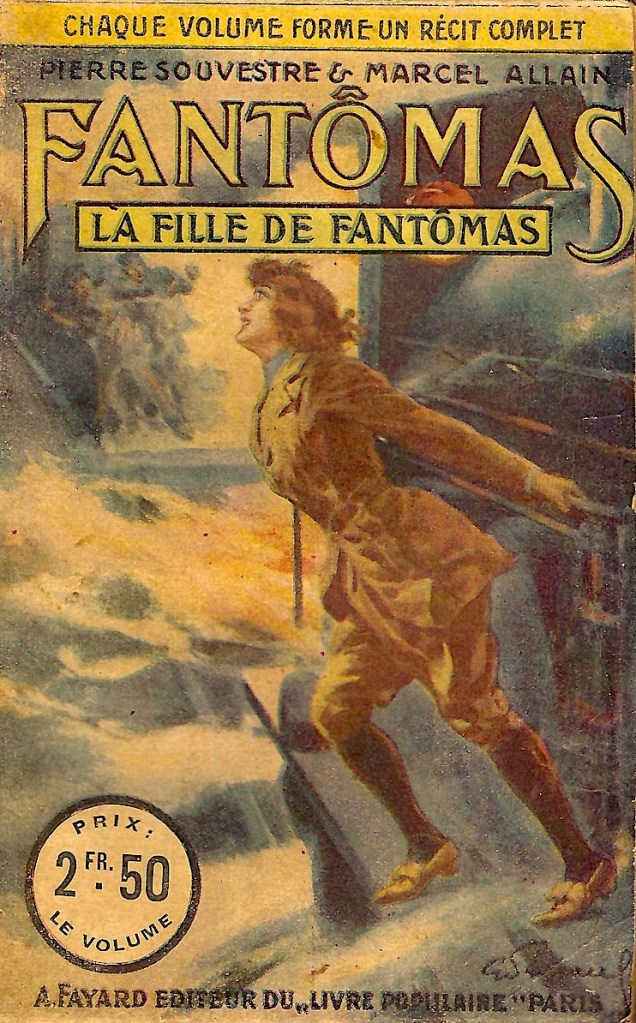
La Fille de Fantômas by Pierre Souvestre and Marcel Allain, vol. 8. Cover illustration by Gino Starace. Paris: Arthème Fayard, 1911 (1920s reprint). Author’s Collection.
In the eighth Fantômas novel, Souvstre and Allain added a new core character to the series, Hélène, the “Daughter of Fantômas.” Born in South Africa and ignorant of her parentage, she was raised outside of Durbin by a nanny named Old Laetitia. Cross-dressed as a rancher called Teddy, she is an excellent horseback rider, crack shot with a rifle, and an occasional opium smoker. On her sixteenth birthday, Laetitia delivers a letter to her written by Fantômas, her absent father who has returned to claim her as his own. The revelation blows Hélène’s mind, and the confused teenager runs away.
Meanwhile, Juve and Fandor have pursued Fantômas to South Africa, following the archcriminal’s escape from the hangman’s noose in London.[1] During the course of their investigations, Teddy befriends Fandor. One day, while riding horses together on the savannah, Teddy takes a fall and is rendered unconscious, prostrate on the ground. Fandor rushes to Teddy’s side, unbuttons the rancher’s shirt to revive his pal, and discovers… ample breasts! Fandor is bouleversé (emotionally overwhelmed) and the quickly revived Hélène fâchée (furious). She leaps back on her horse and gallops away, leaving the slack-jawed Fandor behind.
As the novel unfolds, Juve and Fandor pressure Hélène to assist them in capturing Fantômas. Repeatedly, she refuses to cooperate. While Hélène fears having inherited Fantômas’s criminal malevolence, she also feels a filial obligation to him. However, she rejects his appeals for the two them to reunite as a family. Fleeing South Africa for good at the end of the novel, Hélène ditches Juve and Fandor by uncoupling a locomotive engine from the coal car, leaving the thwarted duo behind.
With the introduction of Hélène, gender trouble entered into Fantômas. Up to this point, the series had resonated in an exclusively masculine key. Fantômas is a domineering man, “The Lord of Terror” who brutally punishes those who thwart or betray him. In their pursuit of the archcriminal, Juve and Fandor bond in a bromance that strengthens with each novel. Among Belle Époque readers of popular novels, men were the greatest fans of Fantômas, while women tended to prefer historical melodramas and sentimental novels, such as Les Deux Orphelines (“The Orphaned Twin Sisters,” 1874) and La Porteuse du pain (“The Bread Delivery Woman,” 1889).[2]
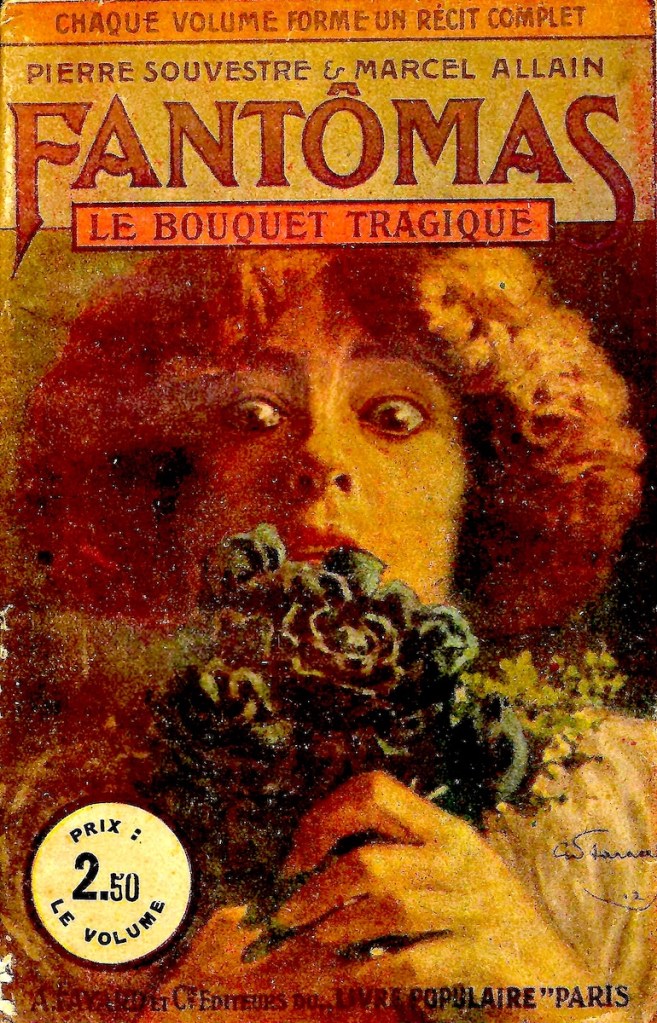
Le Bouquet tragique (“The Fatal Bouquet”) by Pierre Souvestre and Marcel Allain, vol. 23. Cover illustration by Gino Starace. Paris: Arthème Fayard, 1911 (1920s reprint). Author’s Collection.
Fantômas is a misogynist and merciless sadist. He sends the Baroness Valentine de Lescaux opium-laced black roses repeatedly before murdering her. In a Monte Carlo casino, he blindfolds Isabelle de Guerray and presses a knife blade against her arm so she can feel blood (actually warm water) flowing down her arm, until she loses consciousness and dies of fright. Fantômas terrorizes working-class women as well. He binds lace maker Marie Pascale to a chair, gags her, and rigs a revolver with strings attached to counterweights to fire once a candle’s flame has burned through its threads.
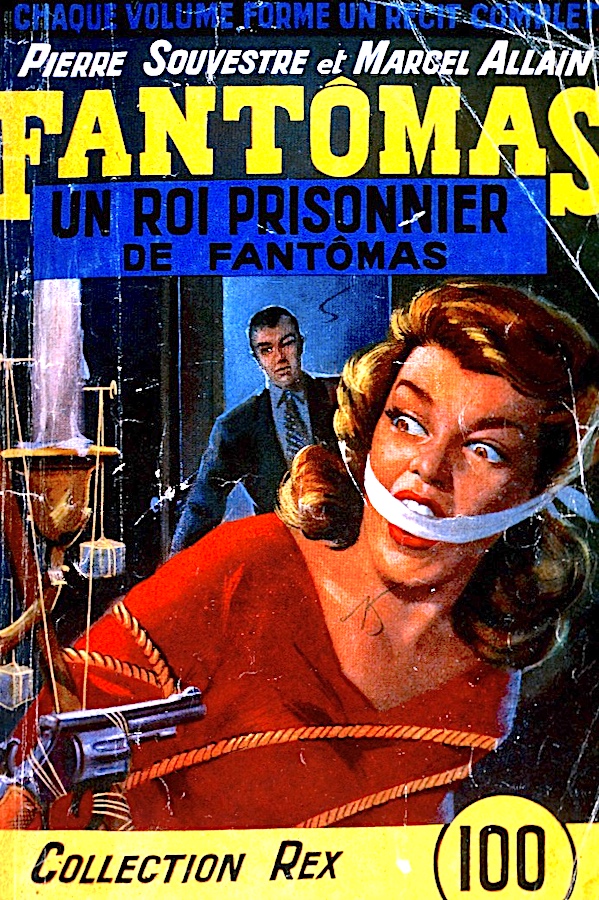
Un roi prisonnier de Fantômas (“A Royal Prisoner of Fantômas”) by Piere Souvestre and Marcel Allain, “Collection Rex” no. IX. Cover Illustration by M. Gourdon. Paris: Vantillard, n.d. (c. 1950). Abridged reissue of the novel in magazine format. Author’s collection.
Conversely, Fantômas enlists women across the social spectrum, from the aristocracy to the bas-fonds (criminal underground), as participants in his criminal schemes. Lady Beltham, the tormented mistress of Fantômas, wavers between obeying le Maître (“The Master”) and assisting Juve and Fandor in their attempts to capture him. The grotesque Mère Toulouche, proprietress of a tapis-vert (low-life bar) whose basement serves as a rendezvous for criminal gangs to stash stolen goods, is a recurring minion throughout in the series. Bobinette, the mistress of Captain Brocq, steals French military secrets for Fantômas to deliver to the Germans in L’Agent secret.
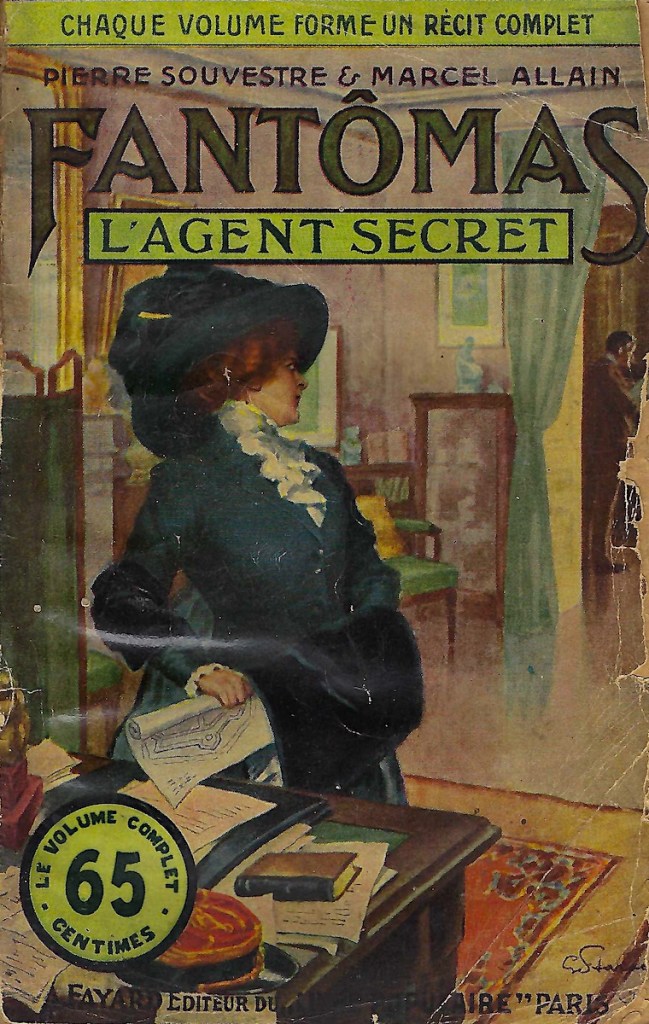
L’Agent secret by Pierre Souvestre and Marcel Allain, vol. 4. Cover illustration by Gino Starace. Paris: Arthème Fayard, 1911. Author’s Collection.
In contrast to women victims and criminals who succumb to Fantômas, Hélène is an active, independent, and self-assured actor who assumes various identities to evade and maintain her distance from Fantômas, Juve, and Fandor. Early in the series, she adopts roles as an innocuous mademoiselle to avoid drawing attention to herself, as saleswoman Mlle. Raymonde of Paris-Galeries, apartment renter Mlle. Denise, and office secretary Mlle. Hélène. As the series develops, she becomes more self-confident and emboldened in her aliases, as La Guêpe Rouge (“The Red Wasp”) beauty of the Parisian apaches criminal gangs, Princess Hélène de Mayenbourg of Holland, horse trainer Mademoiselle Mogador in the Barzum Circus, and Comrade Olga in a secret society of Russian nihilists.
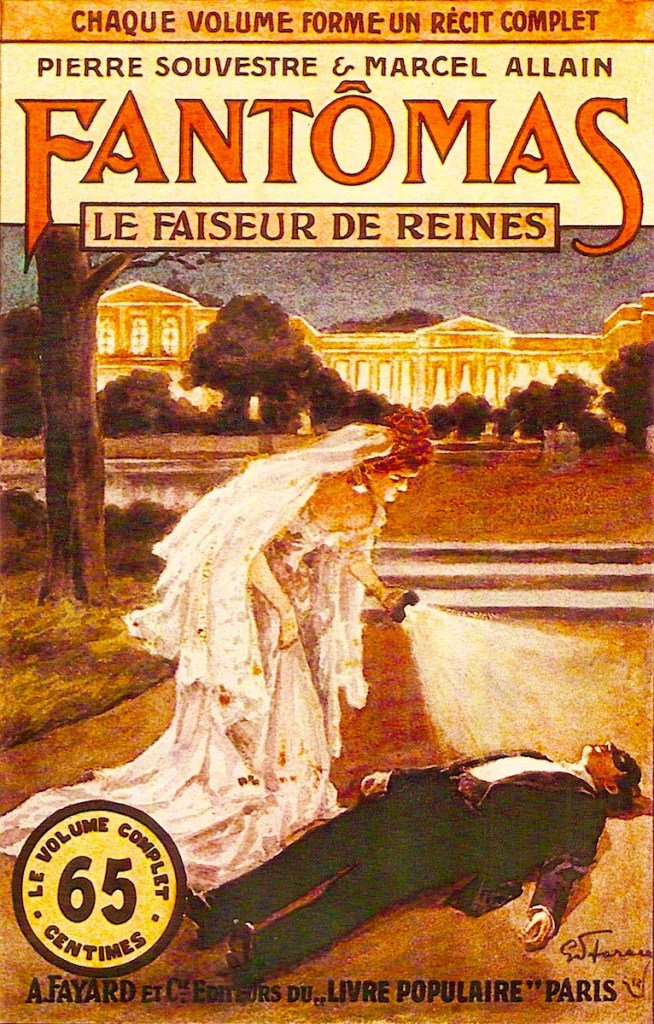
Le Faiseur de reines (“The Queen Maker”) by Pierre Souvestre and Marcel Allain, vol. 26. Cover illustration by Gino Starace. Paris: Arthème Fayard, 1912. Image Source: Gino Starace, l’illustrateur de “Fantômas.” Author’s Collection. The Princess of Mayenbourg (Hélène) discovers a corpse on the lawn.
In addition to her initial alias as Teddy, periodically Hélène assumes male personas. Some are minor characters, such as Louis, a mousse de péniche (“barge moss”) cabin boy, and Daniel, valet to a Danish art restorer. In other instances, her cross-dressing yields more substantial roles, such as the feigned lover Florestan d’Orgelès, who courts courtesans and then urges them to abandon their impudent ways, and the renowned horse racing jockey Cascadeur. Like her father, Hélène is most dynamic when she is someone else.
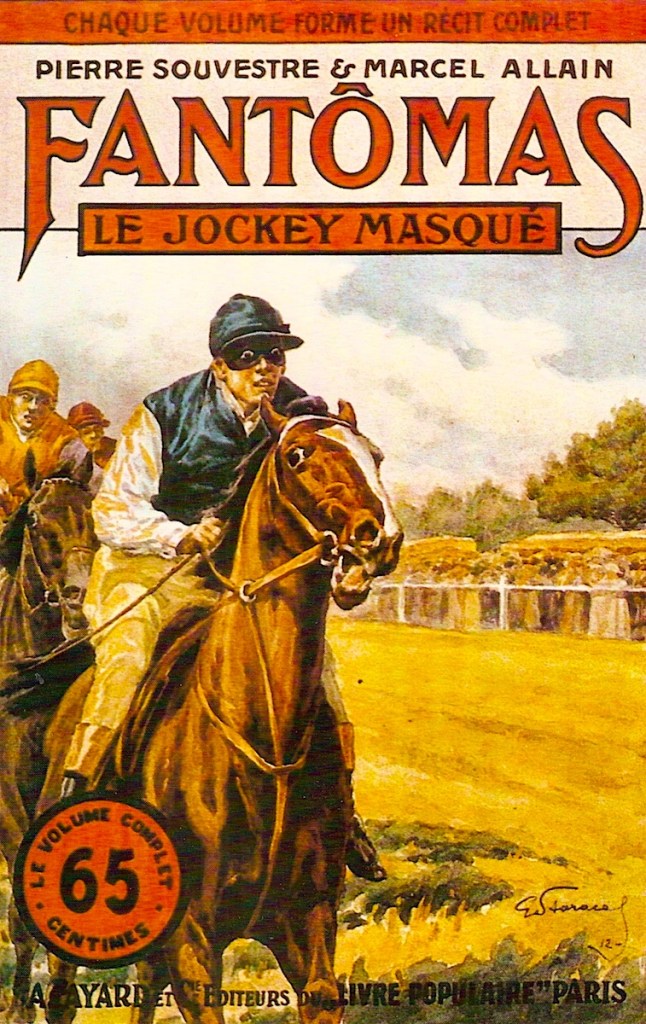
Le Jockey masqué (“The Masked Jockey”) by Pierre Souvestre and Marcel Allain, vol. 24. Cover illustration by Gino Starace. Paris: Arthème Fayard, 1911. Image Source: Gino Starace, l’illustrateur de “Fantômas.” Author’s Collection.
Over time Hélène and Fandor develop an unrequited love for each other, and increasingly she relies upon him to get her out of jams. Fandor helps her escape from Saint-Lazare women’s prison on a trumped-up murder charge. When Hélène is unmasked as the false comrade Olga by a secret society of Russian nihilists, Fandor comes to the rescue.
Their road to romance is a long and fitful one. Two-thirds through the series, Hélène finally declares her ardor for Fandor in a letter, “I love you… be careful!”[3] Falsely believing the two are actually sister and brother, Fantômas hires an apostate Orthodox priest to conduct a black mass to join them in an incestuous marriage.
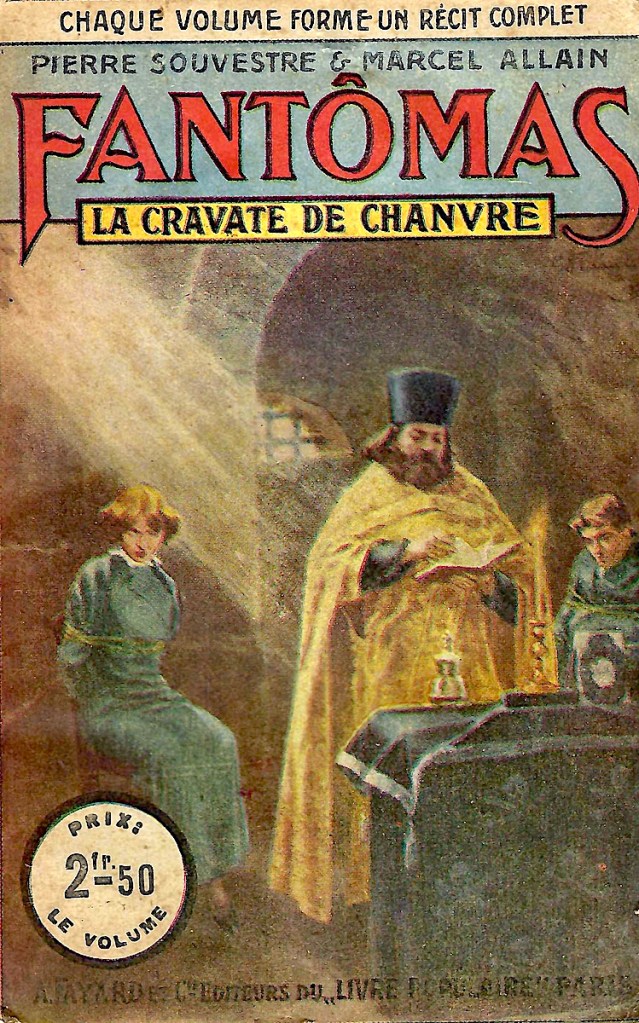
La Cravate de chanvre (“The Hemp Necktie”) by Pierre Souvestre and Marcel Allain, vol. 31. Cover illustration by Gino Starace. Paris: Arthème Fayard, 1911 (1920s reprint). Author’s Collection.
In the La fin de Fantômas (“The End of Fantômas”), finally Hélène and Fandor marry, and the strength of her character diminishes. After Fantômas sets off an explosion at the Folies-Françaises theatrical revue, Hélène is seriously wounded and sent to a hospital to convalesce. To promote her recovery, Fandor books them a trans-Atlantic cruise on the Gigantic, but en route they are forced to escape by lifeboat when Fantômas sinks the ocean liner into the icy waters. Although Hélène continues to show some pluck, she ceases to be an action heroine.
Still, Hélène never adhered to the socially accepted nineteenth-century French conception of womanhood with its matrimonial duties and maternal emphasis upon domesticity. On the contrary, she spends the preponderance of the Fantômas series giving Fandor the slip to maintain her independence. In this regard, Hélène is version of the Belle Époque femme nouvelle, the French phrase for the American “New Woman” — young, athletic, capable, defiant, clever, courageous, and at ease in traditionally masculine roles.[4]
At the same time, Hélène does not entirely fit the New Woman mold. She is not a feminist intellectual, politically engaged journalist, or aspiring professional. In fact, Souvestre and Allain ridiculed such femmes nouvelles, most notably in their derogatory characterization of Madame Alicet, editor-in-chief of the fashionable review Littéraria.[5] Hélène’s independent woman and cross-gender performances operate within the Belle Époque framework of conservative patriarchal values, rather than openly challenging them.
Contrary impulses found in Hélène’s character can be traced to women criminals and detectives from earlier French popular fiction who challenged the male hierarchy of French society. Adèle d’Escars, the female prostitute-leader of a criminal bands from the final volume of Vidocq’s Mémoires, is a foundational in this regard. Originally conceived by Vidocq’s ghostwriter Louis-François L’Héritier in Les Malheurs d’une libérée (“The Misfortunes of a Liberated Woman,” 1829), Adèle was an accomplished courtesan and thief who commanded criminal gangs of men.
The notion that liberated French women are by nature criminals who threaten the male social hierarchy resurfaced forcefully in the mid-nineteenth century novel La Franc-maçonnerie de femmes (“The Secret Masonic Society of Women,” 1856) by journalist, playwright, and novelist Charles Monselet.
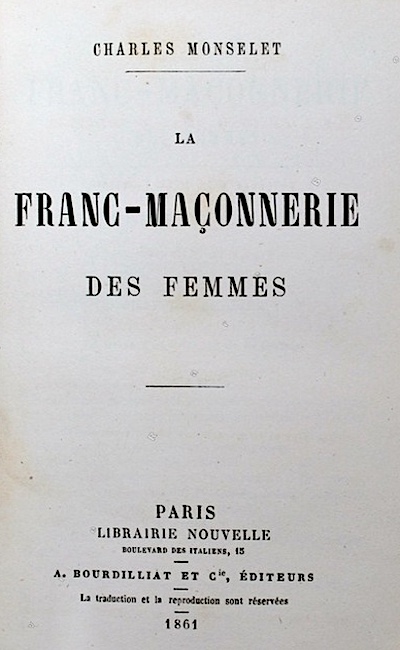
Title page of La Franc-maçonnerie de femmes (“The Secret Masonic Society of Women”) by Charles Monselet. Paris: Librarie Nouvelle, A. Bourdilliat, 1861 (orig. 1856). Image Source: Illibrarie, Geneva, Switzerland.
The novel opens with the social ruination of renowned vocalist Marianna Rupert, mistress of the ambitious, conceited, and rich dandy Philipe Beyle, after he breaks off their relationship. Enter the Grand Masonic Mistress Pandora, who welcomes the emotionally wounded Marianna into her fold. United under the motto Toutes pour une, une pour toute (“All women for one, and one woman for all!”), the Secret Masonic Society of Women orchestrates the downfall of Beyle, as well as other reprobate aristocrats and erstwhile bourgeois gentlemen.
At the dawn of the twentieth century, the woman criminal takes center stage in the Maud novels by Antoinin Reschal, a magazine editor and the author of diverse genres ranging from gastronomy and humor to romance and soft porn.[3]
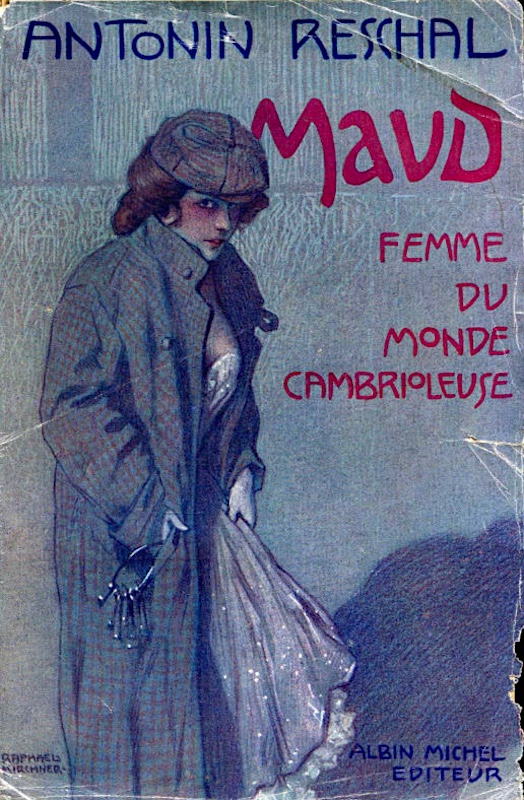
Maud, femme du monde cambrioleuse (“Maud, Society Woman Burglar”) by Antoinin Reschal. Paris: Albin Michel, 1909. Cover Illustration by Raphael Kirschner. Collection: Yale University Sterling Memorial Library.
Maud, a young woman élevée à la moderne (“raised in the modern manner”), is married to the Comte de Fréjeville, an exemplary but sexually impotent member of a gentlemen’s club. Maud openly flaunts her illicit liaisons with Jack d’Urville, a handsome and shiftless “neurasthenic” who inhabits an immoral milieu of promiscuity, gambling, and low-life slumming. Her desire for Jack is fueled equally by the thrills of sex and crime:
Taking her by the waist, Jack continued to speak softly and, suddenly, gave her a forceful kiss. Caught off guard, the young woman savored the rough and slightly savage kiss, and whispered excitedly:
“The complicitious kiss… the link that unites the pimp and his girl… the thief and the prostitute…”
“Yes, my dear Maud, the kiss that drives two wills toward the same ideal… the red sealing wax that locks the secret of two lost souls together…”
(Maud: Femme du monde cambrioleuse, pp. 18-19).
A souris d’hôtel (“hotel mouse”), Maud dons a black body suit to carry out Jack’s hotel burglary schemes. Together, the criminal lovers commit a string of hotel thefts across France, Italy, England, and Scotland.
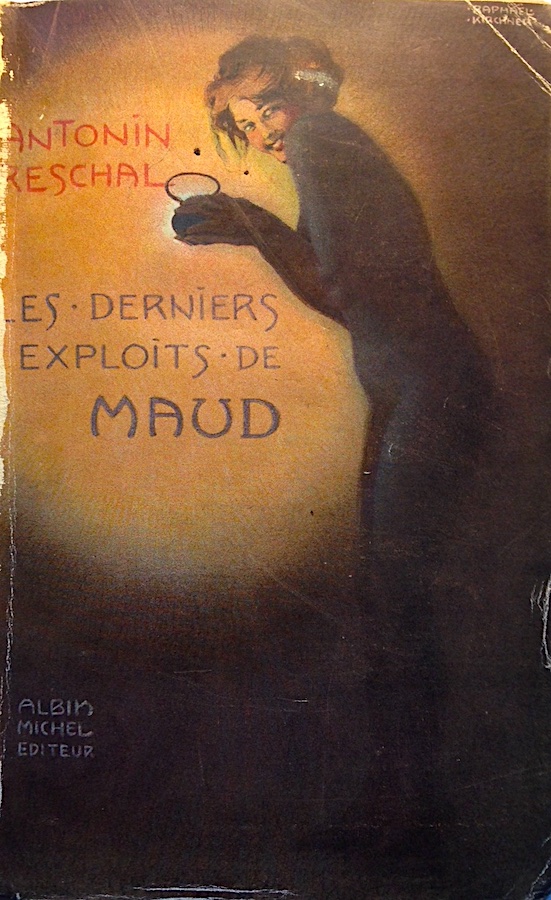
Les Derniers exploits du Maud by Antoinin Reschal. Paris: Albin Michel, 1910. Cover Illustration by Raphael Kirschner. Collection: Yale University Sterling Memorial Library.
In Les Derniers exploits de Maud (“Maud’s Final Exploits”), Jack marries the young and naïve Lucienne de Villennes to gain access to her aristocratic wealth. Maud goes nearly mad with jealousy, takes up sexual relations with multiple men, and flirts with Russian Princess Vénoff (while stopping short of giving in to her “sapphic” advances). Toward the end of the novel, she commits suicide by drinking poison.
Grief-stricken, Jack bursts into the hotel room where Maud’s inert body lies. Then, miraculously… she begins to stir! Maud had swallowed a concoction that merely suppressed her breathing and heart rate to undetectable levels. Declaring their eternal love for one another, the novel ends with Maud and Jack setting off on further adventures.
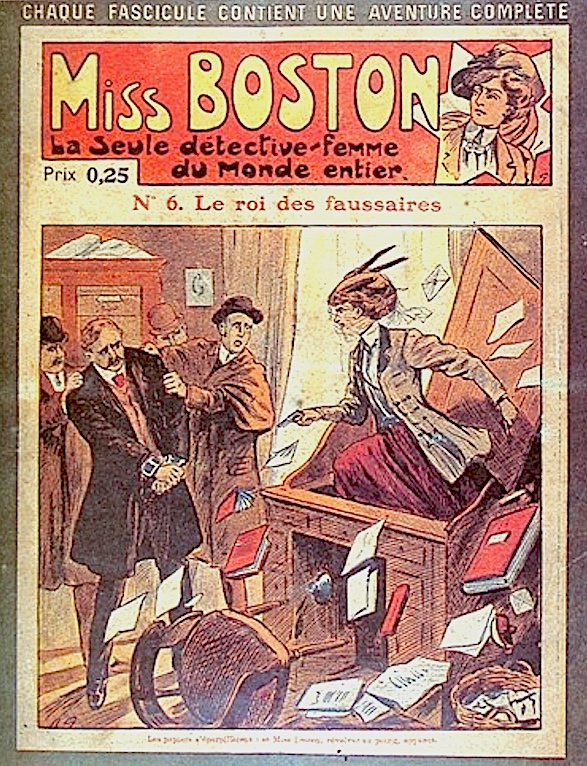
Le Roi des faussaires (“The King of Forgers”). Series Miss Boston, no. 6, 1908. Image Source: Jess Nivens Blog.
Previous to the Maud novels, Reschal tried his hand at writing a fictional detective series featuring an American New Woman, Miss Boston, le seule détective-femme du monde entier (“Miss Boston, the Only Woman Detective in the Entire World,” 20 issues, 1908-1909).[6] Ethel Boston is a highly educated, athletic, and intrepid private detective who, in her first case, solves the mystery of the murder of Sherlock Holmes at the Circus Hotel. Miss Boston rides the New York subway on her own, drives a soundproof electric automobile, carries out night investigations with an electric flashlight, bugs rooms with miniature microphones, uses a Y-ray machine to see through walls, and packs two revolvers, one in a holster and the other in her purse.
A more prolific female detective series was Ethel King, le Nick Carter féminin (“Ethel King, the Female Nick Carter”), anonymously written or translated by Jean Petithuguenin (100 issues, 1912-1914).[7] Private detective Ethel King is an astute, charming, daring, elegantly dressed, intelligent and physically fit woman who moves comfortably through high society. Miss Boston and Ethel King are both from America, one in New York the other in Philadelphia, so their New Woman attributes could be read by French women without openly challenging conventional gender expectations domestically.
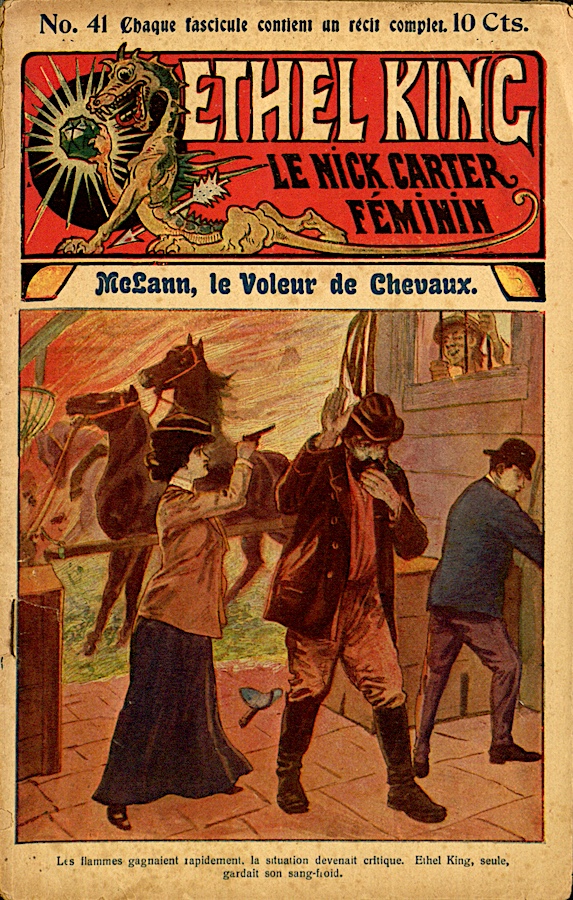
McLann, le Voleur de Chevaux (“The Horse Thief McLann”). Series Ethel King, le Nick Carter féminin, no. 41, 1912. Anonymous cover illustration. Caption: “The situation had become critical, as the flames rapidly spread. Ethel King alone kept her sangfroid.” Wikimedia Commons: Villanova University Digital Library.
As the “Daughter of Fantômas,” Hélène shares features of both her fictional criminal women forebears and the American New Woman, without fully being a femme nouvelle. Practiced in the arts of deception and dissimulation, Hélène is the granddaughter of Adèle d’Escars and the daughter of Maud, merging outlaw impulses with romantic desires. She also holds her own with the intrepid Miss Boston and Ethel King, assuming multiple aliases and independently directing her own actions. Above all, she refuses to bow to men who wish she would behave otherwise.
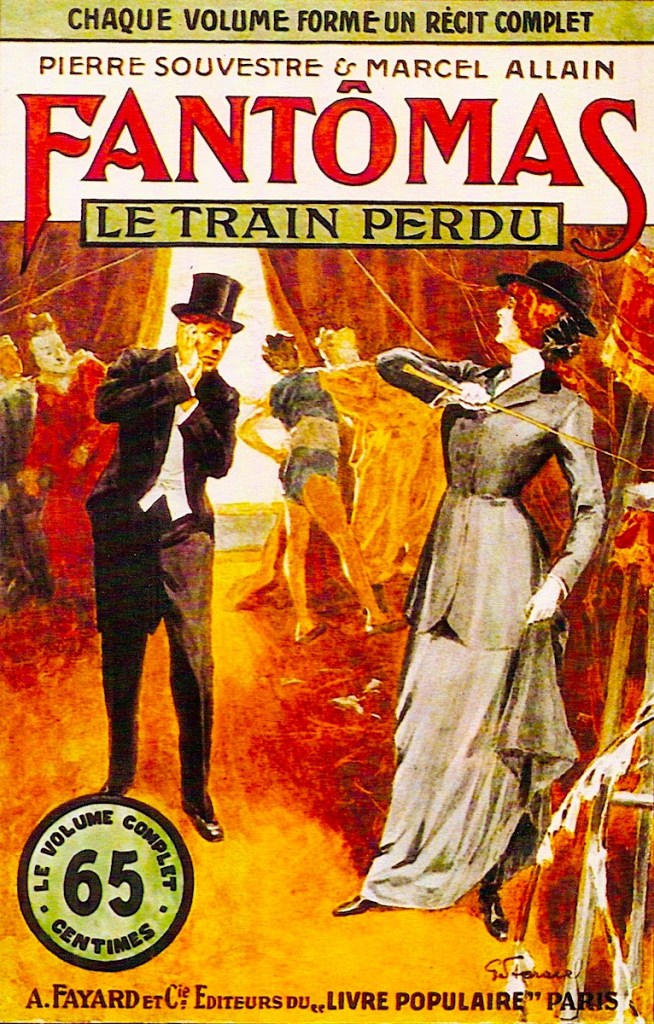
Le Train perdu (“The Vanished Train”) by Pierre Souvestre and Marcel Allain, vol. 21. Cover illustration by Gino Starace. Paris: Arthème Fayard, 1912. Source: Gino Starace, l’illustrateur de “Fantômas.” Author’s Collection. Circus horse trainer Mademoiselle Mogador (Hélène) teaches impresario Barzum a lesson.
Yet although athletic, energetic, occasionally cross-dressed, and fiercely independent, Hélène operates within the commonly accepted male hierarchy of French society by playing secondary and complementary roles to Juve, Fandor, and Fantômas. Conceived and written by two very male and typically bourgeois authors of popular fiction, the “Daughter of Fantômas” is a modern action and adventure heroine who expresses contrary gender impulses in Belle Époque France, yet her character stops short of becoming a femme nouvelle.
NOTES
[1] Souvestre and Allain, Pendu de Londres, vol. 7 (Paris: Arthème Fayard, 1911). English edition: Slippery as Sin, trans. B. J. (London: Stanley Paul, 1920).
[2] Anne-Marie Thiesse, “L’univers de la lecture populaire,” in Le roman du quotidien: Lecteurs et lectures populaires à la Belle Époque (Paris: Éditions du Seuil, 2000), pp. 59-73. While obscure to English readers, both Adolphe d’Ennery and Eugène Corman’s Les Deux Orphelines and Xavier du Montépin’s La Porteuse du pain were most frequently cited by women readers born during the Belle Époque interviewed by Thiesse, and both titles enjoyed a century of popularity in France in romans feuilletons (serialized in newspapers, magazines, and books), theatrical productions, and movies. However, the gender binary in popular crime readership broke down with the advent of silent cinema, as women reported enjoying early crime serials such as Fantômas (1913-1914), Les Mystères de New-York (“The Exploits of Elaine,” 1914-1915), and Judex (1916). In the United States, director D. W. Griffith adapted Les Deux Orphelines as Orphans of the Storm (1921) as a silent-film melodrama set during the French Revolution that starred sisters Lillian and Dorothy Gish.
[3] “Je vous aime… soyez prudent!” in Le Bouquet tragique by Pierre Souvestre and Marcel Allain, vol. 23, collection “Bouquins” (Paris: Robert Laffont, 1987), p. 557. English translations from the French throughout this post are by the author.
[4] This characterization of the femme nouvelle is taken from Mary Louise Roberts, Disruptive Acts: The New Woman in Fin-de-Siècle France (Chicago: University of Chicago Press, 2002).
[5] “La directrice de « Littéraria »,”in Les Amours d’un prince by Pierre Souvestre and Marcel Allain, vol. 22, collection “Bouquins” (Paris: Robert Laffont, 1987), pp. 323-333.
[6] While not actually the world’s first fictional woman detective, preceded by Miss Lois Cayley by Charles Grant Blairfindie Allen in 1899 and Cora Myrl by McDonnell Bodkin in 1900, translator Nina Cooper notes that Miss Boston was the first to appear in French; see The Adventures of Miss Boston, p. 9.
[7] Whether Petithuguenin wrote the Ethel King series or only translated it from German remains unresolved. Translator Nina Cooper affirms Petithuguenin was definitely the author; see The Adventures of Ethel King, p. 10. By contrast, authoritative crime fiction encyclopedist Charles Mesplède insists he was only a translator; s.v. “PETITHUGUENIN, Jean,” in Dictionnaire des littératures policières, 2nd ed., 2 vols. (Nantes: Joseph K., 2007).
SOURCES
Alfu, Patrice Caillot, and François Ducos, Gino Starace, l’illustrateur de “Fantômas” (Amiens: Encrage, 1987).
Charles Monselet, La Franc-maçonnerie de femmes (1856), Collection “Labyrinthes” (Paris : Éditions du Masque, 2011).
Jean Petithuguenin, The Adventures of Ethel King, The Female Nick Carter, adapted by Nina Cooper (Encino, Calif.: Black Coat Press, 2014).
Antonin Reschal (pseudo. Charles Arnaud), The Adventures of Miss Boston: The First Female Detective, adapted by Nina Cooper (Encino, Calif.: Black Coat Press, 2012).
_____. Maud, femme du monde cambrioleuse (Paris: Albin Michel, 1909).
_____. Les derniers exploits de Maud (Paris: Albin Michel, 1910).
Pierre Souvestre and Marcel Allain, Fantômas, édition intégrale, “Bouquins” in 8 vols (Paris: Robert Laffont, 1987-1989, 2013-2015).
_____. The Daughter of Fantômas, adapted by Mark Steele (Encino, Calif.: Black Coat Press, 2006).
Updated: May 9, 2026
Robin Walz © 2026


Leave a Reply