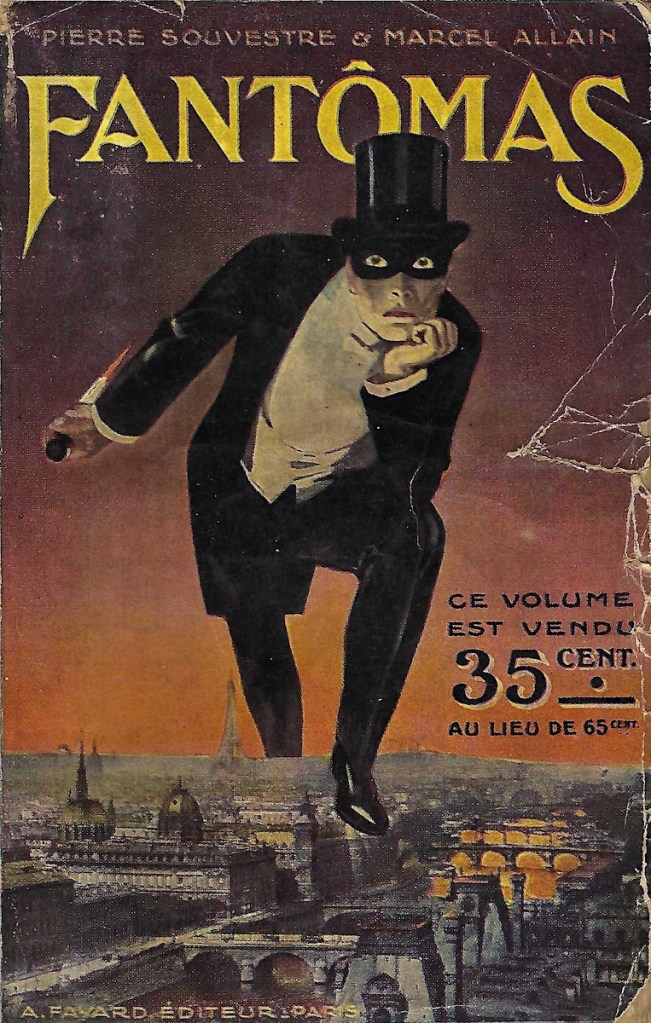
Fantômas by Pierre Souvestre and Marcel Allain. Anonymous Cover Illustration. Paris: Arthème Fayard, 1911. Author’s Collection.
Fantômas burst upon the scene on February 10, 1911. The book’s cover portrays a man dressed in tuxedo, top hat, and ball mask looming over the Paris landscape, concealing a bloody knife behind his back. He stares impassively at the reader, chin resting on clenched fist. The novel opens with an enigmatic conversation:
“Fantômas!”
“What did you say?”
“I said… Fantômas.”
“What does that mean?”
“Nothing… and everything!”
“Yet, what is it?”
“No one… but still, someone!”
“For goodness sake, what does this someone do?”
“Spreads terror!!!”[1]
Murders and mysteries fill the next four hundred pages. The Marquise de Langrune is brutally murdered in her chateau on the outskirts of Corrèze, neck slashed and head nearly cleaved from her body. Butler Jacques Dollon, in possession of a map fragment that provides a clue to the Marquise’s murder, is thrown to his death from a train. The corpse of British Army Officer Lord Beltham, stuffed into a trunk, is delivered to a ramshackle apartment in the disreputable Belleville neighborhood of Paris. At the Hôtel Palais Royal on the Champs Élysées, Russian Princess Sonia Danidoff is threatened in her bath by a bearded masked man in a dinner jacket, who steals her diamond necklace.
Sûreté Inspector Juve is charged with solving these crimes. He suspects that businessman Étienne Rambert who was one of the Marquise’s guests at the chateau, a English soldier named Gurn who served under Lord Beltham during the Boer Wars, and the masked thief who stole Princess Danidoff’s necklace are all… the archvillain Fantômas! Aided by journalist Jérôme Fandor, Juve tracks down and arrests Gurn, who is tried, convicted, and executed for the murder of Lord Beltham. Immediately after the guillotine blade falls, Juve rushes to the scaffold and retrieves the severed head from the basket:
“It isn’t Gurn who has been killed! The dead man’s head hasn’t gone pale, because it was painted, made up like an actor! Curses! Fantômas has escaped! Fantômas is free! He had an innocent man guillotined in his place. Fantômas! I tell you, Fantômas is alive!”[2]
Over a series of thirty-two novels, Fantômas would repeatedly elude Juve’s grasp and continue to perpetrate outrageous crimes.
It was not an original idea. A little more than a year previously, on December 7, 1909, the daily newspaper Le Matin issued the first installment of Zigomar by Léon Sazie, a crime writer for the weekly magazine L’Œil de la police (“Eye of the Police,” 1908-1914). Released in daily installments over the course of an entire year, Zigomar spun a massive tale of interminable crimes.
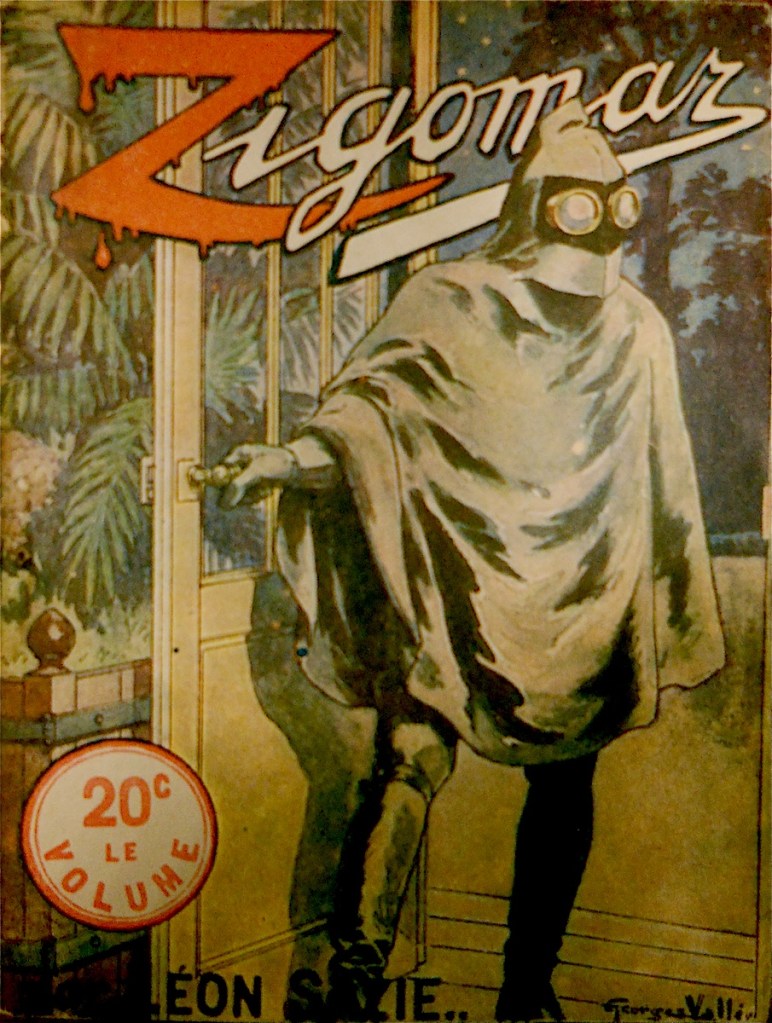
Zigomar by Léon Sazie, issue 13. Paris: J. Ferenczy, copyright 1909-1910 (n.d.). Cover illustration by Georges Vallée. Collection: Bibliothèque des littératures policières, Paris.
Zigomar is a redoubtable villain who poisons, kidnaps, tortures, and murders victims, and marks the scenes of his heinous crimes with a bloody “Z” signature. He commands the bande de Z (“Z gang”), a secret criminal brotherhood cloaked in cagoule rouge (red hood and robe) to carry out his evil plans. They obey le Maître (“The Master”) unquestioningly, pledging loyalty and life to him with the rallying cry, “Z’a la vie, Z’a la mort!” (“For better or worse, until death!”).
Opposed to the malevolent Zigomar, the upright and indefatigable Sûreté Inspector Paulin Broquet tracks down the criminal and his gang. Unlike rogue detectives in the mold of Vidocq, virtually indistinguishable from criminals, Broquet is a well-heeled and refined investigator, “a perfect gentleman.”[3] While Broquet often foils Zigomar’s nefarious plans and “saves the day,” repeatedly the archvillain eludes his grasp and continues to execute atrocious crimes.
Readers went wild for Zigomar. So much so, that publisher Joseph Ferenczi quickly obtained the rights to Sazie’s feuilleton novel and republished it in twenty-eight small format fascicules (booklets), each 128 pages in length and individually priced at 20 centimes per volume. These were not self-contained adventures, like those in Nick Carter or Nat Pinkerton magazines, but simply chunks from the feuilleton serial that would end abruptly on the final page — mid-story, mid-paragraph, or even mid-sentence — and would continue in the next issue. Silent-film director Victorien Jasset quickly jumped in and released a series of Zigomar crime movies: Zigomar (1911), Zigomar contre Nick Carter (1912), and Zigomar peau d’anguille (“slippery as an eel,” 1913).[4] A decade later, Sazie and Ferenczi teamed up to publish Zigomar contre Zigomar (“Zigomar versus Zigomar”), a sequel series of eight magazines, each story thirty-two pages long, that pit Zigomar and the Z gang against one another.[5]
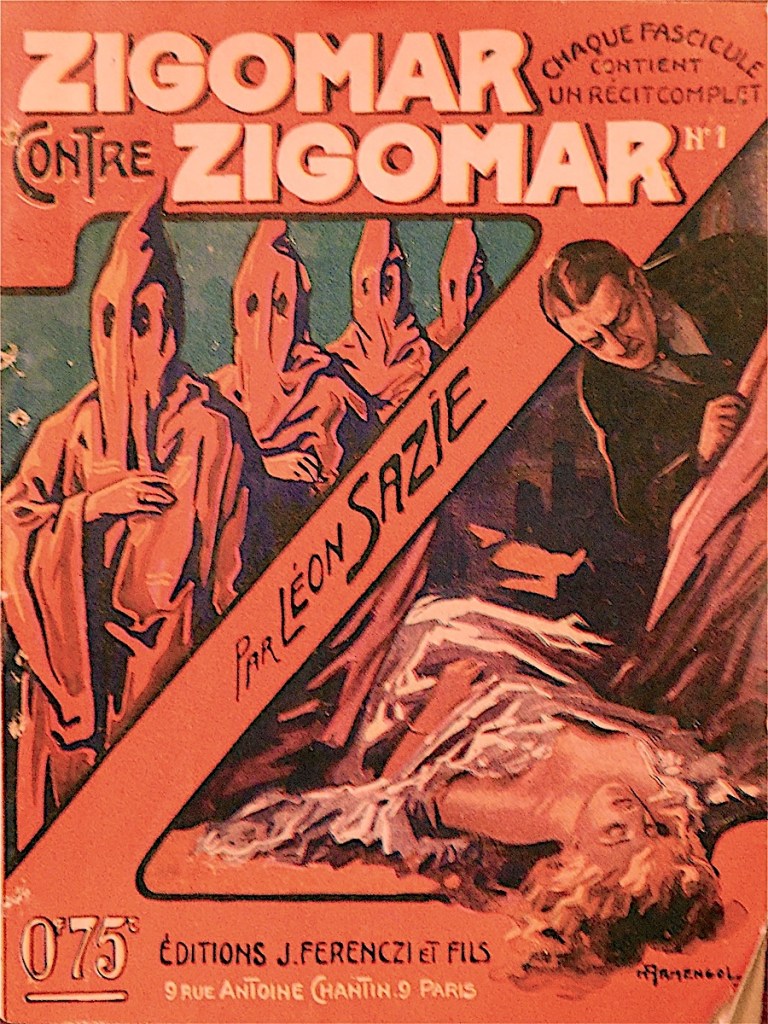
Zigomar contre Zigomar by Léon Sazie, Issue 1. Paris: J. Ferenczy, 1924. Cover illustration by Henri Armengol. Collection: Bibliothèque des littératures policières, Paris.
The popularity of Zigomar compelled commercially competitive publisher Arthème Fayarard II to produce his own crime and detective series. In 1905, Fayard had launched Le Livre Populaire, a collection of popular novels guaranteed to be over three-hundred pages in length and priced at sixty-five centimes (the equivalent of a week’s worth of daily newspapers). To date, the collection reissued popular nineteenth-century novel series, such as Eugène Sue’s Les Mystères de Paris, Ponson du Terrail’s Rocambole, Paul Féval’s Les Habits Noirs, and Émile Gaboriau’s Monsieur Lecoq.
With Fantômas, Fayard upped the ante. On April 29, 1910, he signed a contract with Pierre Souvestre, a journalist who had recently turned to writing popular fiction, to put together a series of twenty-four romans policiers (“detective novels”) that featured recurring characters and would be issued in consecutive months. Souvestre and co-author Marcel Allain decided to name the series after its criminal antagonist, “Fantômas.”[6] The other core series characters were Sûreté Detective Juve, journalist Jérôme Fandor, and Hélène, the daughter of Fantômas (who was added later).
Fantômas was a resounding financial success for the Fayard. An advance advertising campaign heralded the series launch, with the price of the first novel slashed from sixty-five to thirty-five centimes. The number of titles issued in the Fantômas series ultimately exceeded the terms of the original contract, thirty-two novels in as many months, yielding an unprecedented run of five million copies.[7] Co-authors Pierre Souvestre and Marcel Allain profited handsomely as well, starting from a contractually guaranteed minimum of 2,000 francs per volume (an entire year’s income for most French workers) and then negotiating better terms as the series unfolded. With the exception of the initial anonymously illustrated book cover, in-house Livre Populaire illustrator Gino Starace designed the color covers for the entire series.
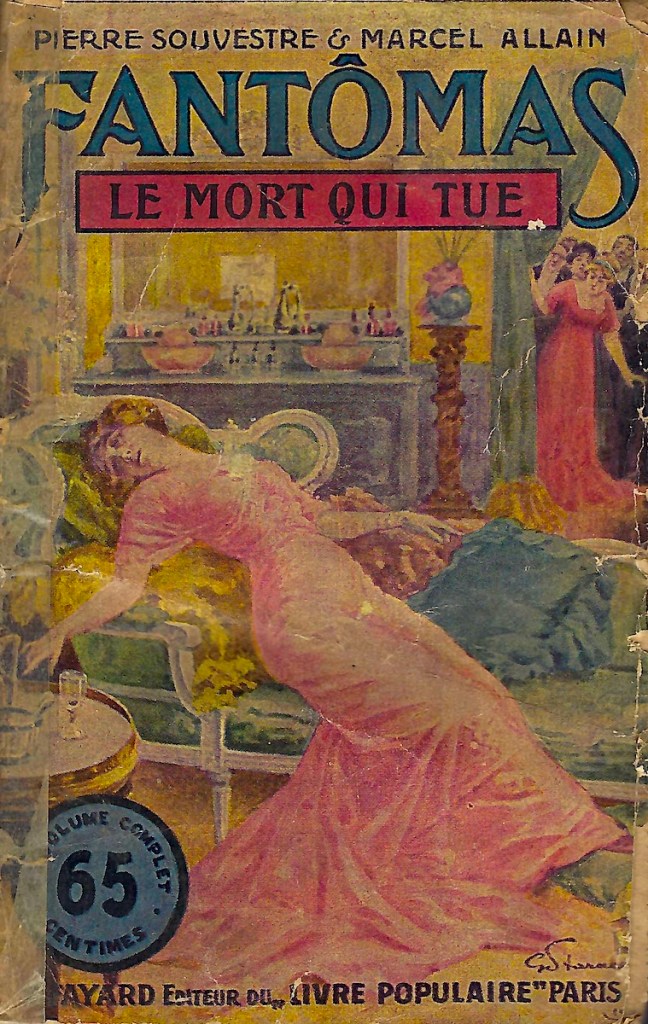
Le Mort qui tue (“The Murderous Cadaver”) by Pierre Souvestre and Marcel Allain, vol. III. Cover illustration by Gino Starace. Paris: Arthème Fayard, 1911. Author’s Collection. Fantômas has drugged the Russian Princess Sonia Dandidoff and stolen her jewelry for a second time.
In contrast to the episodic serial exploits of Zigomar, each volume in the Fantômas series promised readers un récit complet (“a complete story”). For the first third of the series, Souvestre and Allain wrote entirely self-contained novels. In the middle third, each novel continued to tell a complete story, but increasingly the plots emphasized interactions and conflicts between the core characters of Fantômas, Juve, Fandor, and Hélène. The final third more resembled the episodic Zigomar, with the action in each new title picking up where the previous book had left off.
To churn out novels over 380 pages in length every month, as required by contract, Souvestre and Allain adhered to a schedule. In the first week, they sketched out the basic plot. Over the next two weeks, they divided responsibilities for writing the chapters. For plot material, they cribbed from other works of detective and crime fiction, immediately and notably Zigomar, and sensationalist faits divers newspaper reports. They also let their imaginations run wild, setting aside reality and logic in favor of horrific and utterly implausible scenarios. In the final week, they reviewed and edited copy, wrote transitions to get in and out of each other’s chapters, conveyed a dramatic scene to Gino Starace to illustrate the cover, and submitted the completed manuscript to Fayard.
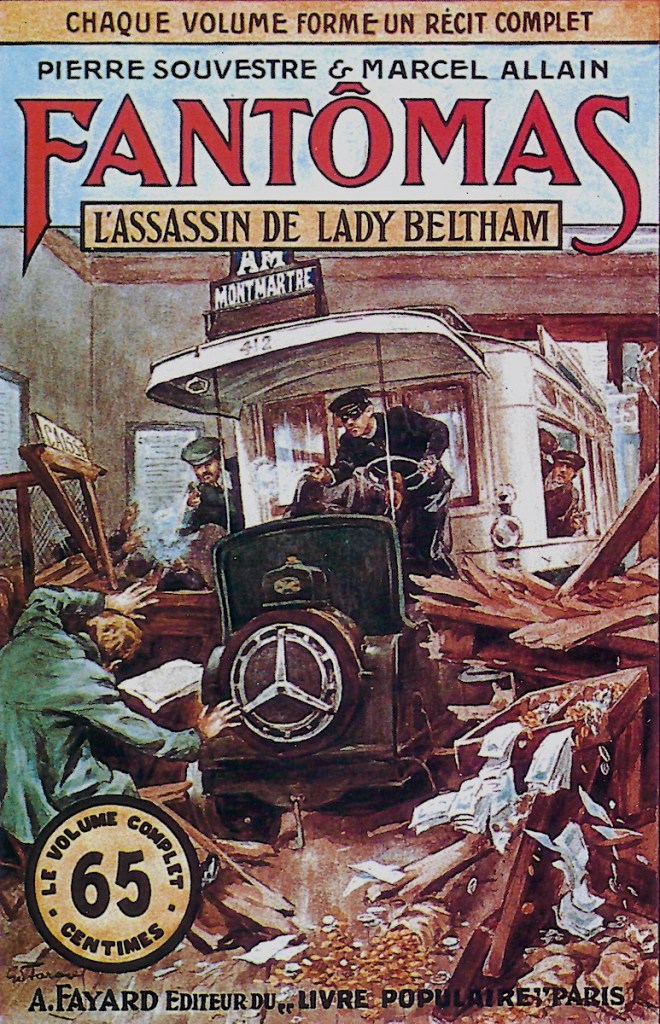
L’Assassin de Lady Beltham (“Lady Beltham’s Murderer”) by Pierre Souvestre and Marcel Allain, vol. XVIII. Cover illustration by Gino Starace. Paris: Arthème Fayard, 1912. Public Domain: Wikimedia Commons. Inspired by the dramatic heists of the Bonnot anarchists reported in the fait-divers press, Fantômas and his gang crash a trolly into a bank.
What foremost attracted readers to the series was the character of Fantômas — Maître de l’Éffroi (“Lord of Terror”), Empereur du Crime (“Emperor of Crime”), Génie du Mal (“Evil Genius”). Across the series, the archcriminal adopts multiple and disparate identities, crossing class lines and national boundaries. Most frequently, his aliases come from the upper-crust mondain professional, aristocratic, diplomatic, and military ranks of society, including: businessman Etienne Rambert, Belgian surgeon Dr. Chaleck, banker Nanteuil, German ambassador Baraon de Naarboeck, the Marquis de Serac of Hesse-Weimar, English soldier Gurn, American detective Tom Bob, Paris-Galeries director Chapelard, London dentist Dr. Garrick, interrogating magistrate Pradier, Russian naval officer Ivan Ivanovich, Tsar Nicholas II, Jockey Club member Count Mauban, and circus director Barzum.
About one-third of the time, Fantômas assumes an alias from the criminal milieu, such as gang leader Loupart, swindler Père Moche, concierge Madame Ceiron, blackmailing street accordionist Vagualâme, and “primitive man” vagrant Ouaouaoua. He also puts in appearances as peripheral characters, such as an actor, apache thug, butler, hospital nurse, maître d’ hotel, taxi driver, and other minor parts. When not in disguise, Fantômas is l’homme noir, the “man in black” dressed in hood, black tights, and cape, with an athletic build but without distinguishing features. Always, he is L’Insaisissable (“The Unseizable”), an evasive criminal phantasm that cannot be stopped.
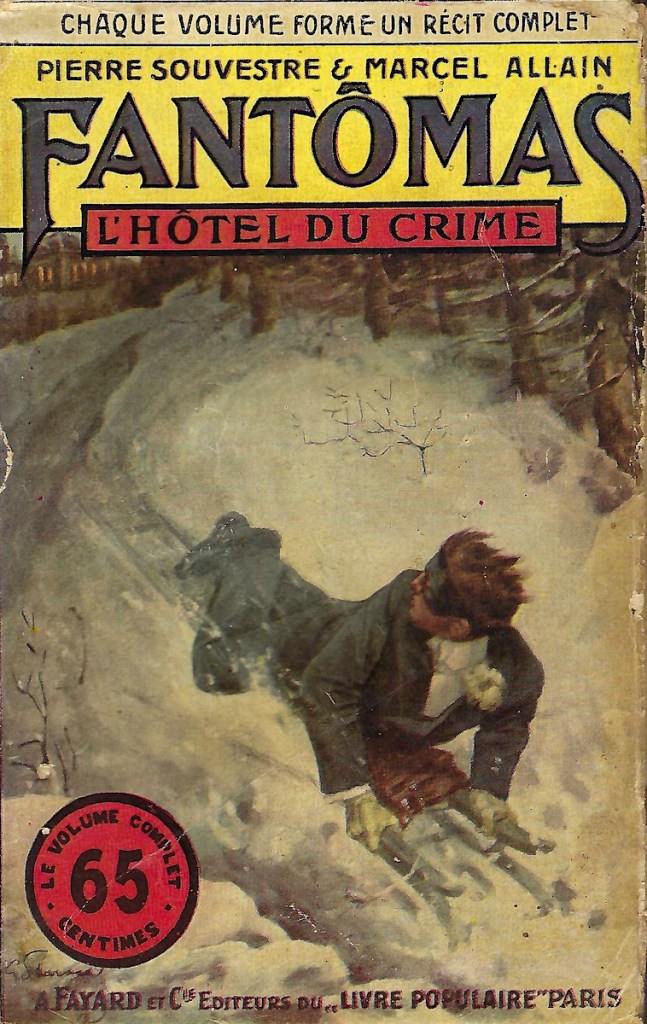
L’Hôtel du crime (“Crime Hotel”) by Pierre Souvestre and Marcel Allain, vol. XXX. Cover illustration by Gino Starace. Paris: Arthème Fayard, 1913. Author’s Collection.
Unlike Arsène Lupin, Fantômas is no gentleman. Although occasionally outfitted in formal attire, he is a brutal and sadistic archvillain whose horrific violence surpasses understanding. Fantômas crashes passenger trains head on. He tricks out a department store with poisoned perfume aspirators, shoes lined with broken glass, and gloves laced with toxic chemicals, maiming and killing scores of shoppers. He releases plague-infected rats on a cruise ship, leaving passengers to howl in agony and scurry around the decks, while withholding the serum for himself. He sets off bombs in an employment agency, splattering maids awaiting placements with blood and gore.
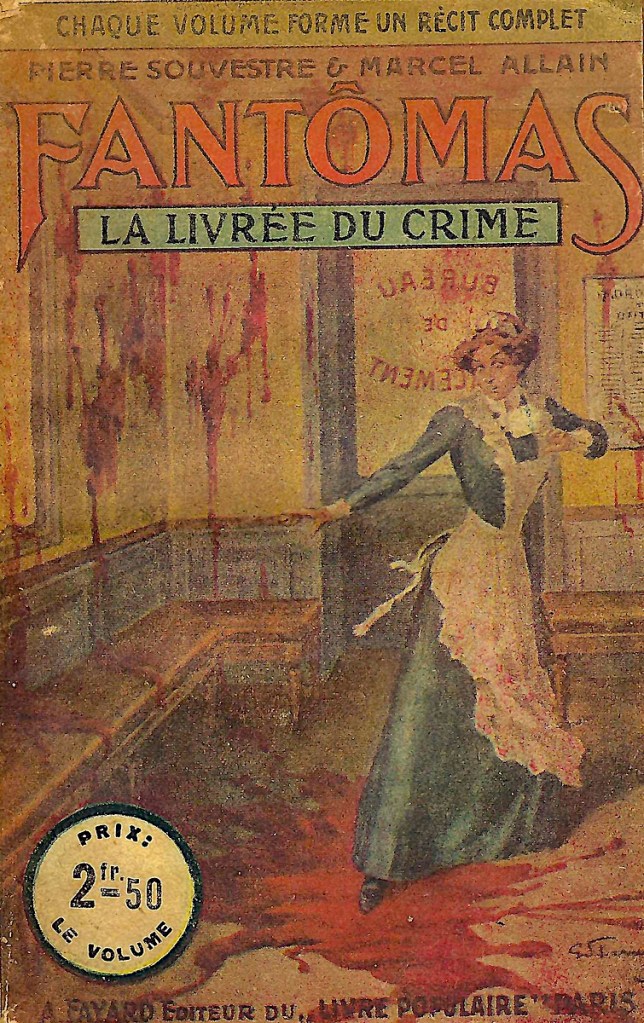
La Livrée du crime (“Crime’s Employment Agency”) by Pierre Souvestre and Marcel Allain, vol. XIII. Cover illustration by Gino Starace. Paris: Arthème Fayard, 1912 (1920s reprint). Author’s Collection.
To assist in carrying out his diabolical schemes, Fantômas commands a gang from la pègre, the “lazy” criminal underworld, with monikers like Beaumôme (“Pretty Boy”), Bec de Gaz (“Gaslighter”), Œil de Bœuf (“Bull’s Eye”), and Bedeau (“Gascon”). Fantômas also exercises control over the tormented Lady Beltham, his mistress and the widow of Lord Beltham, who vacillates between submitting to her criminal lover’s demands and assisting Juve and Fandor in their attempts to capture him.
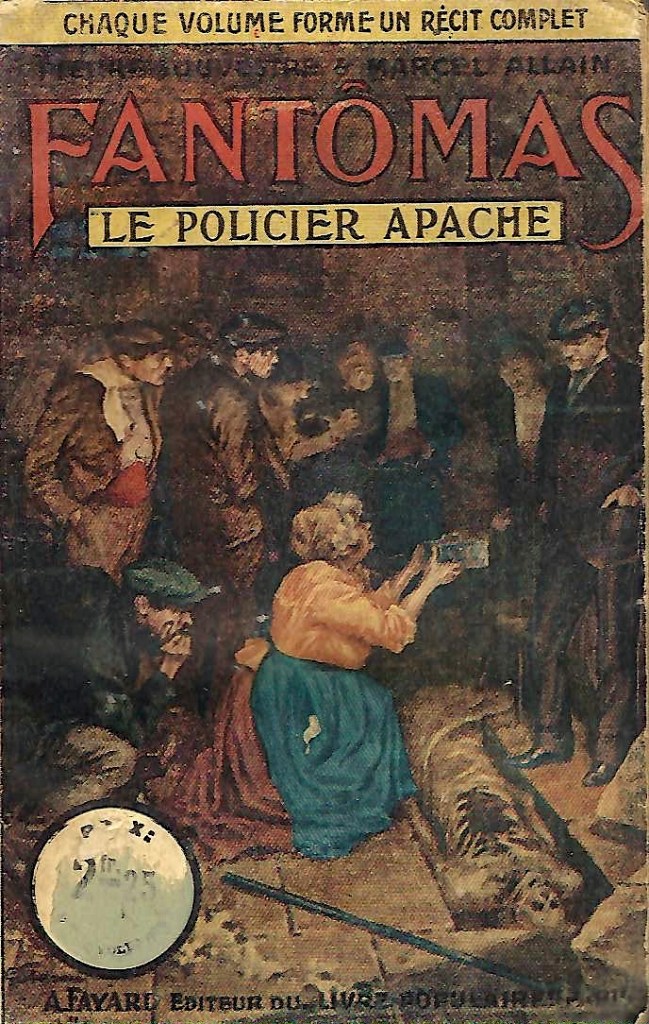
Le Policier Apache (“The Thug Policeman”) by Pierre Souvestre and Marcel Allain, vol. VI. Cover illustration by Gino Starace. Paris: Arthème Fayard, 1911 (1920s reprint). Author’s Collection.
For those who oppose him, Fantômas metes out brutal punishments. After being double-crossed by a minion, he places the traitor face up in a guillotine to witness his own execution. Believing his whereabouts have been betrayed by laundress Blanche Perrier, he catches her hair in the mechanized rollers of a washing machine, scalping her alive and flaying the skin from her face. After a henchman retrieves a jewelry box from a church bell tower, Fantômas strands him upon the enormous bell clapper. As soon as Fantômas realizes the box is empty and he has been deceived, the hour sounds and the perfidious accomplice is bashed to a bloody pulp as diamonds and rubies, stashed in the lining of his coat, rain upon the street below.
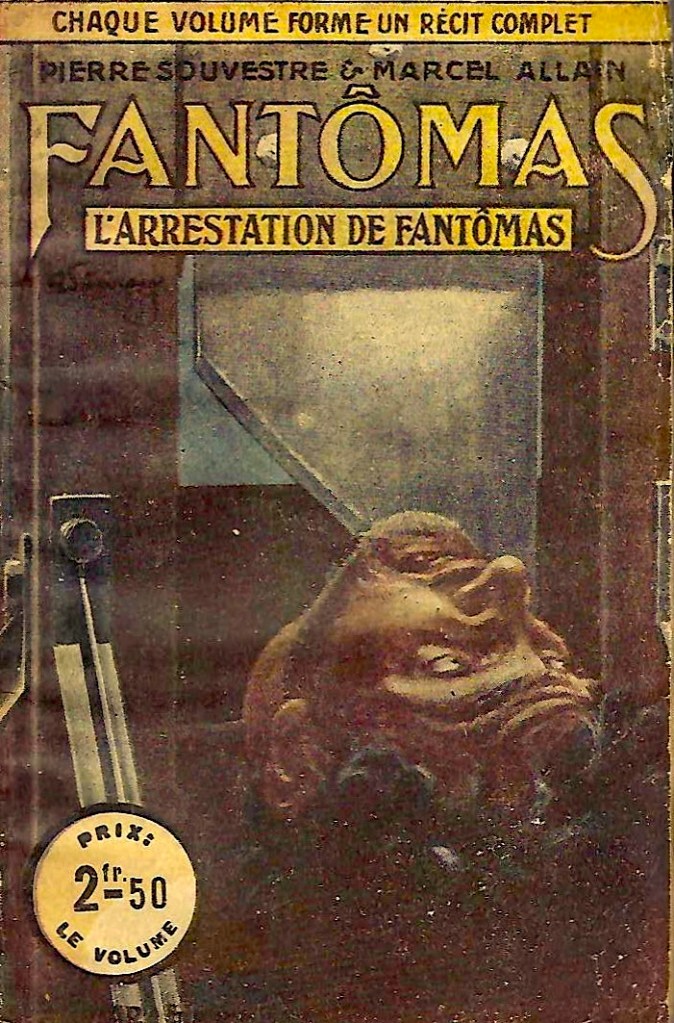
L’Arrsetation de Fantômas (“Fantômas Arrested”) by Pierre Souvestre and Marcel Allain, vol. XI. Cover illustration by Gino Starace. Arthème Fayard, 1911 (1920s reprint). Author’s Collection.
Sûreté Inspector Juve’s obsession with Fantômas is all-consuming. Like his nemesis, Juve is a master of disguise, and he engages in various ruses and aliases in pursuit of the archvillain. Juve’s intimate knowledge of his adversary is so uncanny, that sometimes Sûreté superiors arrest him for being Fantômas. He even imprisons himself on occasion to uncover the malefactor’s evil designs. From time to time, Juve manages to arrest Fantômas, but in short order the villain escapes. Yet whether it’s Fantômas or Juve who has been imprisoned, upon release the criminal and detective immediately resume their perpetual struggle against one another.
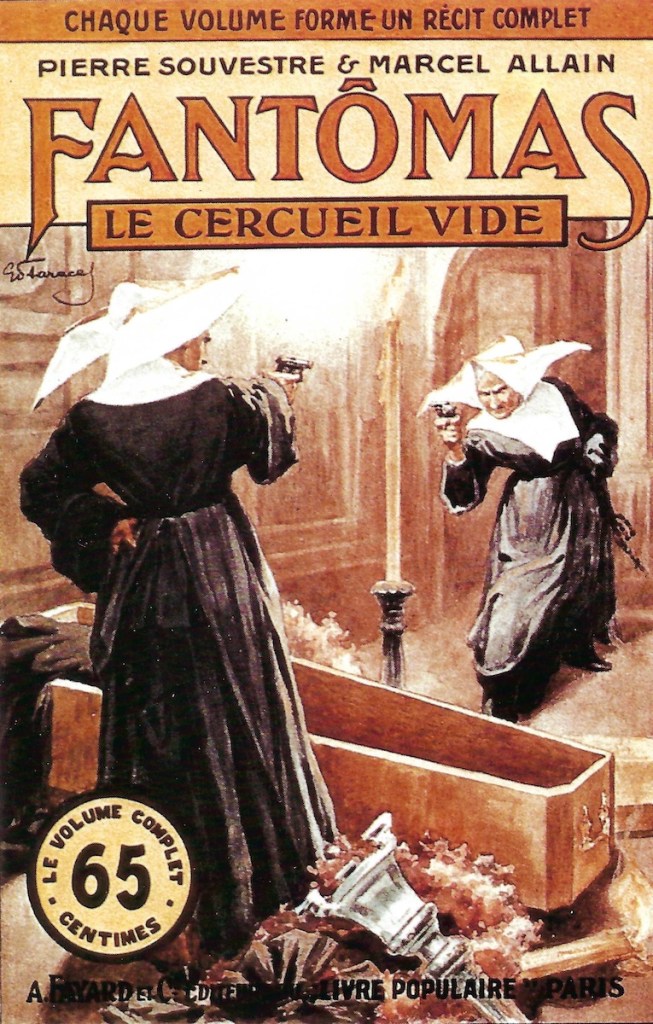
Le Cerceuil vide (“The Empty Coffin”) by Pierre Souvestre and Marcel Allain, vol. XXV. Cover illustration by Gino Starace. Paris: Arthème Fayard, 1913. Public Domain: Wikimedia Commons. In nun drag, Fantômas and Juve exchange gun fire.
Reporter Jérôme Fandor assists Juve in the quest to apprehend Fanômas. In the first Fantômas novel, Charles Rambert, the son of businessman Étienne Rambert and whose mother Alice is sequestered in a lunatic asylum, is arrested for the murder of Marquise de Langrune. Inspector Juve subjects young Charles to a test on a “dynamometer” invented by Bertillon, and he declares the young man incapable of having severed the Marquise’s neck with a single blow.[8] Renamed Jérôme Fandor by Juve, he becomes a journalist for La Capitale newspaper. Henceforth an inseparable duo, the senior detective and his athletic junior partner dedicate themselves to defeating Fantômas.
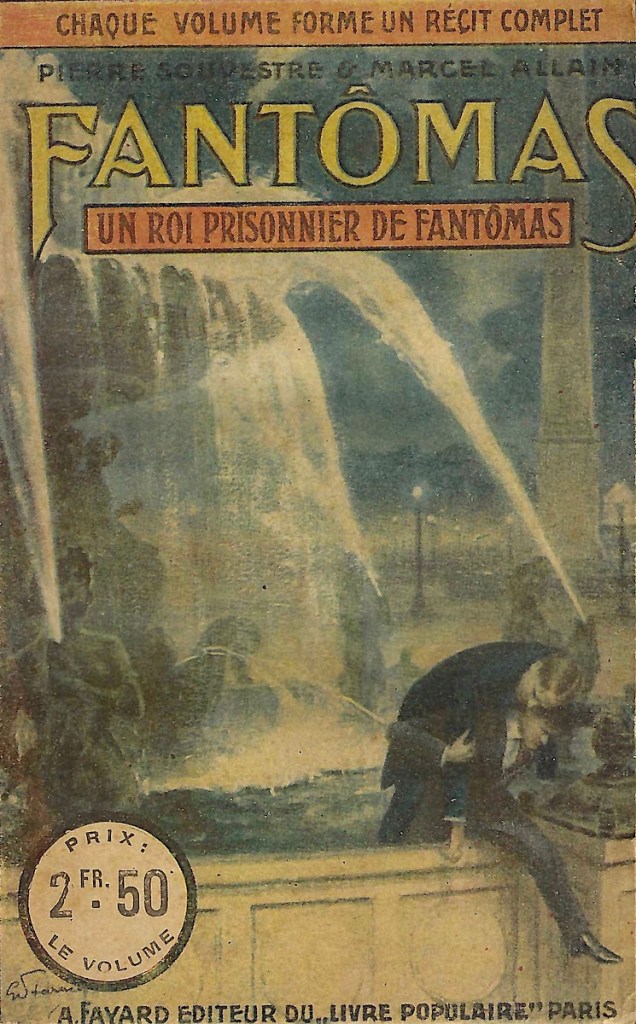
Un Roi prisonnier de Fantômas (“A Royal Prisoner of Fantômas”) by Pierre Souvestre and Marcel Allain, vol. V. Cover illustration by Gino Starace. Paris: Arthème Fayard, 1912 (1920s reprint). Author’s Collection. Juve saves Fandor from drowning in the fountains at the Place de la Concorde in Paris.
Hélène, the daughter of Fantômas, joined the core cast of characters in the eighth novel of the series, La Fille de Fantômas. She detests her criminal father, but as a dutiful daughter is bound to him. She distrusts Juve, but in the name of justice assists him from time to time. Intimately, she harbors unrequited love for Fandor, yet adopts numerous aliases to evade their union. These tensions in Hélène remain largely unresolved throughout the series, although over time increasingly she repudiates her father and grows closer to Fandor.
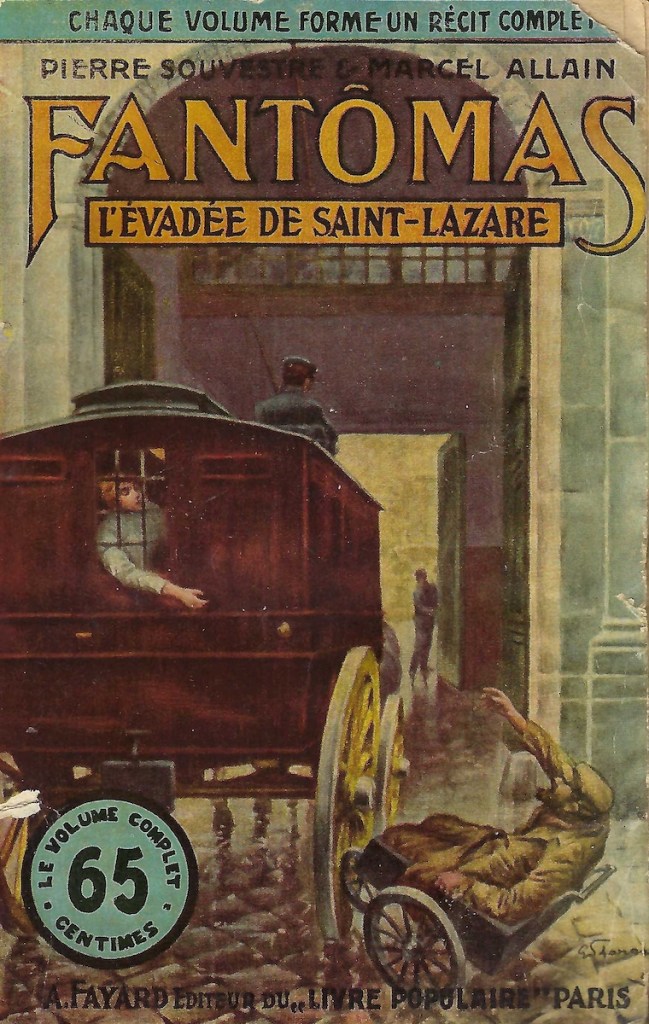
L’Évadée de Saint-Lazare (“The Escapee from Saint-Lazare”) by Pierre Souvestre and Marcel Allain, vol. XV. Cover illustration by Gino Starace. Paris: Arthème Fayard, 1912. Author’s Collection. Hélène tosses a note to Fandor, disguised as a cul-de-jatte (legless beggar), as she is being taken into the Saint-Lazare women’s prison.
In September 1913, Souvestre and Allain brought the series to a conclusion with La fin de Fantômas (“The End of Fantômas”). In the final chapters of the novel, Juve, Fandor, and Hélène have booked passage on the transatlantic ocean liner Gigantic.[9] Juve is convinced Fantômas is on board and plans to take command of the ship. Then catastrophe strikes when the Gigantic hits an iceberg, the outer hull is breached, and seawater rushes in. The lights go out, the ship submerges into icy waters, and passengers, including Hélène and Fandor, are loaded into lifeboats. Inside the doomed vessel, Fantômas and Juve chance upon each other in the corridor and take refuge in a cabin. As the water rises to engulf them, the criminal reveals to the detective they are twins. “Juve, my brother… Forgive me!”[10]
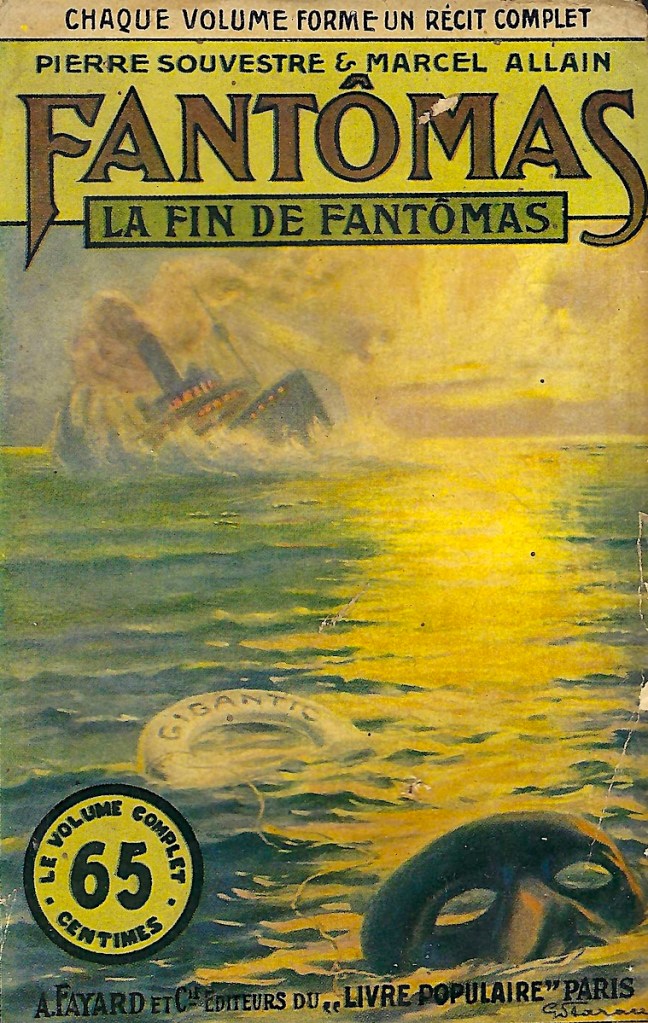
La Fin de Fantômas (“The End of Fantômas”) by Pierre Souvestre and Marcel Allain, vol. XXXII. Cover illustration by Gino Starace. Paris: Arthème Fayard, 1913. Author’s Collection.
FURTHER READING
The first seven novels in the Fantômas series were published in abridged English translations by Stanley Paul (London) and Brentano’s/Macaulay (New York): Fantômas (1915), The Exploits of Juve (1917), Messengers of Evil (1917), A Nest of Spies (1917), A Royal Prisoner (1918), The Long Arm of Fantômas (1924), and Slippery as Sin (1920). All are in the public domain and may be read and downloaded for free (e.g., Project Guttenberg, Internet Archive), or purchased in reprint and on-demand editions. More recently, additional Fantômas titles have been published in English translation by Black Coats Press (Encino, CA): The Daughter of Fantômas (adapted by Mark Steele, 2006) and The Death of Fantômas (vols. XXXI and XXXII, adapted by Sheryl Curtis, 2017).
SOURCES
Alfu, L’Encyclopédie de Fantômas (Paris: Autoédition, 1981).
Alfu, Patrice Caillot, and François Ducos, Gino Starace, l’illustrateur de “Fantômas” (Amiens: Encrage, 1987).
Loïc Artiaga and Matthieu Letourneux, Fantômas! Biographie d’un criminel imaginaire, series “Singulières Modernities” (Paris: Les Prairies Ordinaires, 2013).
Didier Blonde, Les Voleurs de visages. Sur quelques cas troublants de changement d’identité: Rocambole, Arsène Lupin, Fantômas, & Cie (Paris: Métailié, 1992).
Dominique Kalifa, “« Zigomar », grand roman sériel (1909-1913),” in Crime et culture au XIXe siècle (Paris : Perrin, 2005).
Léon Sazie, Zigomar, 28 fascicules (Paris: J. Ferenzy, copyright 1909-1910 [s.d.]).
Pierre Souvestre and Marcel Allain, Fantômas, édition intégrale, “Bouquins” in 8 vols. (Paris: Robert Laffont, 1987-1989, 2013-2015).
NOTES
[1] Pierre Souvestre and Marcel Allain, Fantômas (Paris: Éditions Arthème Fayard, 1911), p. 7. English translations throughout this post are by the author.
[2] Souvestre and Allain, Fantômas, p. 414.
[3] Zigomar no. 2 (Paris, J. Ferenzy, copyright 1909-1910 [n.d.]), pp. 109-110.
[4] Jasset’s Zigomar movies were distributed by Cinéma Éclair, Paris. While each is a full-length movie, the quasi-autonomous episodes were released variously in single or multiple reels. For a comprehensive account of the Zigomar movies, see Richard Abel, “The Rise of the Feature Film, 1911-1914,” in The Ciné Goes to Town: French Cinema 1896-1914, updated and expanded edition (Berkeley: University of California Press, 1998), pp. 358-361.
[5] Léon Sazie, Zigomar contre Zigomar, 8 issues (Paris: Éditions J. Ferenczi et fils, 1924).
[6] Marcel Allain later recalled that Souvestre and he originally named the character “Fantômus,” but Fayard misread their handwriting and turned the “u” into an “a.” Allain first recounted this story in an interview with journalist Pierre Scize, “49.280.00 lignes, c’est à quoi se monte la production d’un des auteurs de Fantômas,” Paris-Journal, June 20, 1924. As the next blog post will emphasize, as a biographer Allain was a self-interested and somewhat unreliable narrator.
[7] Histoire de la Librairie Arthème Fayard (Paris: Fayard, 1961), pp. 10-11. Fayard asserts Fantômas was most commercially successful series in the Livre Populaire collection.
[8] A hydraulic dynamometer measures the torque load required to move a dead weight. Bertillon actually invented a dynamometer to determine the amount of force required for breaking and entering through doors and windows, more a fantasy of police control than a practical application.
[9] This episode aboard the Gigantic is obviously modeled after the Titanic, which sank just the year before in 1912.
[10] Souvestre and Allain, La Fin de Fantômas (Paris: Éditions Arthème Fayard, 1913), p. 382.
Robin Walz © 2026


 Shady Detectives, Elegant Criminals & Dark Avengers
Leave a reply to Robin Walz Cancel reply