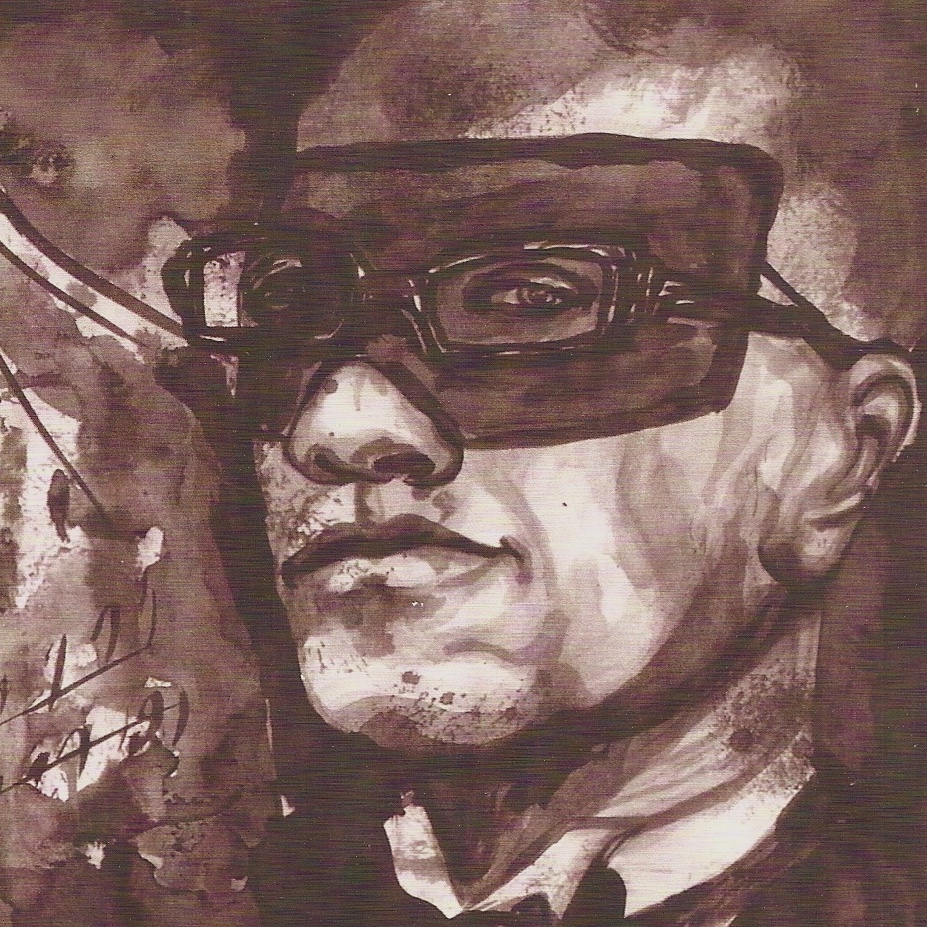
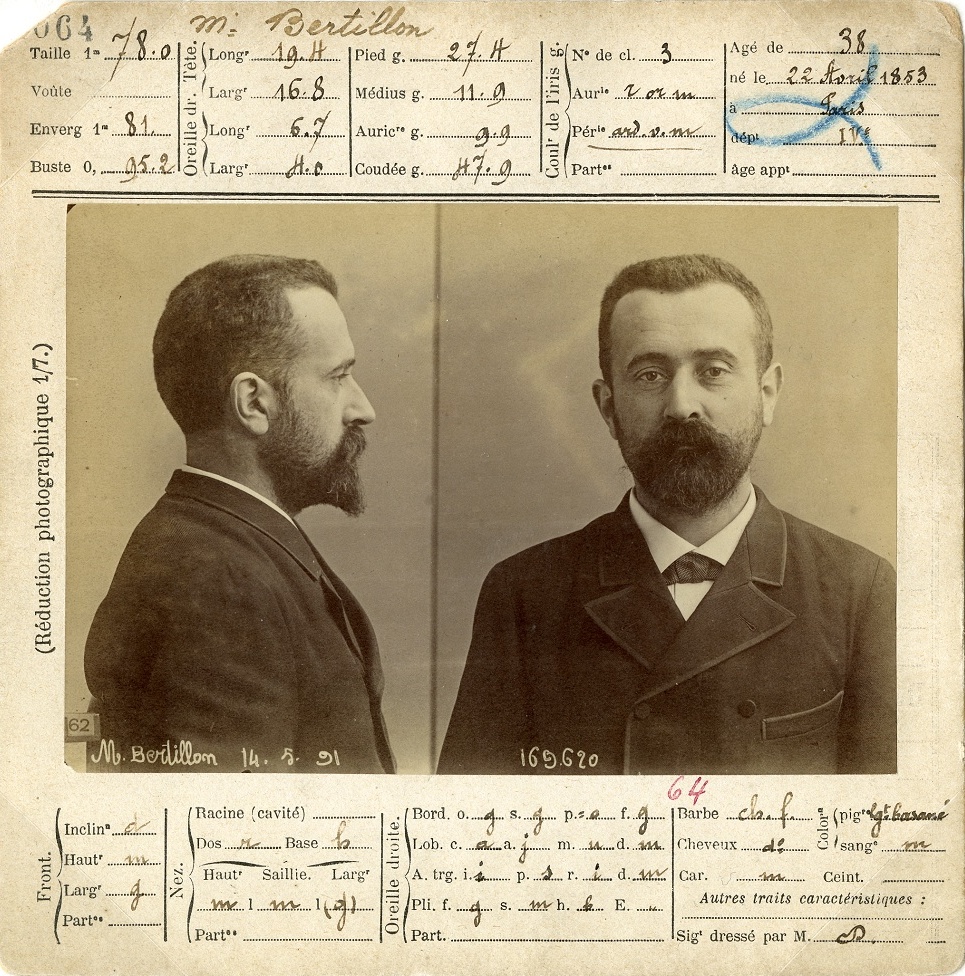
Sample portrait parlé (“talking portrait”) anthropometric identity card with Alphonse Bertillon’s self-portrait photo, May 14, 1891. Wikipedia Commons: Criminocorpus.org.
While Émile Gaboriau enhanced the image of the Paris police by creating the upright fictional Sûreté Detective Monsieur Lecoq, Alphonse Bertillon set out to reform actual practices at the Paris Prefecture of Police. Applying statistics to biometrics, Bertillon developed the anthropometric portrait parlé, or “talking portrait,” to identify criminal recidivists. Bone measurements, a profile and facial photo, and annotations on physical features were recorded on a fiche anthropométrique, a standardized identity notecard for each criminal suspect, which could be subsequently retrieved when cross-referenced against a collective card catalog.
In the 1880s, Bertillion’s anthropometric identification system was implemented in police departments throughout Europe and the United States. By the 1890s, however, it spiraled out of control, becoming increasingly complex, complicated, and unwieldy. What had started out as a simple set of measurements and cross-referencing had mushroomed into a morass of excessive information and annotations. In the early twentieth century, it was superseded by the much simpler method of fingerprint analysis.
Born on April 22, 1853, Alphonse was the second son in the bourgeois family of Dr. Louis-Adolphe Bertillion, from a family of Dijon vinegar producers, and Zoé Guillard, from a family of educators and ribbon manufacturers.[1] The earliest intellectual influences in his life came from his maternal grandfather, Achille Guillard, who studied human demography and statistics, and the craniologist Paul Broca, a close family friend. As a student, Alphonse was obstinate and performed poorly in his studies, with the exception of mathematics. After cycling through a series of lycée boarding schools, at age nineteen his father sent him to England to complete his education (“at least he’ll learn some English!”).
Returning to France for military service, Alphonse received training as an army physician and passed his first medical examination in 1876. After a bout with typhoid fever, he returned to Paris to convalesce. In 1879, his father pulled some strings to get his son a position copying police records at the Paris Prefecture of Police. Concurrently, Bertillon pursued studies in phrenology and ethnography at the École d’anthropologie (“School of Anthropology”) and completed his thesis on Les races sauvages (“The Savage Races”) in 1881.
Although the Paris Police Prefecture had compiled over 50,000 files on criminals, Bertillon found them useless in terms of recidivist identification. Arrested individuals were most commonly described as “average” and “ordinary.” Photographs attached to files were equally of limited use, as an arresting officer simply relied upon his memory to make a match. Bertillon also regarded the practice of arranging files alphabetically worthless, as criminals “change their names like a shirt.”[2]
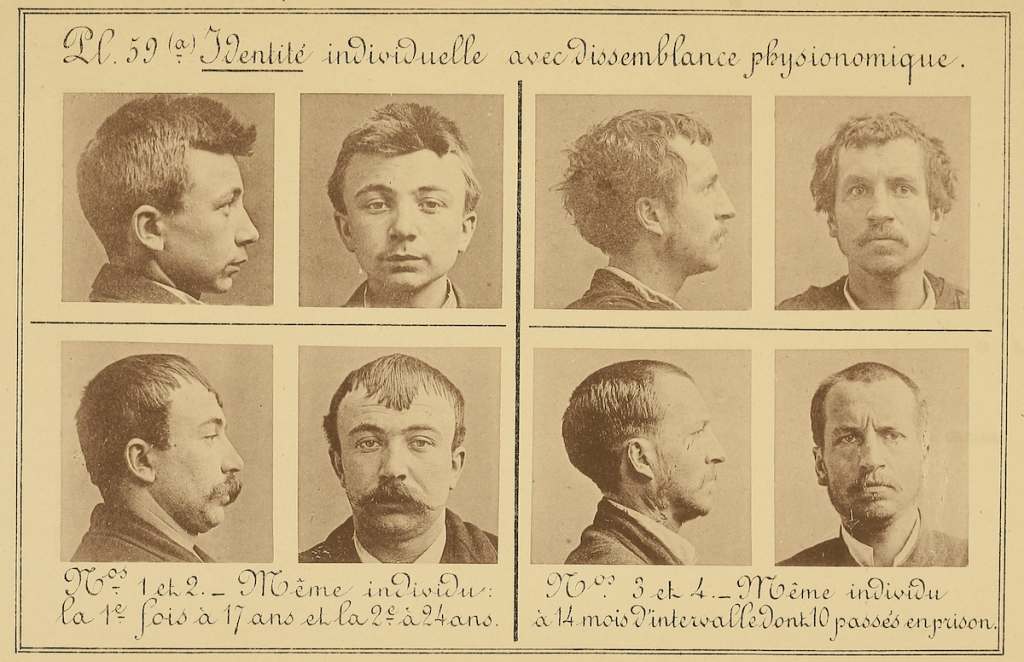
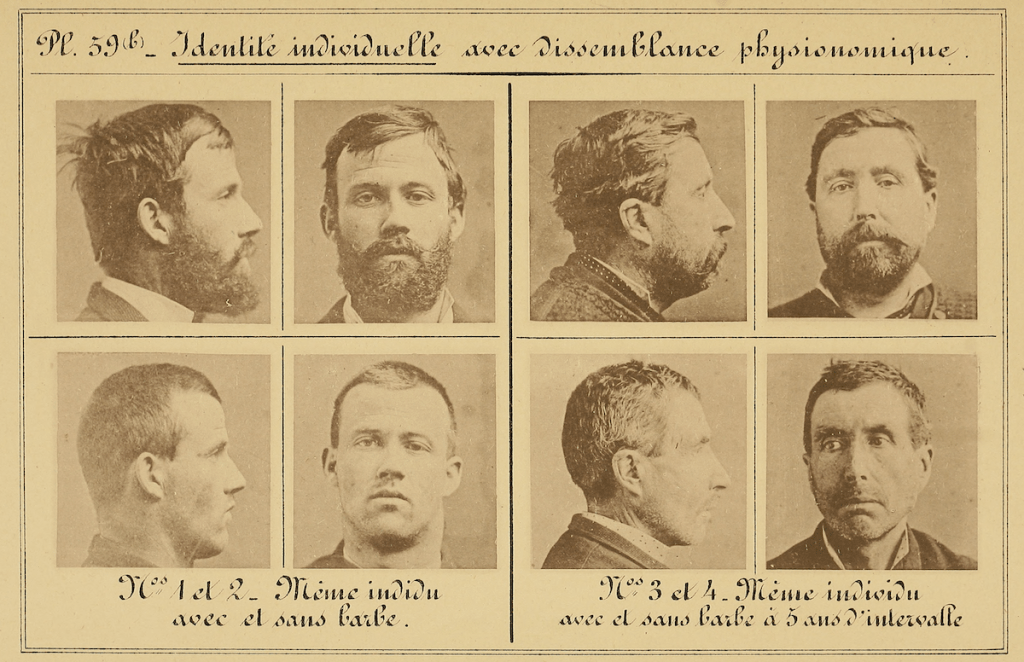
“The same individual with differences in physical appearance.” Plate 59(a): at ages 17 and 24 (nos. 1 & 2); after spending 14 months in prison (nos. 3 & 4). Plate 59(b): with and without a beard (nos. 1 & 2); with and without a beard after five-years (nos. 3 & 4). Wikimedia Commons: Identification Anthropométrique, Instructions Signalétiques (1893).
The solution to this mess, in Bertillon’s view, lay in gathering specific and standardized information on arrested individuals that could be disaggregated into categories in a collective catalog. By both photographing and completing a questionnaire on an individual at the time of arrest, and then comparing those details to the collective file of information already gathered by the police, a path towards the positive identification of criminal recidivists became possible.
From his training in physical anthropology, Bertillon thought skeletal measurements, which he believed remained fairly constant in individuals after 20 years of age (or even by age 16, but best to be conservative he advised), provided the best approach for collecting objective information. The first measurement, he proposed, should be height, divided into six categories, which distributed the 50,000 criminals currently on record into groups of 8,000 to 9,000 each. The head was subsequently measured, which reduced the number of individuals from the previous categories into groups of 1,200 to 1,300. A foot measurement came next, cutting each group down to about 250. More followed: the length of the middle finger, length of the upper leg, the height of the lower leg, with additional measurements as needed. After five or six measurements (with two additional ones, if a photograph was not provided), Bertillon concluded, 50,000 criminal records would be whittled down to twenty or thirty files the police could compare with an arrested suspect, making identification fairly easy.
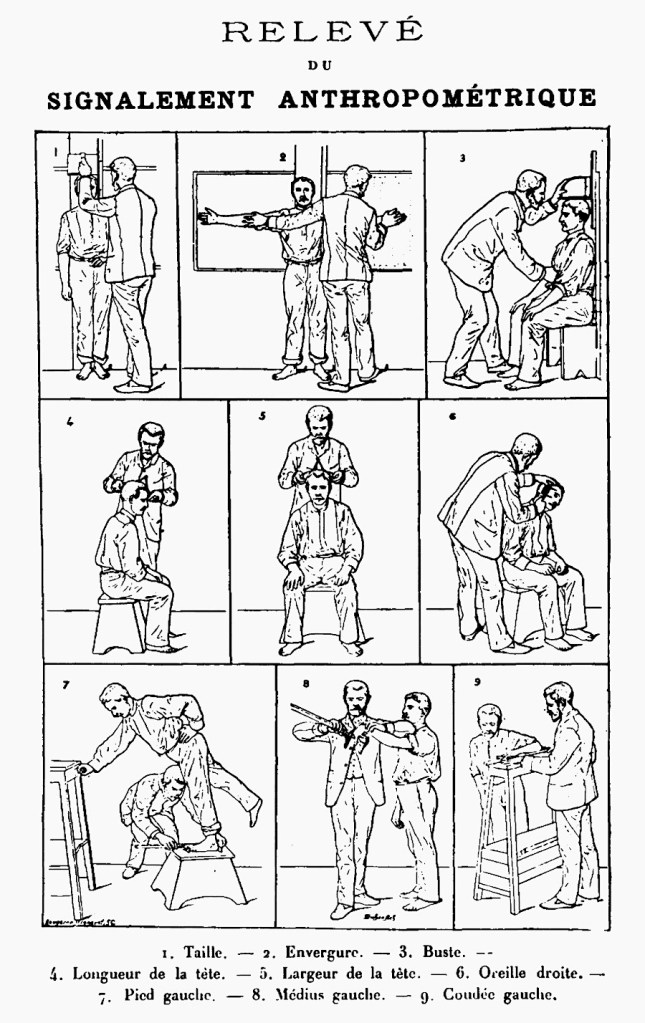
Sample Chart of Anthropometric Measurements: 1. Height, 2. Arm span, 3. Trunk, 4. Head length, 5. Head width, 6. Right ear, 7. Left foot, 8. Left middle finger, 9. Left forearm. In Alphonse Bertillon, Identification Anthropométrique, Instructions Signalétiques (1893).
On December 13, 1882, Bertillon successfully applied his anthropometric system to identify an unknown recidivist. In November 1885, he presented his anthropometric system at an International Penitentiary Congress in Rome. Earlier that year, Bertillon had published Identification anthropométrique, Instructions signalétiques (“Anthropometric identification, Instructions for defining physical features”), a concise application manual of 65 pages with 30 illustrations.
For the fiche anthropométrique individual identity card, Bertillon settled on seven bone measurements — height, head length, head width, length of the left middle finger, length of left foot, arm span — and the color of the left eye.[2] A collective file would organize the disaggregated measurements into categories of small, medium, and large in a collective catalog. Should the records within a single category become excessive, it could be subdivided yet again by three; e.g., the small category becomes large-small, medium-small, and small-small. And so the subdivisions could continue indefinitely, until each category contained a manageable number of records. In seven simple steps, Bertillon boasted, a pool of 100,000 persons could be reduced to nine individuals, whose identity could be easily established by comparing those identity cards to the arrested individual.
While Bertillon’s anthropometric system involved quite a bit of “fuzzy math,”[3] there was widespread agreement at the Rome conference that it paved a solid path toward recidivist identification. In 1888, Bertillon was made Chief of the Service de l’Identité Judiciaire (“Judicial Identity Services”) at the Paris Police Prefecture. His crowning achievement occurred in March 1892, when his system was used to positively identify the anarchist bomb thrower Ravachol.
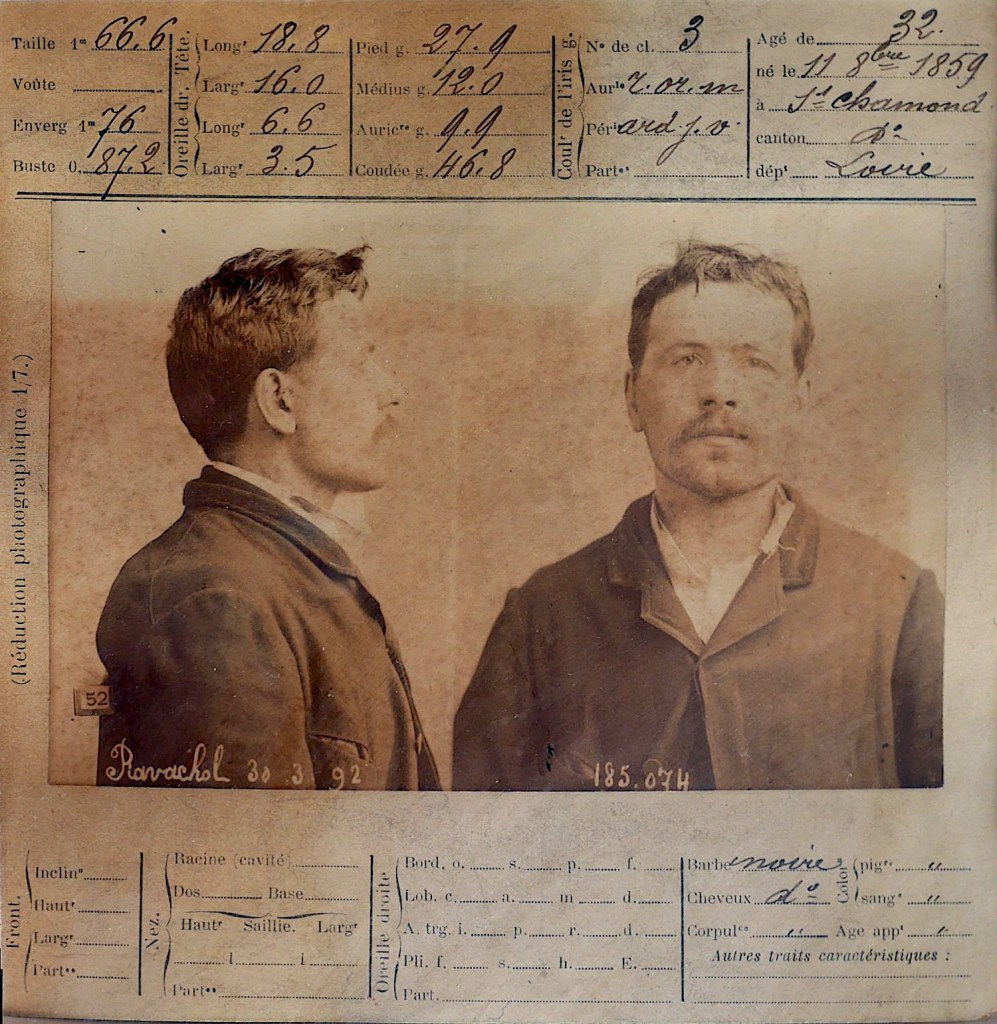
Anthropometric card for the anarchist Ravachol (François Claudius Koenigstein), March 30, 1892. Criminocorpus.org: Musée d’histoire de la justice, des crimes et des peines.
Anthropometric services were established in police departments across France and internationally. In the United States, a display of equipment used to photograph a detainee, as well as a crime scene, was included at the Chicago World’s Columbian Exposition of 1893.[4] The same year, the American Bertillon Prison Bureau was established at the State Penitentiary in Joliet, Illinois.
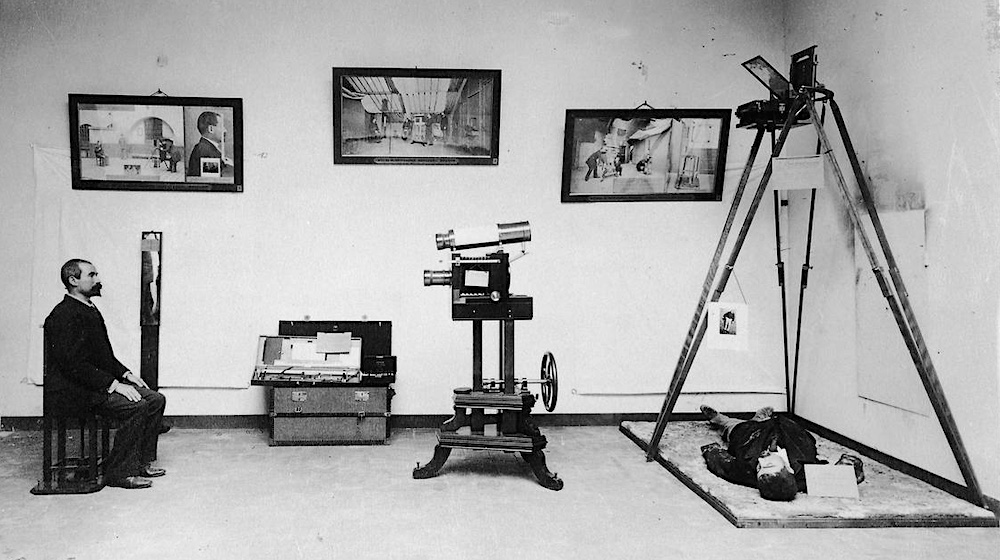
Anthropometric photography display from the Bertillon exhibition at the 1893 World’s Columbian Exposition in Chicago. Note the addition of a camera tripod on the right to photograph crime scenes. National Gallery of Canada, Ottawa. Visible Proofs: Forensic View of the Body: National Library of Medicine, Bethesda MD.
1893 also marks the year when Bertillon’s anthropometric method began to spin out of control. That year, he produced a new edition of Identification anthropométrique, Instructions signalétiques, “entirely reformulated and considerably augmented.” In the preface to the revised edition, Bertillon apologized for the brevity of the 1885 edition and boasted the new volume had three times the information and twice the illustrations (emphasis added).[5]
Basic anthropometric measurements remained the same, but now only constituted one-tenth of the text. The bulk of the book gave detailed instructions on how to describe a detainee’s face, profile, nose, ears, forehead, eyebrows, mouth, lips, chin, and eyes. Skilled technicians had to be trained on standardized terminology, abbreviations, and symbols to record these details. Observations about how a detainee was dressed and impressions about his social status were recorded as well. As a consequence, Bertillon’s “simple” anthropometric identification system became a phantasmagoria of esoteric markings.
The portrait parlé, the “talking portrait” identity card, became the centerpiece of Bertillon’s revised anthropometric method.[6] The information recorded on the 1885 card is concise. The front contained six anthropometric measurements and one eye notation, observations about distinctive features and physical anomalies, and a profile and face photo (if taken). The back of the card contained personal information: name, birthplace, profession, residence, identification documents, and previous arrests.
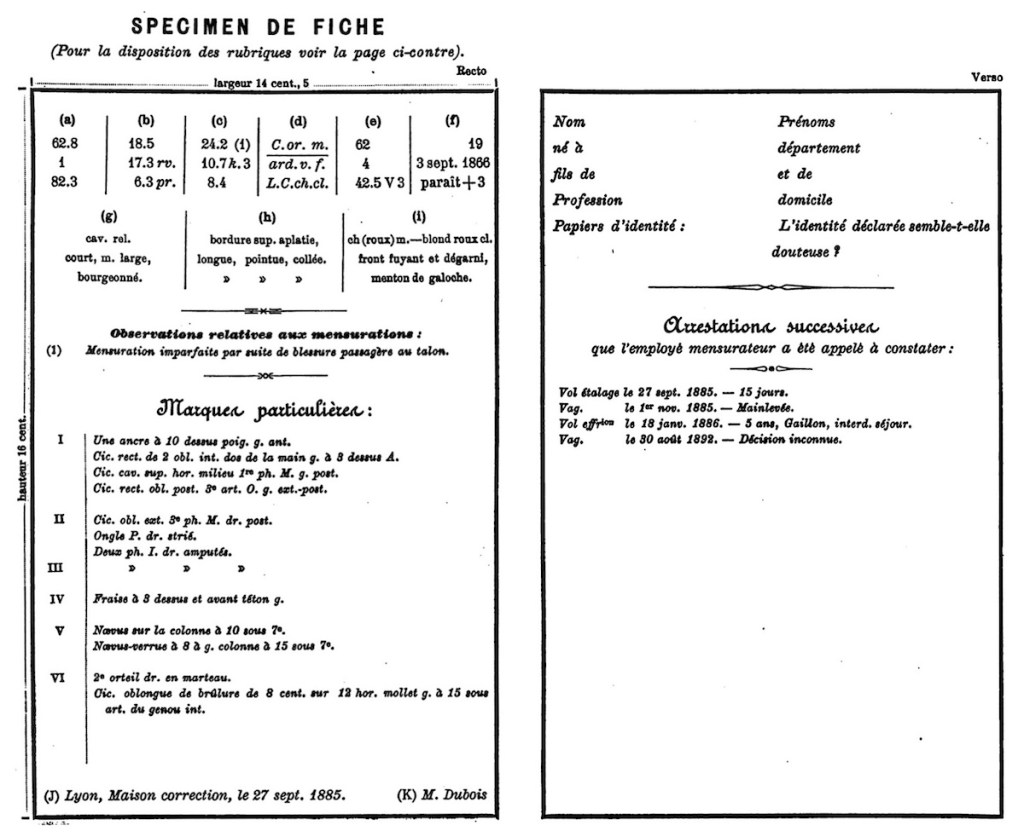
“Example of Identity Card Information” (1885).
By 1893, anthropometric bone measurements only constituted a small fraction of the information recorded on the individual identity card. By comparison, the portrait parlé (“talking portrait”) had been vastly expanded to include details about coloration (iris, hair, beard, skin pigmentation), profile and face (forehead, nose, right ear, lips, chin), hair characteristics (cut, volume, part), eye anomalies, shape of the mouth, wrinkles, body type, dress attire, attitude, allure, and diverse observations. The back of the card mostly remained the same.
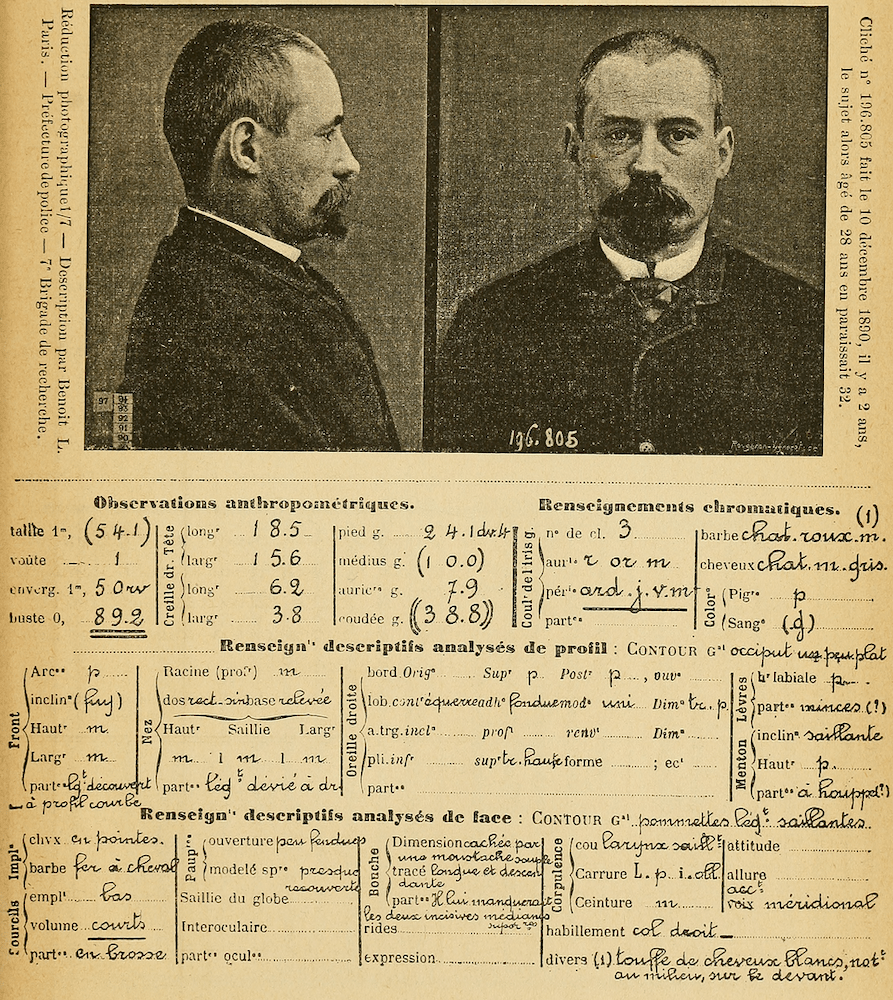
The revised portrait parlé individual identity card (1893).
Terms and abbreviations used to annotate the portrait parlé became more extensive as well. The 1885 edition contained a limited set of terms and abbreviations used to designate the hands, face, forehead slope, and additional notations (tattoos, posture, bone stiffness, boils, skin complexion).
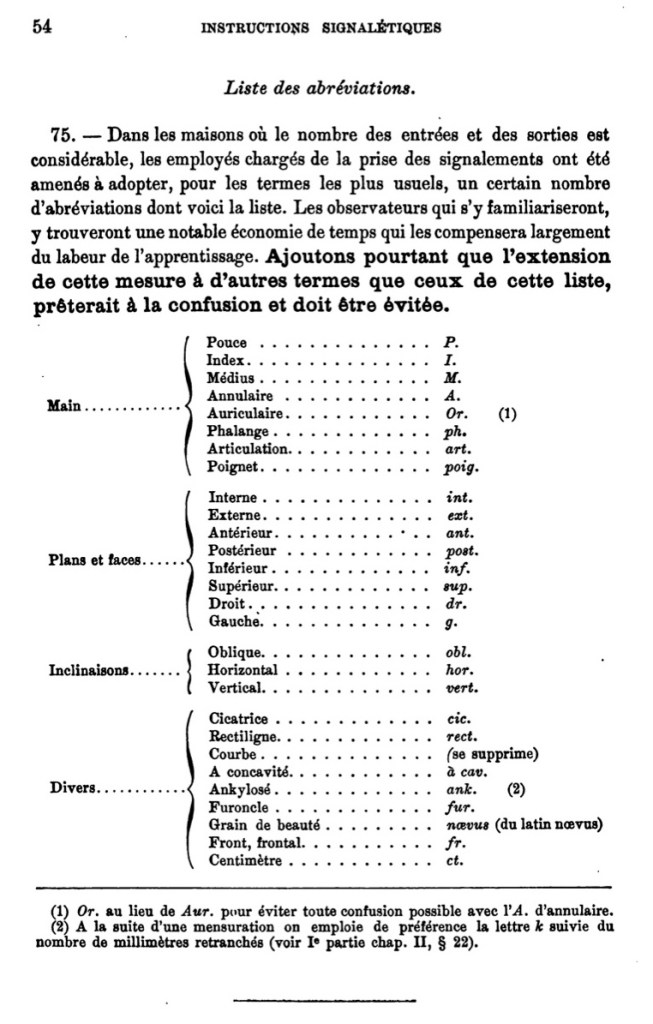
“List of Abbreviations” (1885)
Eight years later, the number of descriptive terms and annotations had increased substantially and were applied to dozens of locations on the body:
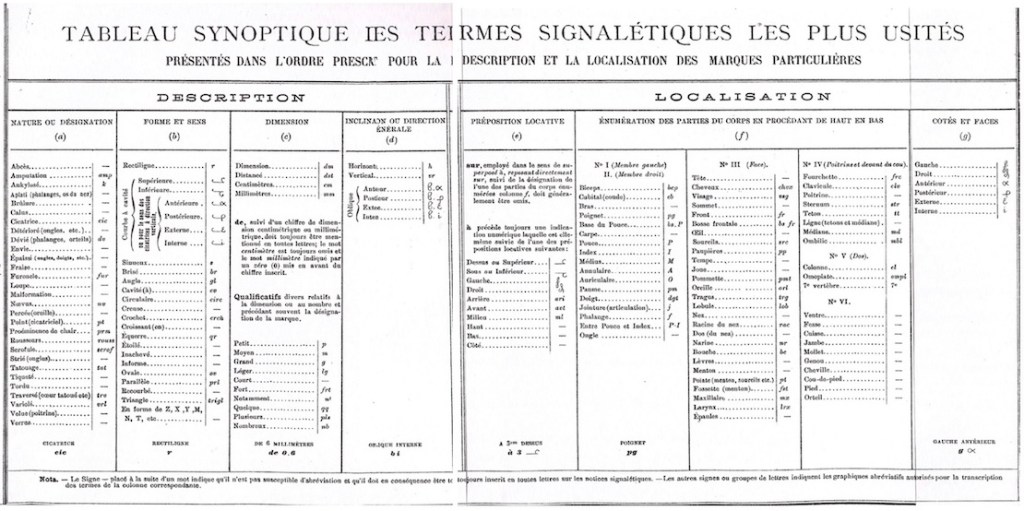
“Summary Table of Most Frequently Used Physical Feature Terms” (1893). Descriptive terms on the left, and body locations on the right.
In addition, anthropometric technicians had to be trained on how to record and read those descriptions in standardized abstract characters, according to over one hundred letters, abbreviations, and symbols .
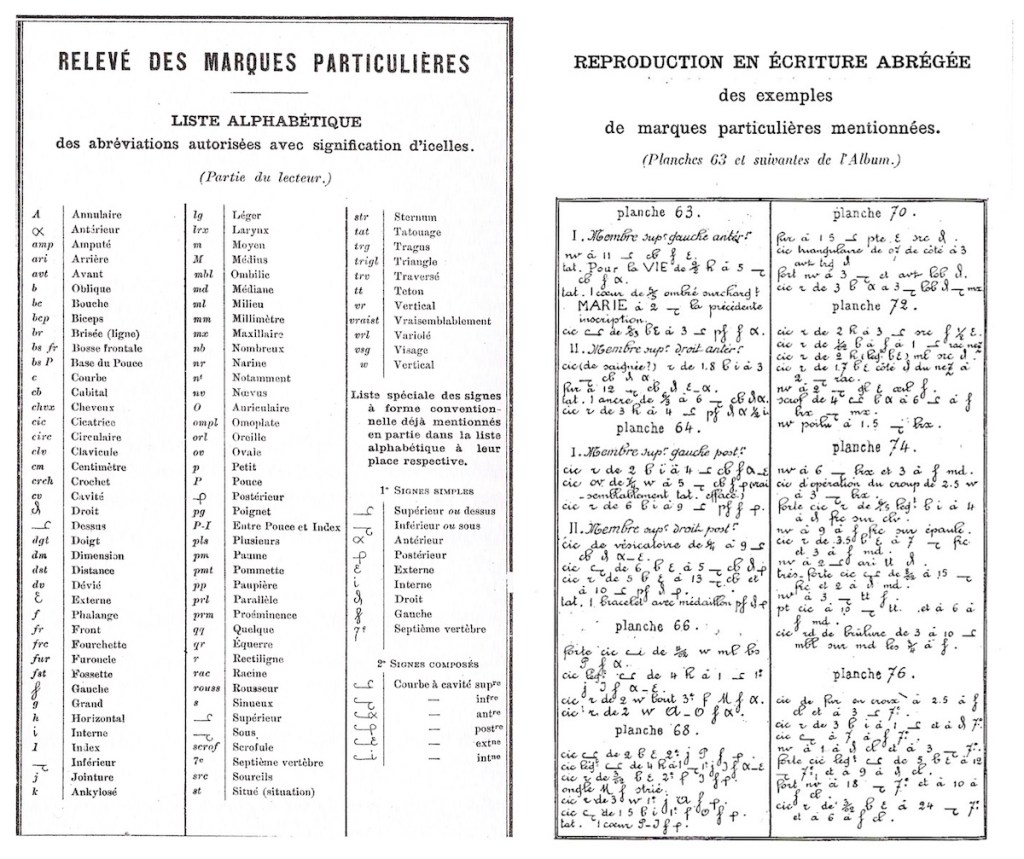
“Survey of Particular Marks” (1893). Left: alphabetical list of abbreviations and symbols used to annotate records. Right: summaries of individual records rendered entirely in abstract characters.
In the 1885 edition of Identification anthropométrique, Instructions signalétiques, Bertillion supplemented anthropometric measurements with observations about the left eye iris. Again, the initial observations were basic: the irises of individuals within the blue-eyed range were either solid or had a “whitish-halo,” while the irises of brown-eyed individuals varied by shade or mixed colors.
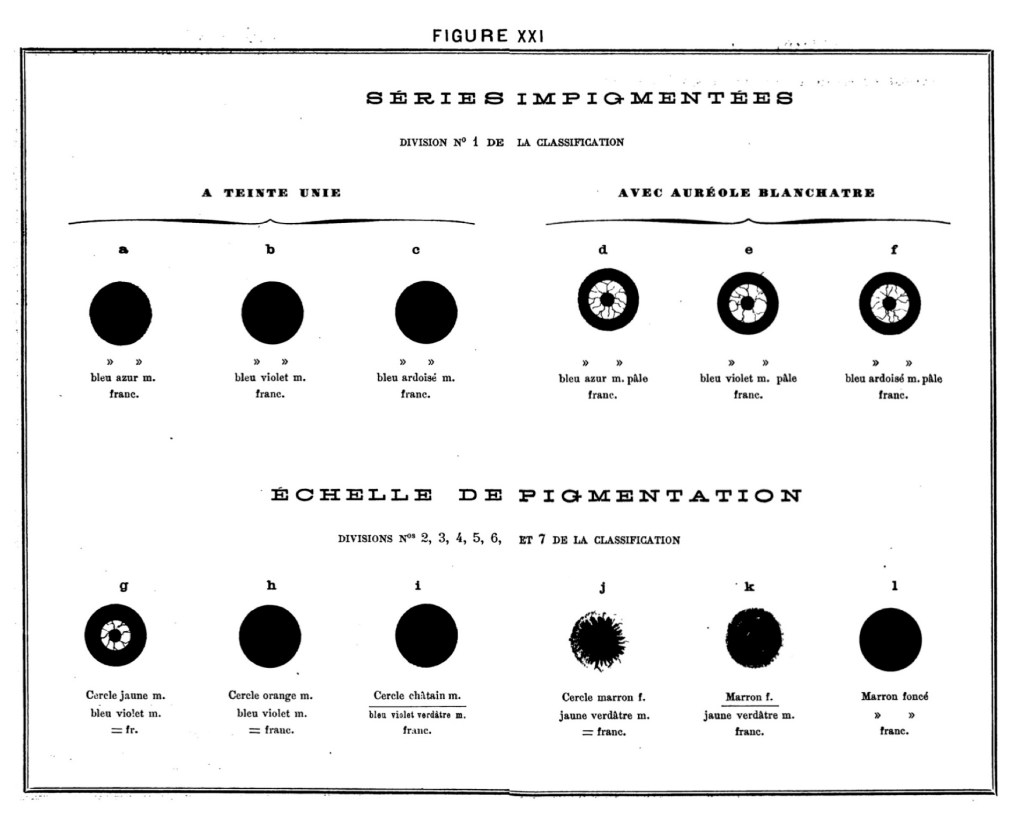
“Iris Pigmentation Sets” (1885)
The colorized eye chart included in the 1893 edition, by contrast, provided fifty-four examples of iris pigmentation from blue to brown on three tiers, with yellow, orange, chestnut, and dark outer ring variations. Each iris description was rendered in abstract notation.
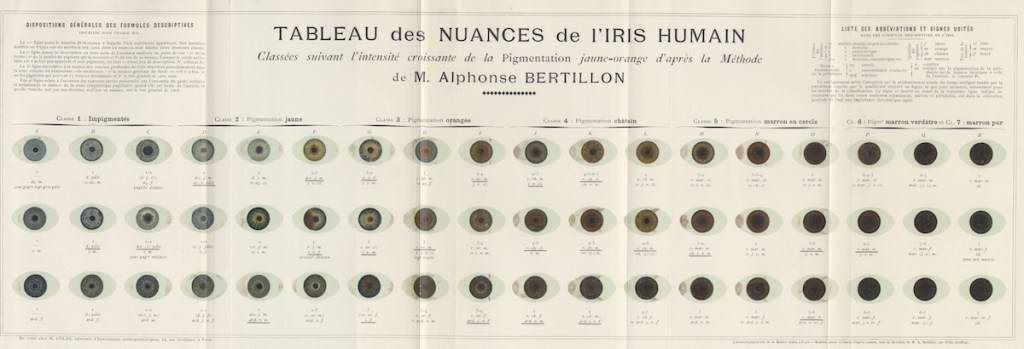
“Table of Human Iris Nuances, by M. Alphonse BERTILLON” (1893).
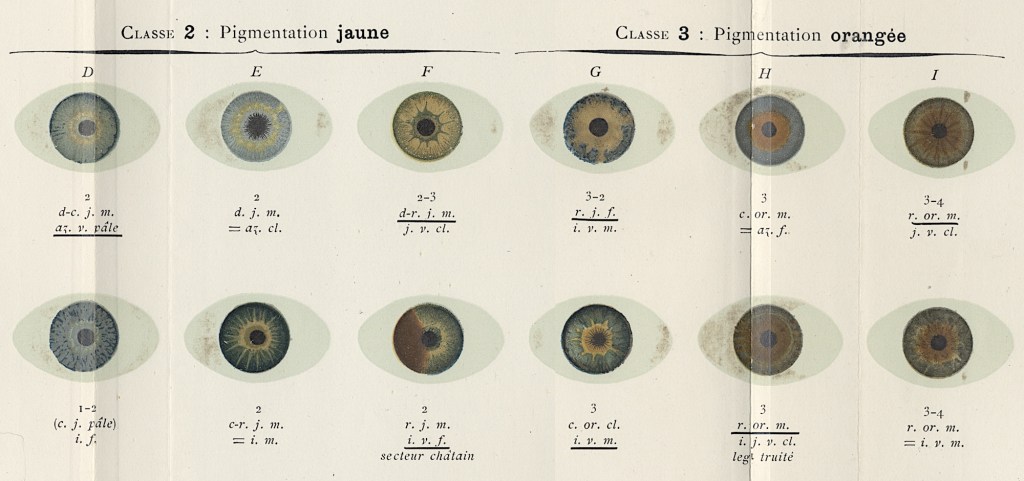
“Categories 2 & 3: Yellow & Orange Iris Pigmentation” (Detail).
Far from a simple system to identify recidivist criminals, the portrait parlé had developed into an esoteric pseudoscience of descriptive notations intelligible only to specialized and rigorously trained anthropometric technicians. The overall effect was not greater certainty, but mystification.
Delusions built into Bertillon’s system were put on public display during his testimony at the second trial of Army Captain Alfred Dreyfus in 1899. In response to Émile Zola’s open letter “J’accuse…!” accusing the French government and military high command of fabricating evidence and falsely convicting Dreyfus of treason in 1894, Bertillon offered his services to the court in this retrial. That expertise had nothing to do with his anthropometric method, however. Instead, Bertillon used the trial as an opportunity to showcase his newly developed system of handwriting analysis.
At the trial, Bertillion produced a series of posters with vector lines, slopes, and annotations that compared Dreyfus’s handwriting to infamous bordereau (“inventory”) of French military secrets recovered from the German embassy in Paris, the primary piece of evidence used in the 1894 conviction. In the intervening years, however, the espionage culprit turned out to be someone else, Major Esterhazy. Undaunted, Bertillon insisted his vector and slope handwriting analysis proved beyond a doubt that Dreyfus had penned the incriminating document. Those who witnessed Bertillon’s performance in the courtroom, or read about it in the press, were convinced he had become completely unhinged, “ripe for the loony bin.”[7] Bertillon’s most ardent supporters lamented the event for years afterward.
More damaging professionally, the practicality of Bertillon’s anthropometric system was being seriously questioned by criminologists outside of France. The analysis of fingerprints, pioneered by Francis Galton in England and Juan Vucetich in Argentina, was rapidly being adopted as an easy and reliable method of recidivist identification by police departments internationally.
By comparison, a reviewer of the 1896 English translation of Signaletic Instructions drew attention to problems with Bertillon’s anthropometric system. To begin with, individuals do not wait until age 20, the baseline for anthropometric measurements, to commit crimes. On a practical level, the terminology and abstract notations in Bertillon’s system required an extensive apprenticeship, whereas minimal training was needed to obtain and match fingerprints. Bertillon’s anthropometric system, the reviewer concluded, suffered under the weight of its own construction:
In fact, it seems to us that, in his anxiety to provide a scientific method of description, he [Bertillon] has so overburdened his subject with details as to render it unworkable, except under very extraordinary conditions.[8]
For his part, Bertillon continued to defend anthropometrics and the portrait parlé as the most scientific and reliable path towards recidivist criminal identification. Fingerprinting, he admitted, could be useful, but was secondary and only supplemental to his system.
It was a losing battle. Within France and internationally, Bertillon’s anthropometric system was quickly modified or abandoned. By the turn of the twentieth century, police records on criminal suspects had returned to simplified identity cards similar to those used in 1885, with portrait parlé descriptions reduced and largely replaced by fingerprints.
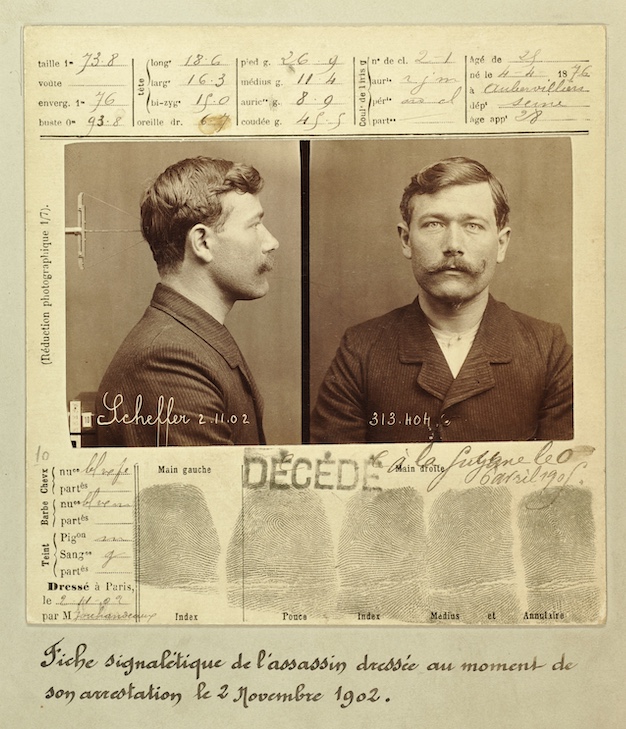
“Identity card of the murderer [Henri Leon Scheffer] made at the time of his arrest, November 2, 1902.” The card includes fingerprints from the left index finger and right thumb, index, middle, and ring fingers. DÉCÉDÉ (“DIED”) was stamped on Scheffer’s card after his death in prison on April 6, 1905. Wikimedia Commons: Service Régionale d’Identité Judiciaire, Paris.
In the end, Bertillon capitulated. His final sample self-portrait anthropometric card was assembled two years before his death at age sixty-one in 1914. Although well dressed and groomed for his portrait photo, Bertillon appears grizzled and worn down. Notably, his fingerprints are missing from the bottom of the card.
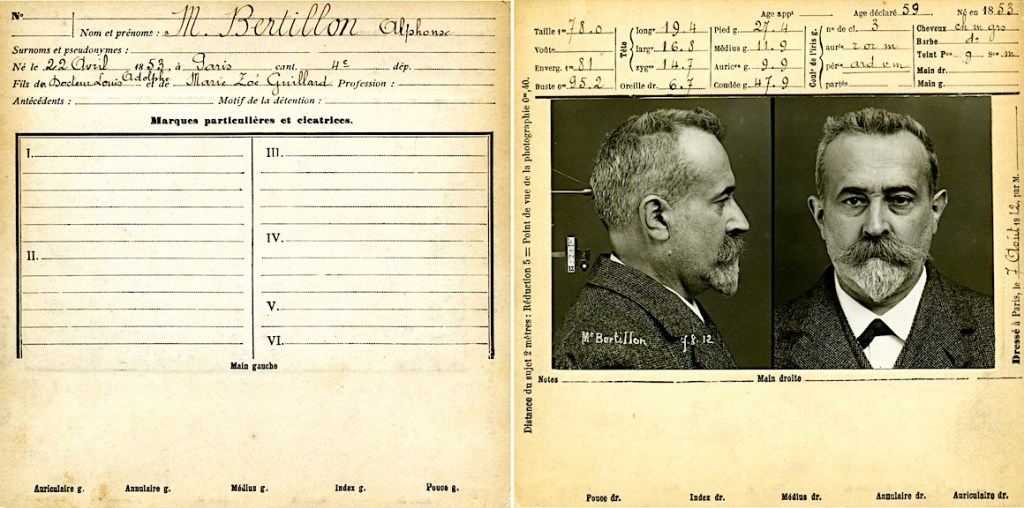
Anthropometric identity card for Alphonse Bertillon, August 7, 1912. Wikimedia Commons: Service Régionale d’Identité Judiciaire, Paris.
NOTES
[1] This biographical sketch is based upon Suzanne Bertillon, Vie d’Alphonse Bertillon (“The Life of Alphonse Bertillon,” 1941). In the absence of diaries or letters left by Bertillon, his granddaughter’s account has become the principal source of information about his life and career. Written and published under the Nazi Occupation, she was member of the fascist Parti Populaire fançais (“French Popular Party”), the most pro-Nazi, anti-communist, and collaborationist political party in Vichy France. Given her ideological slant, information presented the book may be somewhat clouded.
[2] Bertillon, “Une application pratique de l’Anthropomètrie,” p. 3. All English translations in this post are by the author.
[3] A survey of Bertillon’s publications on anthropometrics shows he was continually revising his method, modifying the order and number of measurements, and changing the number of entries and descriptions on individual files.
[4] For insights into the uses and abuses of Bertillon’s application of crime scene photography, see: Lela Graybill, “The Forensic Eye and the Public Mind: The Bertillon System of Crime Scene Photography,” Cultural History 8, no. 1 (2019), pp. 94-119.
[5] Bertillion provides a curious chart of section page lengths in the 1893 editions of Identification anthropométrique to emphasize its superiority (p. ii):
| Identification anthropométrique, Instructions signalétiques | 1885 | 1893 |
| Forward | 5 | 10 |
| Introduction: On the General Method | — | 72 |
| General Instructions | — | 14 |
| Part I: Anthropometric Observations | 21 | 25 |
| Part II: Information Descriptions | 19 | 67 |
| Part III: Survey of Particular Marks | 15 | 20 |
| Annex: Judicial Photography and the Portrait parlé | 5 | 15 |
| Album of Charts, Illustrations, and Photographs | 30 | 90 |
| Page Totals | 95 | 313 |
[6] The following illustrations from the 1885 and 1893 editions of Identification anthropométrique, Instructions signalétiques were downloaded or scanned by the author.
[7] “Voyez ce fou, cet halluciné, il est mûr pour un asile d’aliénés!” Quoted in Suzanne Bertillon, p. 168.
[8] Review of Signaletic Instructions, Including the Theory and Practice of Anthropometrical Identification by Alphonse Bertillon, trans. R. W. McLaughry (1896), in The Journal of the Anthropological Institute of Great Britain and Ireland no. 26 (1897), p. 297.
SOURCES
Alphonse Bertillon, “Une application pratique de l’Anthropomètrie, sur un procédé d’identification permettant de retrouver le nom d’un récidiviste au moyen de son seul signalement, et pouvant servir de cadre pour une classification de photographies à la préfecture de police, à la sûreté générale, au ministère de la justice, etc…” Annales de Démographie Internationale (Paris: G. Masson, 1881).
_____. Identification anthropométrique, Instructions signalétiques (Melun: Typographie-Lithographie Administrative, 1885).
_____. Identification anthropométrique. Instructions signalétiques. Nouvelle édition entièrement refondu et considérablement augmentée, avec un album de 81 planches et un tableau chromatique des nuances de l’iris humain (Melun: Imprimerie Administrative, 1893).
Suzanne Bertillon, Vie d’Alphonse Bertillon, inventeur de l’anthrométrie (Paris: Gallimard, 1941).
Updated: September 1, 2025
Robin Walz © 2025
 Shady Detectives, Elegant Criminals & Dark Avengers
Leave a comment