
Le Jargon, ou le langage de l’Argot Réforme (Troyes: Girardon, 1660). Bibliothèque bleue chapbook cover. Gallica: Bibliothèque nationale de France.
Two centuries before Paul Féval penned Les Habits Noirs, French readers were already taking delight in publications about argot slang and an imaginary criminal underworld. The foundational Bibliothèque bleue chapbook in this regard is Le Jargon, ou le langage de l’Argot Réforme (1660): “Jargon, or the language of updated slang. As it is currently spoken among the deserving poor. Gathered and collected by the most renowned Argotiers (slang speakers) of our times.”[1] The seventeenth-century chapbook was so popular that it was reissued in at least twenty updated editions to the mid-nineteenth century.[2]
Le Jargon includes a story about a clandestine trial that took place in an Anjou village in western France. In a marital dispute, four suitors each laid claim to Poictevine, the “Marquise of Poitou,” as his legitimate wife. The Grand Cagoux of Normandy — a grand coërse or “beggar king” — convened his secret cagoux court of hooded inquisitors and judges, composed of heretical clerics and monks, to determine which among them was the most deserving.
One of the claimants, Millard Manceau, a wealthy local land owner, testified he had been sharing a bed with Poictevine for the past four years. She is the reason he gets up in the morning, he proclaimed, the sweet red wine that makes his head spin. For her part, Poictevine affirmed she was living with Manceau, and perhaps had even loved him once. But after years of abuse, she could no longer tolerate his grabbing her bottom, insults, and beatings. In short, she wanted to be done with him. Two others, the “rich man” Mathelin Richineux and Collas “the fixer,” delivered their arguments for Poictevine’s affections as well.
Finally, a mischievous decommissioned soldier named Narquois stated his case. Red-faced and unaccustomed to speaking in such solemn proceedings, he addressed the Grand Cagoux directly:
“Most high, most powerful, and illustrious Excellency, magnanimous and virtuous Lord. If one judges causes by their effects, and the master’s soul by his actions, it is easy to conclude Manceau has mistreated the Marquise, in fear of her life and health, with extreme malice. Without violating any of the laws of Argotique society — which I follow, will always follow, and hold in great esteem — I appeal to you, my dear Cagoux King, to rule in her favor and permit her to break with this most sinister man. I humbly commit myself to you, and repudiate all who would deny your monarchical authority.”[3]
The Grand Cagoux then called upon his court to render judgment. They ruled that Poictevine was properly wife of Narquois. However, the cagoux court continued, she also should be dispossessed of the ill-gained wealth she acquired during her marriage to Manceau. In recompense, her riches should be distributed to the inhabitants of the local Anjou village.
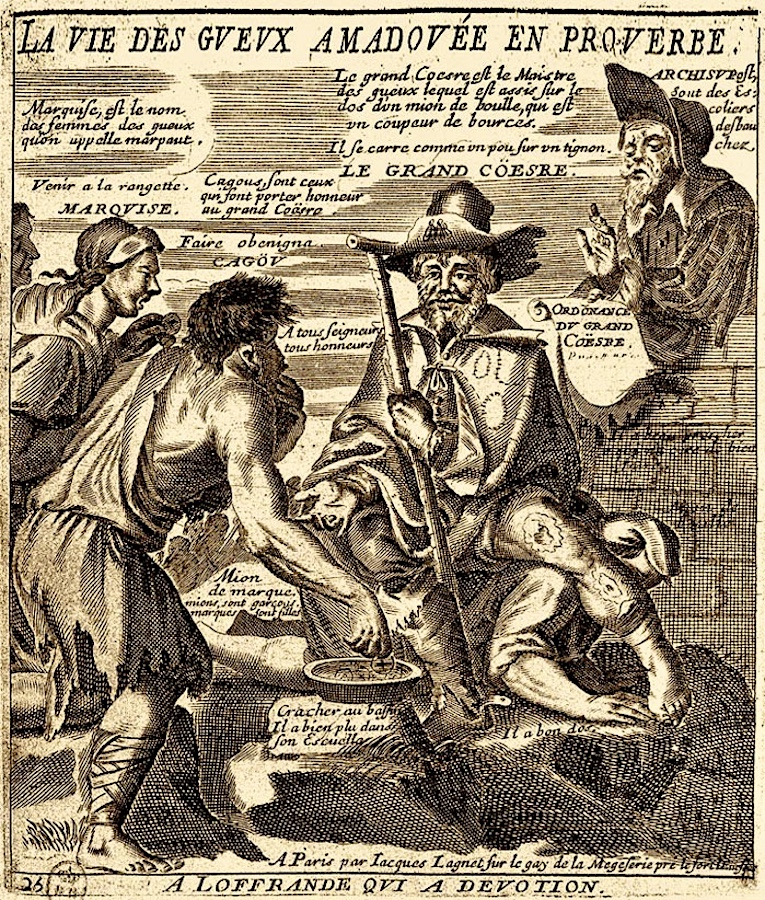
“The Life of Beggars, Soothed by Proverbs.” Engraved illustration in Jacques Lagniet, Recueil des plus illustres proverbes, vol. 3 La vie des gueux en proverbes (Paris, 1663). Bottom caption: “Offerings of Devotion.” In the center, Le Grand Coësre (“beggar king”) is seated upon a common laborer’s back. Above him is a heretical archbishop, displaying a copy of “Ruling by the Grand Coërse.” Paying tribute below are a marquise and a gueu (destitute beggar). Gallica: Bibliothèque nationale de France.
The story about Marquise of Poitou is most certainly apocryphal, having nothing to do with any actual event. Rather, its appeal came from recounting the imaged proceedings of the Grand Cagoux and his court, a carnivalesque inversion of the familiar three social estates of clergy, aristocracy, and commoners. Since the Middle Ages, mocking official court proceedings was a popular entertainment during festivals and in traveling theatrical plays. Commoners who actually ended up in court for legal infractions had to rely upon their own wits and skill at crafting stories to defend themselves and to plead for mercy in the punishments meted out by magistrates and clerics. They certainly would not have held their social superiors in high esteem, and no delighted doubt in stories about besting them.
In the imaginary trial about which husband had the strongest claim to Poictevine — who symbolically represents the Anjou region of western France (Poitevine was the regional dialect) — the cagoux court favored the lowest-of-the-low, the ne’re-do-well decommissioned soldier Narquois, over his richer and more well-placed rivals.
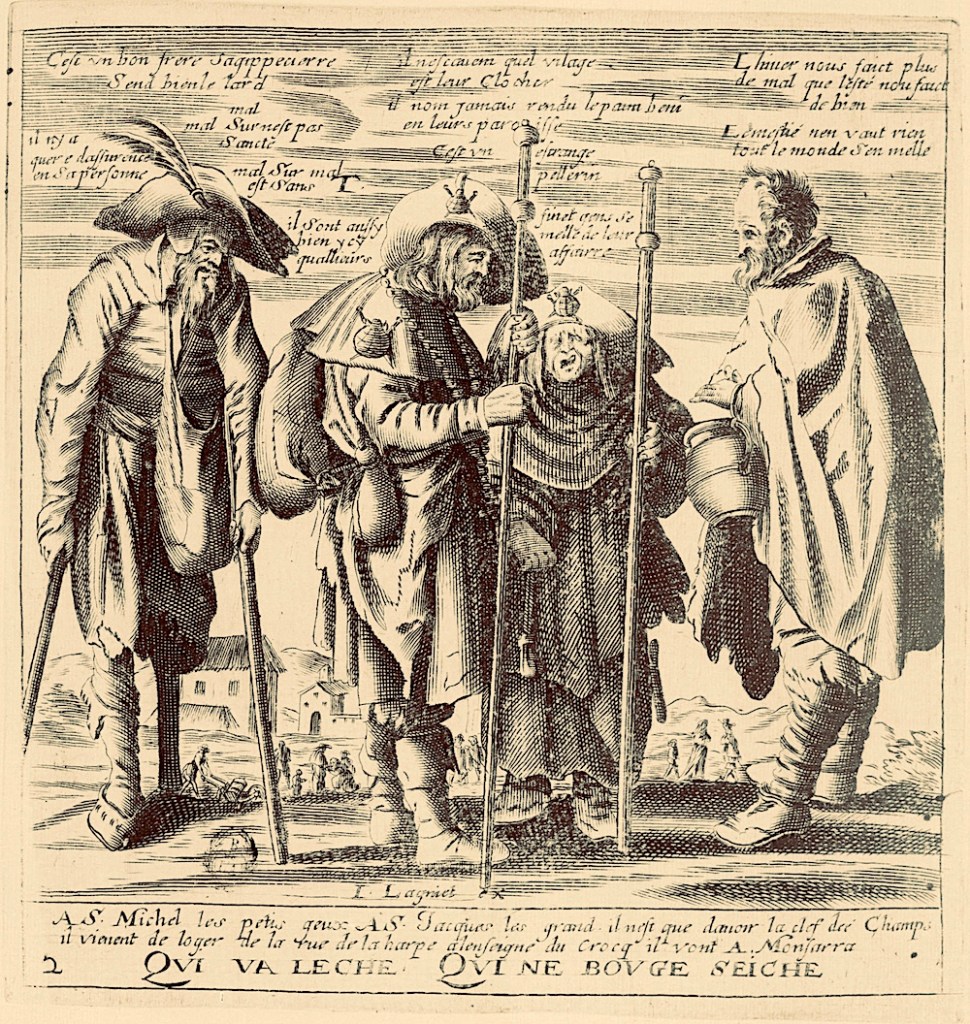
“Whoever’s been licked, can’t move around to dry out.” Engraved illustration of maimed and decommissioned soldiers in Jacques Lagniet, Recueil des plus illustres proverbes, vol. 3 La vie des gueux en proverbes (Paris, 1663). Gallica: Bibliothèque nationale de France.
In addition, the court redistributed the wealth of the Marquise of Poitou to the entire village. For a peasant population who believed that heaven was the pays de Cocagne — a land of milk and honey overflowing with endless food, wine, and sensual pleasures — the ruling was most just.
Le Jargon was widely circulated through Bibliothèque bleue chapbooks by itinerant peddlers in towns and village across France. The centerpiece was a French-Argot dictionary. The chapbook also included vignettes, plays, poems, and songs about the origins and composition of Argotique society, whose hierarchy extended from the grand coërse beggar king and his heretical court to the numerous communities of swindlers, beggars, and vagabonds over whom he ruled. Entertaining stories made it easy to slide from argot slang to the secret customs and rituals of an imaginary “fourth estate.”
The earliest extant chapbook about such imaginary Argotique criminal societies is La vie genereuse des marcelots, gueuz et boesmies, contenans leur façon de vivre, subtilitez et Gergon. Mis en lumière par Monsieur Pechon de Ruby, Gentil’homme (“The generous life of peddlers, beggars and bohemians, including their manner of living, wiles and Jargon, brought to light by Monsieur Pechon de Ruby, Gentleman,” 1595).[4]

Title page of La vie genereuse des Mattois, Gueux, Boemiens & Cagouz, contenant leurs façons de vivre, subtilitez & gergon, 2nd edition (Paris, 1612). As Middle French was not standardized, note differences in wording and spelling from the first edition title, mentioned above. This edition also added Cagouz to represent the Argotique “fourth estate.” Gallica: Bibliothèque nationale de France.
Its presumptive author, the aristocratic-sounding Pechon de Ruby, promised readers insider knowledge about the wily practices of peddlers, beggars, and gypsies, claiming to have lived among and traveled with them in his early years. Yet his descriptions were not based on personal observation, so much as they were parodies of the three established orders of society, whose religious, royal, and guild activities were already known to chapbook readers, albeit in mysterious fashion.
The Argotique society invoked by Pechon de Ruby begins with marcelots (mattois, merciers), an actual guild of ambulatory merchants at the bottom of the pecking order, who peddled sundry goods in baskets strapped to their backs. The second group, gueux, originally denoted afflicted, maimed, and destitute persons who begged for alms, but by the end of the sixteenth century had come to refer to any “vagabonds” who badgered people into giving them money. The final category, boemiens (“bohemians”), was a catch-all term for “Gypsies,” having nothing to do with Roma or Sinti peoples. In popular belief, these were wandering people from numerous origins — the lost children of Cain, the descendants of Egyptian pilgrims, displaced tsiganes (gitanes, “Gypsies”) from the Seljuk Zengitane Dynasty, remnant bands of Attila the Hun, or in more recent history Hussites expelled from Bohemia.[5]
The notion that migratory and destitute people constitute a secretive criminal society of thieves did not originate in Bibliothèque bleue chapbooks, however, but had its roots in a pejorative vocabulary generated by religious confessors, inquisitors, and magistrates in written sanctions against nomadic, homeless, and impoverished peoples since the late‑fourteenth century.[6] Pechon du Ruby’s suggestion that these wanderers led “generous lives,” however, invoked an amount of sympathy between social outcasts and chapbook readers. Still, his general advice was méfiez-vous! — “stay away!” from such nefarious types. Whatever the category of migrants, villagers and town dwellers generally viewed outsiders suspiciously as crooks and thieves.

“It must be very warm to have all one’s clothes.” Engraved illustration of the wandering poor in Jacques Lagniet, Recueil des plus illustres proverbes, vol. 3 La vie des gueux en proverbes (Paris, 1663). Gallica: Bibliothèque nationale de France.
The inclusion of a short dictionary of Gergon (jargon, argot) in La vie genereuse lent an air of credibility to the belief that these groups constituted an Argotique society. However, the argot in the Bibliothèque bleue chapbooks did not correspond to actual criminal subcultures. Rather, it was produced through the playful and systematic deformation of Middle French language and regional dialects, linguistically modified by prefix and suffix inversions, along the lines of “Pig Latin” in English and verlan in contemporary French.[7]
In the sixteenth century, the French language was still in formation as a national vernacular, only one of multiple languages and dialects spoken across the country.[8] Encounters between countryfolk, villagers, town inhabitants, and travelers, regularly provoked linguistic confusion and mutual incomprehensibility. No doubt, the chapbook’s claim to provide a key to decoding the strange and secret language of strangers who periodically wandered through their communities was a selling point with popular reading audiences, although more for purposes of entertainment than to gain practical knowledge.
By the eighteenth century, traditional Argotique tales were supplemented by contemporary stories about the leaders of bands of highway robbers, thieves disguised as royal messengers or as gentry, and smugglers, who were transformed into popular heroes. Among them, Louis Mandrin was the quintessential outlaw gang leader and popular avenger.[9] Born in 1734 to a family of artisans from the Isère region in southeastern France, as a young man Mandrin joined the King’s Army, deserted, and then organized a band of smugglers to transport contraband goods from the Savoy Alps to markets in southeastern France. His popular acclaim derived from his confrontations with the despised fermiers généraux (“farmers-general”), royal tax collectors who as businessmen were entitled to keep a cut of collected goods and revenues for themselves.

Engraved print of “Mandrin, Leader of Brigand Troops.” (Paris: Chez Basset, 1755). Gallica: Bibliothèque nationale de France.
In popular folklore, Mandrin robbed royal tax collectors, forced them to purchase his contraband merchandise, and then redistributed stolen goods and money back to villagers. He also enjoyed a popular reputation as a violent avenger, killing tax collectors and army officers who attempted to arrest him. When royal troops pursued Mandrin, his band would be granted safe haven by le peuple (“the people”). It was even claimed that on one occasion the mayor of Beaune in Burgundy welcomed Mandrin at the Hôtel de Ville (“City Hall”) and lauded him with honors.
According to canard broadsheets, Mandrin was arrested by the Savoy police after being betrayed by his mistress. Condemned to execution, he was broken on the wheel and strangled to death on May 26, 1755.
Yet Mandrin’s popularity and legendary status continued to grow. He was posthumously credited as the author a collection of lyrical ballads about his exploits called La mandrinade, poème en quatre chants et vers burlesque (“The Mandrinade, epic poem in four songs and burlesque verse,” 1775). An apocryphal chapbook charting his life and adventures, Testament politique de Louis Mandrin, Généralissime des Troupes des Contrabandiers, écrit par Lui-même dans sa Prison (“Political Testament of Louis Mandrin, Generalissimo of Troops of Smugglers, written by Himself from his Prison Cell,” 1775), was so popular that it was immediately translated into English the same year.[10] Mandrin’s legendary status as a popular avenger persisted in both fictional and “true crime” accounts throughout the nineteenth century, and on film and television in the twentieth.

La complainte de Mandrin (“The Ballad of Mandrin”), interpreted by Monique Moreilli. Theme song for Mandrin television mini-series (6 episodes, 55 minutes each, ORTF 2/France 2, 1972).
For centuries to come, French readers continued to delight in stories about imaginary criminal subcultures and their secret lingo. Nineteenth-century literary and popular authors, from Honoré de Balzac and Vidocq to Eugène Sue and Paul Féval, worked argot terms and dialog into their books and novels. Victor Hugo devoted an entire chapter of Les Misérables to “Argot” (1862), set firmly within the imagined tradition of linking slang terminology to the imaginary subculture of la pègre, a popular term for underworld criminal class.[11] Renewed editions of Argot-French-dictionaries continued to be produced over the centuries as well.[12] Criminal argot constitutes a long cultural continuity in the French popular imagination, one that stretches across centuries.
NOTES
[1] Le Jargon ou le langage de l’Argot Réformé. Comme il est a present en usage parmy les bons pauvres. Tiré & receuilly des plus fameux Argotiers de ce Temps. Composé par un pilier de Boutanche, qui maquille en molache en la Vergne de Tours. Augmenté de nouveau dans le Dictionnaire de mots plus substantifs de l’Argot, outré les precedent impressions, par l’autheur ” (1660). Reprinted in Roger Chartier, Figures de la gueuserie, collection “Bibliothèque bleue” (Paris: Montalba, 1982). Author’s translations from Middle and contemporary French in the blog text throughout.
[2] Annexe II “Les éditions du Jargon, 1630-1833: bibliographie descriptive,” in Chartier, Figures de la gueuserie.
[3] Le Jargon, in Figures de la gueuserie, p. 175.
[4] La vie genereuse des mercelots, gueux, et boesmiens, contenans leur façon de vivre, Subtilitez & Gergon. Mis en lumière par Monsieur Pechon de Ruby, Gentil’homme Breton, ayan esté avec eux en ses ieunes ans, où il a exercé ce beau Mestier. Plus a esté adiousté un Dictionnaire en langage Blesquien, avec l’explication en vulgaire (1595). Annexe I “Les éditions de La Vie généreuse,” in Chartier, Figures de la gueuserie.
[5] S.v. “Bohémien, ienne.” Pierre Larousse, Grand Dicionnaire universel du XIXe siècle, vol. 2 (Paris: Administration du Grand Dictionnaire Universel, 1865).
[6] Bronislow Geremek, Truands et misérables dans l’Europe moderne, 1350-1600 (Paris: Éditions Gallimard/Julliard, 1980).
[7] Marcel Schwob and Georges Guieysse, Étude sur l’argot français (1889; Paris: Éditions du Boucher, 2003).
[8] Graham Robb, Chapter 4 “O Òc Sí Bai Ya Win Oui Oyi Awè Jo Ja Oua,” in The Discovery of France: A Historical Geography from the French Revolution to the First World War (New York: W. W. Norton, 2007). Graham argues that over a dozen major language groups, nearly four dozen regional dialects, and hundreds of local dialects and patois persisted in France well into the nineteenth century, which presented linguistic challenges for anyone traveling across the country. Standardized French finally gained a foothold in the 1860s, but only became universal in the early twentieth century.
[9] S.v. “Mandrin (Louis),” in Pierre Larousse, Grand Dictionnaire universel du XIX siècle, and Dictionnaire, vol. 10 (1873). For a scholarly treatment of Mandrin’s actual activities and historical significance, see Michael Kwass, Contraband: Louis Mandrin and the Making of a Global Underground (Cambridge, Mass.: Harvard University Press, 2014).
[10] Louis Mandrin [pseudo.], La mandrinade, ou l’histoire curieuse, veritable et remarquable de sa vie (Saint Geoirs, 1755). Satirist François Antoine de Chevrie, is the likely author of its reissue as La mandrinade, poème en quatre chants et vers burlesque (Valenciennes [Liège]: Chez Jacques Le Camus, 1758). Testament politique de Louis Mandrin, Généralissime des Troupes des Contrabandiers, écrit par Lui-même dans sa Prison (Geneva, 1755) was actually written by the French diplomat, journalist, and swindler Pierre Angel Goudar. In English translation: Louis Mandrin [pseudo.], Authentic memoirs of the remarkable life and surprising exploits of Mandrin, captain-general of the French smugglers who for the space of nine months resolutely stood in defiance of the whole army of France, with the copy of an intercepted letter, from one chief to another, relating some curious particulars, concerning the taking of Mandrin, translated from the French, to which is added, a geographical description of those cities, towns and castles on the frontiers of Savoy and Switzerland, and France, which were the principal scenes of action (London: M. Cooper, 1775).
[11] Victor Hugo, Appendix I “Argot,” in Les Misérables, trans. Norman Denny (New York: Penguin Classics, 1982), pp. 1214-1232.
[12] My personal collection of argot dictionaries, for example, includes: Eugène-François Vidocq, Les Voleurs: Physiologie de leurs mœurs et de leur langage (1837), in Mémoires. Les Voleurs, Collection “Bouquins” (Paris: Robert Laffont, 1998); Émile Chautard, La vie étrange de l’argot (Paris: Denoël et Steele, 1931); Dictionnaire de l’argot, ed. Jean-Paul Colin, Jean-Pierre Mével and Christian Leclère (Paris: Larousse, 1990); and, Dictionnaire du français argotique & populaire, ed. François Caradec (Paris: Larousse, 2003).
Updated: May 9, 2025
Robin Walz © 2025
 Shady Detectives, Elegant Criminals & Dark Avengers
Leave a comment