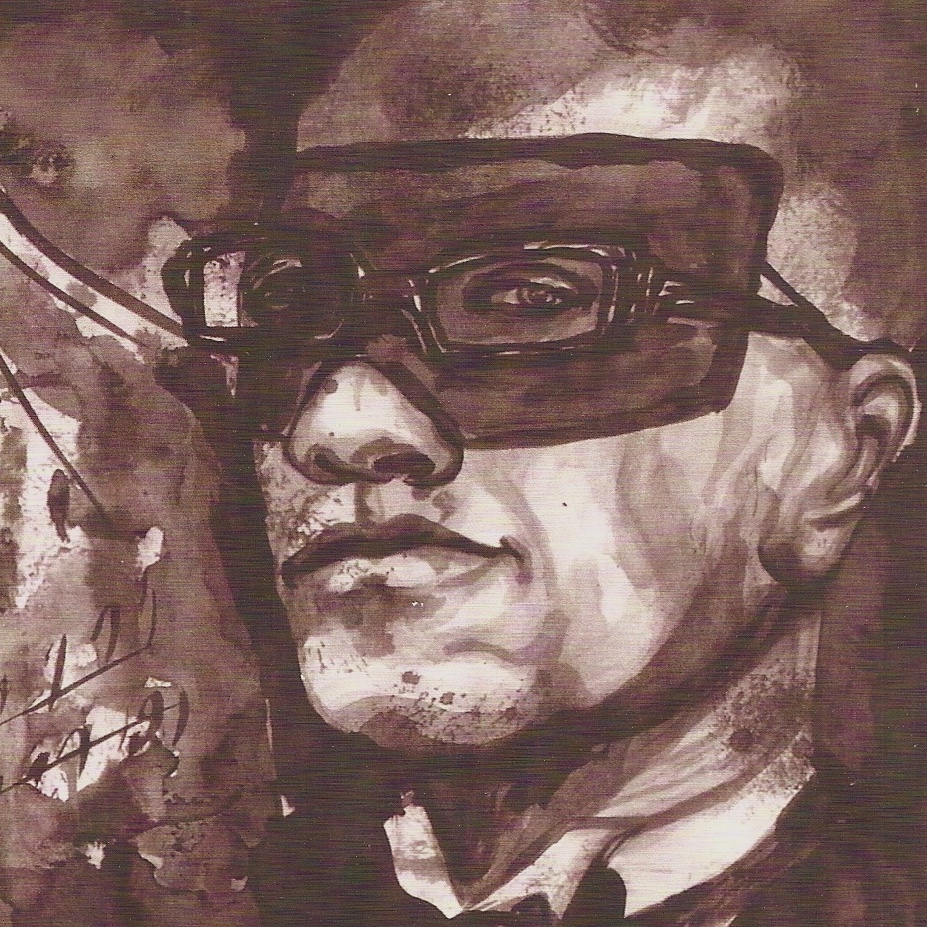
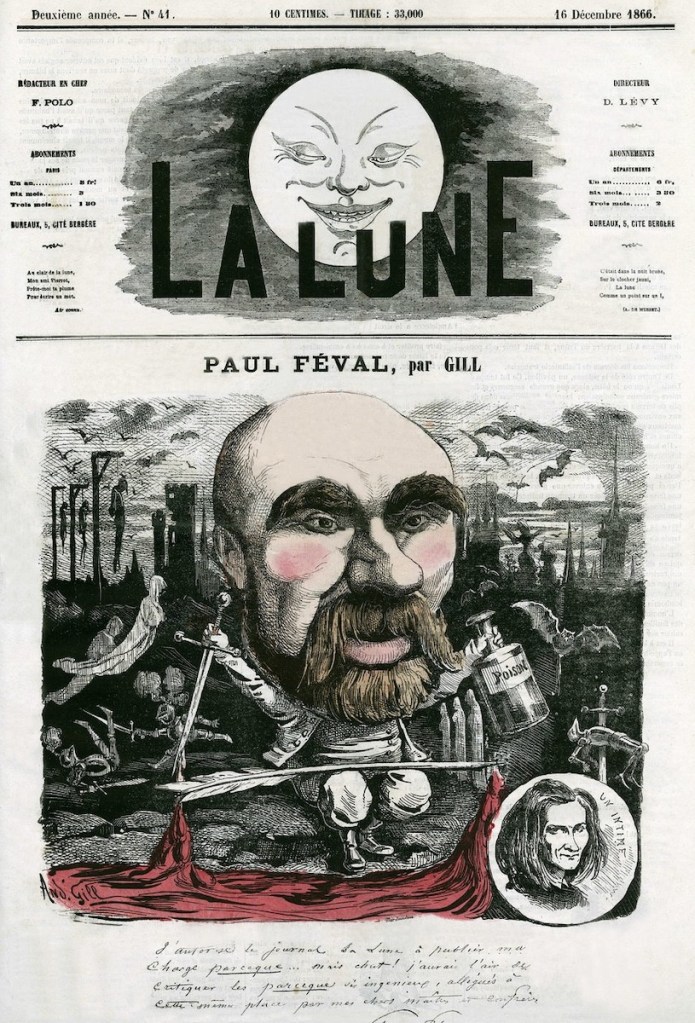
Caricature of Paul Féval by André Gill. La Lune, September 16, 1866. Wikimedia Commons: Public Domain.
In 1866, popular novelist Paul Féval lamented, “For several years now, the crime industry just hasn’t been delivering the goods.”[1] By his calculation, there were upwards of two million upright and intelligent French readers who were dying for crime stories. Despite the Académie Française establishing a Montyon Prize for crime writing, literary realism and melodramas simply weren’t keeping up the pace.[2] Féval urged his fellow authors to stop up their elegant inkwells and imbibe a little blood instead.
To satisfy popular demand, Féval estimated the output of crime stories needed to be augmented two or three-fold, a hundred times even. But that would require a massive advertising campaign. Regrettably, he bemoaned, this meager announcement would have to suffice:
Unforgettable, Colossal, Stunning Best Seller!
THE CRIME FACTORY
A DREADFUL NOVEL
By a Murderer
Le Fabrique de crimes, Féval boasted, is the novel all of France and Europe has been waiting for. In 100 installments with 73 murders per issue, it yields an impressive total of 7,300 victims. And that’s only murders, he emphasized, not taking into account the novel’s vast number of thefts, rapes, cases of child smuggling, kidnapping, fraud, forgeries, goods sold at false weight, confidence scams, break-ins by scaling walls and picking locks, the corruption of minors, miscellaneous unlawful activities, and crimes “guided by prudence.” Féval proclaimed:
This is a work without precedent — striking, staggering, incisive, convulsive, true, incredible, terrifying, monumental, entombed, audacious, furious, monstrous — in a word, AGAINST NATURE. After this, nothing more is possible, not even advanced putrefaction. We must…
Mount the scaffold!
Le Fabrique de crimes, p. 8
This darkly humorous preface was Féval’s parody of his own métier, that of the feuilletoniste who writes installment novels. Over the previous two decades, Féval’s star as a novelist had been rising with more than a dozen titles to his name, the most well-known being Le Fils du Diable (“The Devil’s Son,” 1846) and Le Bossu (“The Hunchback,” 1858). When rival feuilletoniste Ponson du Terrail took a hiatus from his Rocambole series, Féval jumped into the vacancy with his own crime series, Les Habits Noirs, a serialized epic about a criminal secret society of “Black Coats,” spread over seven novels (1863-1875). So, when Féval lampooned “the crime factory” in terms of reader popularity based on sensational crimes and astronomical body counts, he wrote from an insider’s perspective.
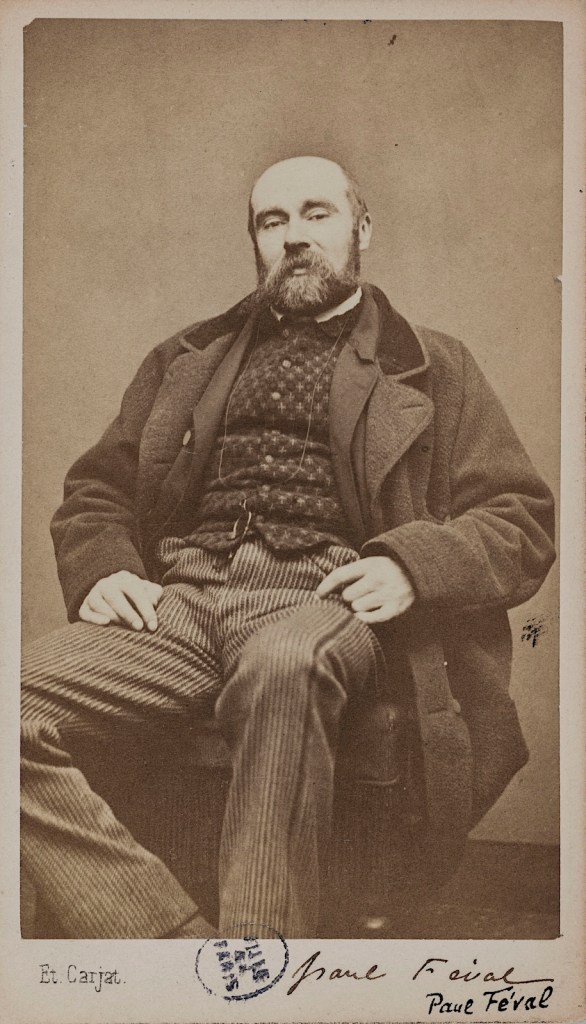
Photographic portrait of Paul Féval by Étienne Carjat, c. 1860. Collection: Musée Carnavalet, Paris.
Paul Henri Coretin Féval was born in Brittany on September 7, 1817, the third son of Jean-Nicolas Féval, Royal Court Advisor of Rennes, and Jeanne-Joséphine Le Baron de Létang, daughter of a Rennes Court of Appeals Prosecutor.[3] After the death of his father, in 1830 his mother moved the family from Rennes to a secluded family manor in far-western Brittany. The small chateau served as a rendezvous for latter-day Chouans, rural counterrevolutionaries who opposed the French Revolution and dreamed of reviving provincial autonomy. As the self-stylized insurrectionists worked late into the night hand manufacturing lead-shot bullets, teenaged Paul delighted in hearing their of tales of local resistance, political conspiracies, and ferocious massacres.
Returning to Rennes, Paul completed his baccalauréat and followed in his father’s footsteps to train as a lawyer. However, his single venture into the courtroom as a defense attorney proved disastrous for his client, chicken thief who kept changing his story over the course of the trial. Féval’s inexperience resulted in the defendant’s conviction and his self-humiliation. Spending the next five years performing office work for the court, in 1838 Féval moved to Paris where, through family connections, he began an apprenticeship as a banker.
He also immersed himself in reading novels and, inspired by Balzac, dreamed of becoming a writer. Quitting his bank job, he rented a sixth-floor attic apartment and began to experience the penury of his newly adopted career. Thwarted by a lack of success at getting his fiction published, Féval managed to squeak out a living as a copyeditor and by writing entries for encyclopedias and dictionaries, a few cheap vaudeville plays, and occasional articles for Legitimist monarchist newspapers. His big break came in 1841, when his first installment novel, Le Club des Phoques (“The Sealed Membership Club”), was published in the prestigious literary magazine, Revue de Paris.
Féval’s novel caught the attention of Anténor Joly, publisher of the conservative Le Courrier français weekly. Joly wanted to launch a new feuilleton novel series, Les Mystères de Londres (“The Mysteries of London”), to cash in on the success of Eugène Sue’s Les Mystères de Paris, currently running in a rival newspaper. When Féval told Joly that he was already writing a new novel, Les Compagnons du silence (“The Silent Brotherhood”), Joly exclaimed:
“That’s it! Let’s get to work!”
“On what?” Féval said.
“On our Mysteries, my friend, our Mysteries! Look, it’s the same thing… We just switch English names for the French ones, beer for wine, and we’re in Great Britain! The first installment comes out tomorrow.” (Mirecourt, pp. 37-38)
From December 1842 through 1844, Féval’s Les Mystères de Londres appeared in Le Courrier français under the pseudonym of Sir Francis Trolopp, to lend an air of English authenticity. The plot revolved around the exploits of the Marquis Rio Santo, alias of the condemned Irish revolutionary Fergus O’Breane.
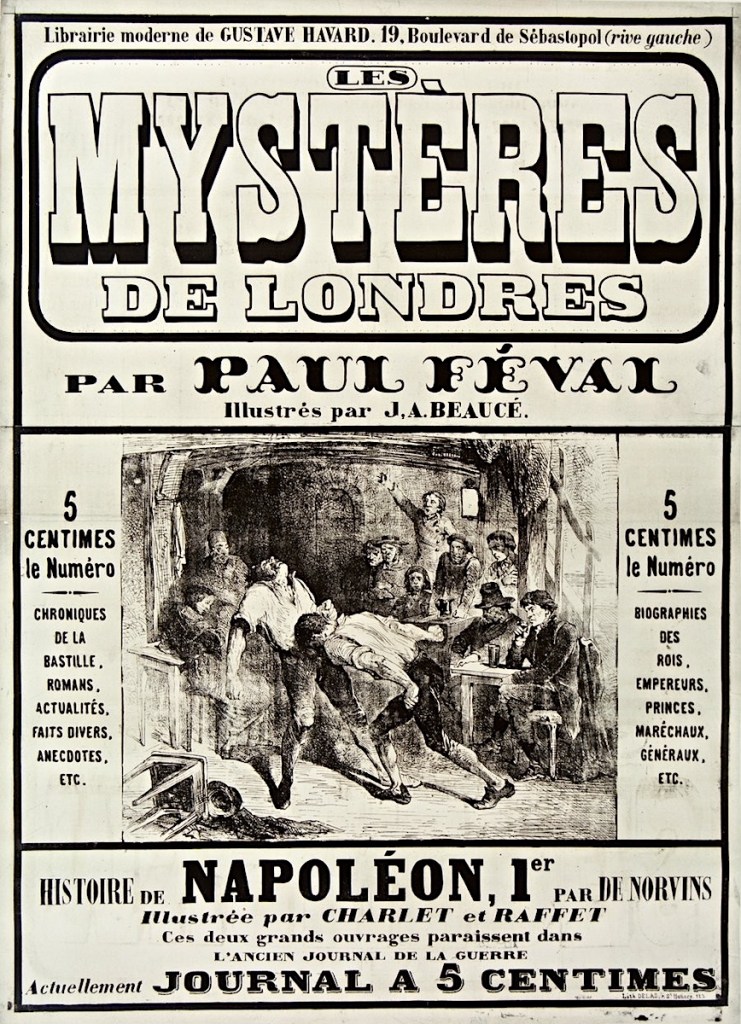
Advertising Poster for “The Mysteries of London” by Paul Féval, illustrated by Jean-Adolphe Beaucé (1859). Gallica: Bibliothèque nationale de France.
The success of Les Mystères de Londres brought additional contracts to Féval, soon regarded one of the most promising authors of the era.[4] With the death of Eugène Sue in 1857, Féval seemed poised to become France’s most popular feuilletoniste.But it didn’t happen. That year the newspaper La Patrie launched Les Drames de Paris by upstart writer Ponson du Terrail. The feuilleton series featured a lying, thieving, and murderous criminal antagonist named Rocambole, instantly popular with the reading public. What galled Féval was that Ponson was a hack writer with absolutely no literary talent whatsoever.
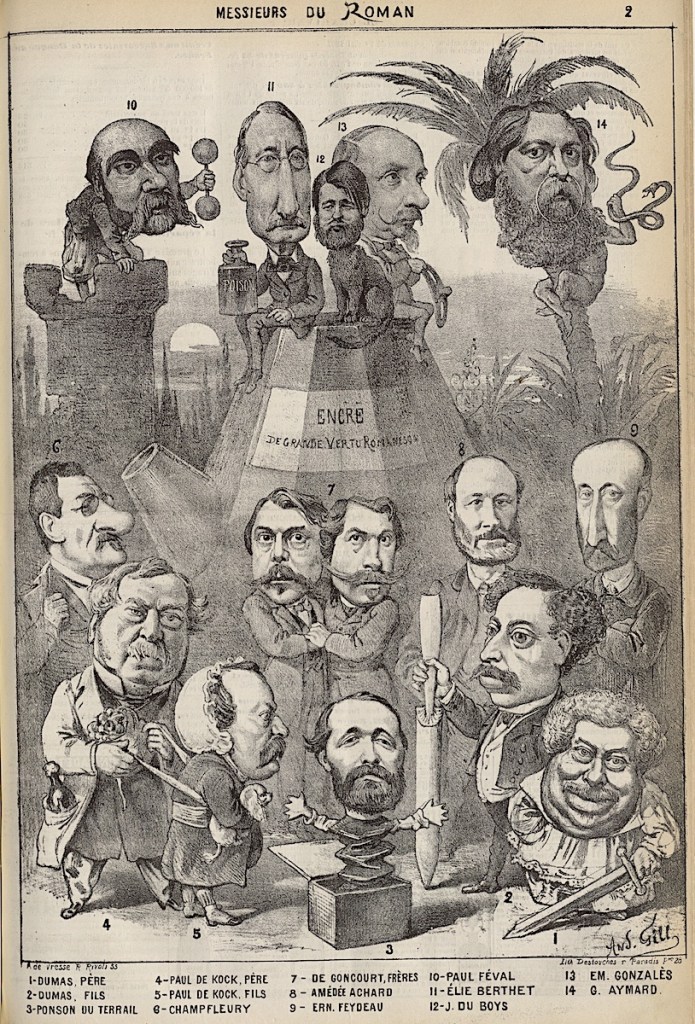
“Gentlemen Novelists” by André Gill. Le Charivari, May 10, 1867. Gallica: Bibliothèque nationale de France. Caricatures of nineteenth-century authors, including Paul Féval holding a rattle (upper left), Alexandre Dumas with a sword (lower right), and Ponson du Terrail as a jack-in-the-box (center bottom).
Then, in 1862 Ponson abandoned Les Drames de Paris to work on feuilleton novels for other newspapers. Sensing the opportunity to cash in on reader enthusiasm for crime fiction, Féval jumped in with Jean Diable (“John Devil,” 1862) about an international criminal and murderer.[5] The following year, in 1863 Féval launched Les Habits Noirs (“The Black Coats”), serialized in the daily newspaper Le Constitutionnel.
Les Habits Noirs follows the misfortunes of André Maynotte, framed by the secret society of “Black Coats” for a crime he did not commit. The story begins in 1825 with a young Alsatian named Jean-Baptiste Schwartz, down on his luck and walking along a Brittany highway. Along the route, a stranger named Monsieur Lecoq approaches Schwartz and persuades him, upon the promise of lucrative remuneration, to drive a horse-drawn coach out of the city of Caen and abandon it at a designated location. Schwartz agrees, unaware the coach contains 400,000 francs that Lecoq has just stolen from a safe in Caen.
A bank had commissioned André Maynotte, a skilled metalworker, to design a large safe to keep 400,000 francs secure. He equipped the safe’s door with a metal-toothed mechanism that would severe the arm of anyone attempting to open it. A protective brassard ciselé, a ruby-studded metal armband, was required to open it without injury. However, now that the safe had been broken into, its contents stolen, and the metal armband missing, André is the primary suspect in the theft.
Bewildered, André flees Caen, accompanied by his wife, Julie. Once safely out of the city sends her on to Paris by coach. Trusting in Providence, André hands himself over to the police and is willingly led to prison, believing his innocence in court will triumph. Of course, this does not happen. Not only is a mountain of evidence amassed against him, he is represented by a worthless defense attorney who assures his conviction. Every day from his prison cell, André writes to Julie, lamenting his miserable circumstances and reassuring her of his love.
One evening, a neighboring prisoner bursts through the wall into André’s cell. The visitor recounts that the cell had previously been occupied by the leader of a mysterious criminal band called Les Habit Noirs (“The Black Coats”), whose members recognize one another with a secret greeting, “Fera-t-il jour demain?” (“Will there be daylight tomorrow?” meaning in criminal argot, “Has a crime been planned?”). The Habit Noir leader had also rigged the window bars of André’s cell as an escape route from the prison. Fashioning a makeshift rope from clothes knotted together, André and his fellow convict descend the prison wall. His companion, however, falls in the attempt and breaks his neck. André swaps clothes with the now dead escapee, assumes his identity, and flees to England.
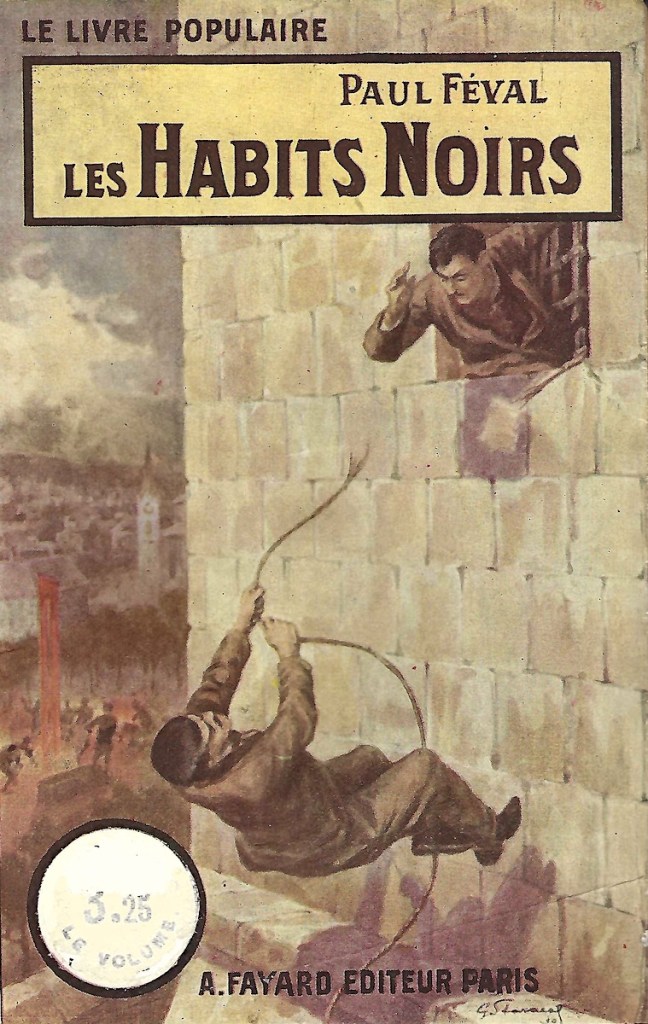
Paul Féval, Les Habits Noirs, Collection. “Le Livre Populaire” (Paris: Arthème Fayard, 1910; reissue 1932). Cover by Gino Starace. Author’s Collection.
From London, André continues to write to Julie, but her return letters become fewer and fewer. When she stops corresponding altogether, he surreptitiously returns to Paris just in time to witness the marriage of Giovanna Maria Reni (Julie) to… Baron Jean-Baptiste Schwartz! Heartbroken, André heads back to London, consoling himself that at least he is a free man. Upon arrival, however, he is arrested for theft and sentenced to hang — the victim of a scheme devised by the nefarious Habits Noirs.
The remainder of the novel elaborates upon the inner workings of the Habits Noirs, a international secret society of criminals across Europe with hundreds of thousands of members. The Habit Noir leader is Colonel Bozzo-Corona, père-à-tous (“father to us all”), a frail centenarian who is the last of the Corsican godfathers. Monsieur Lecoq, known in the criminal underworld as Toulonnais-l’Amité (“The Toulon Swindler”), is the Bozzo-Corona’s chief associate and heir apparent. A number of minor characters in the criminal society are featured as well, most notably a conniving and subservient hunchback called Trois-Pattes (“Three-Footed”).
As Féval’s sprawling novel ambles toward a denouement, Colonel Bozzo lies dying in bed. On the Schwartz estate, the missing 400,000 francs are once again secured within a massive safe that requires the protective brassard ciselé armband to open it. Following the funeral of Colonel Bozzo, publicly venerated as a great philanthropist, Lecoq orders Trois-Pattes to rally the Habits Noirs to steal the safe’s contents during a grand ball hosted by Baron Schwartz.
Instead, Lecoq betrays the Habits Noirs by planning to abscond with the 400,000 francs for himself. Enlisting the assistance of Trois-Pattes to pull off the heist, Lecoq dons the protective armband to open the massive safe, only to discover it is filled with… counterfeit notes! Adding to the shock, Trois-Pattes reveals himself as… André Maynotte! Not only is André still alive, he produces the sacred Scapular of the Master of Mercy entrusted to him by Colonel Bozzo upon his deathbed. This is the sign that André has been chosen as the next leader of the Habits Noirs, and Colonel Bozzo’s vast fortune is bequeathed to him.
Hand to hand mortal combat between Lecoq and Maynotte ensues. When the Baron and Countess Schwartz make an unexpected appearance, Lecoq draws a two-shot revolver and fires — one bullet killing the Baron and the other wounding André. In a supreme effort, André heaves himself towards his nemesis, pushes him into the safe, and pulls a trigger mechanism. The safe’s massive door crushes Lecoq’s head, leaving his mangled body in a bloody heap. André faints and collapses on the floor.
The Countess Schwartz, once again Julie, cradles André’s slack body. Relieved to find a still faint pulse in him, she declares everlasting devotion to her true love. But the bullet has found its path; his aorta has been severed and André dies. Meanwhile, guests continue to dance at the Schwartz’s ball, oblivious to these events. But rumors have begun to circulate, “Monsieur Schwartz is dead! The Black Coats!…” (Les Habits Noir, vol. 1, p. 396).
Les Habits Noirs was a resounding success for Féval and Le Constitutionnel. The same year, in 1863 book publisher Louis Hachette issued the novel in a single volume. Yet it turned out to be a pyrrhic victory.
In 1865, Ponson du Terrail released La Résurrection de Rocambole, an installment novel sequel published in Le Petit Journal, one of the most widely read mass-circulation daily newspapers in Paris. With the rebirth of Rocambole, Ponson transformed his energetic criminal antagonist into an equally redoubtable avenger protagonist. In response, Féval threw himself more vigorously into the Habits Noirs saga, adding multiple sequels to the series over much of the next decade.[6] Although Les Habits Noirs was a commercial success, Ponson’s Rocambole novels remained more popular among readers for the remainder of the Second Empire.
In 1875, Féval suffered a major psychological breakdown and became an ultra-conservative Catholic. External events worked against him as well. The revolutionary Paris Commune and subsequent establishment of the French Third Republic stuck a death knell for his Legitimist politics. Financially, he was ruined by failed speculative financial investments in the Ottoman Empire. Féval abandoned Les Habits Noirs and spent the final decade of his life writing confessional religious books and editing his earlier works of fiction to render them morally less reprehensible.[7]
Despite the continuing support of some literary, dramatic, and critical luminaries, Féval never achieved the degree of official or popular recognition he craved.[8] Suffering apoplexy following the death of his wife in April 1884, Féval became paralyzed, physically and artistically, until his death in 1887. It fell to his son, Paul Féval fils, to shoulder his father’s mantle as a popular novelist.
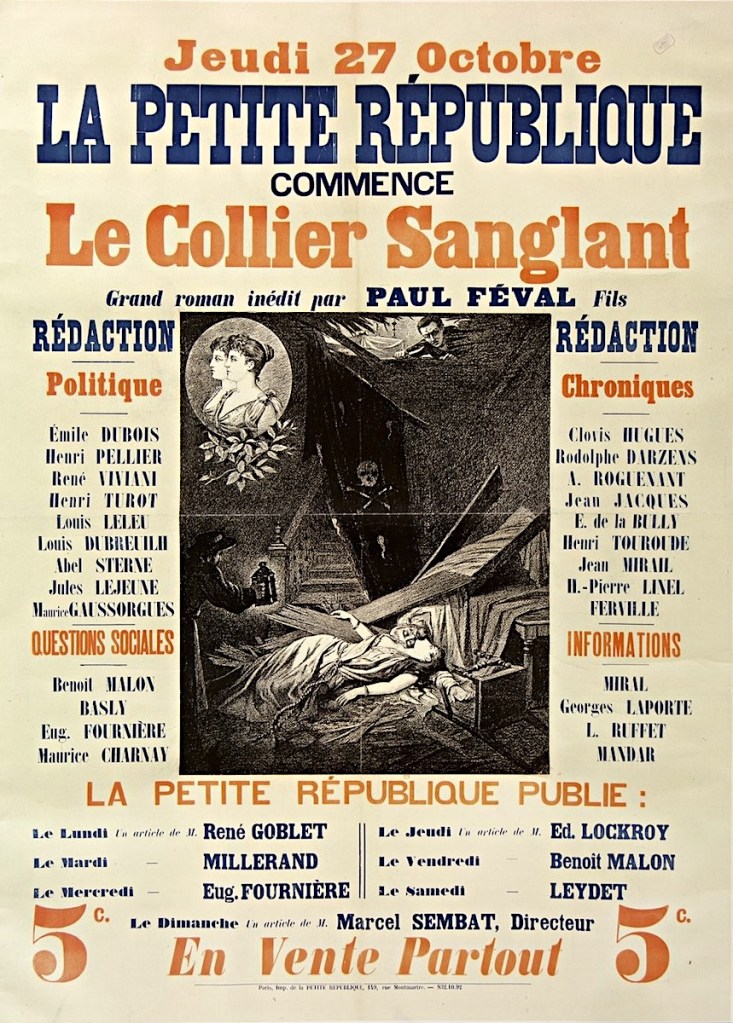
Advertising poster for “The Bloody Necklace” by Paul Féval fils. Installment novel published in La Petite République newspaper (1892). Gallica: Bibliothèque nationale de France.
FURTHER READING
Thanks to the tireless efforts of translator Brian Sableford and Black Coat Press (Encino, California), Féval’s entire Les Habits Noirs series has been translated into English under the uniform series title The Black Coats: The Parisian Jungle (2008), Heart of Steel (2010), ’Salem Street (2005), The Sword Swallower (2011), The Invisible Weapon (2006), The Companions of the Treasure (2008), and The Cadet Gang (2010). All may be purchased in paperback directly from Black Coats Press or as Kindle e-books.
NOTES
[1] Paul Féval, La fabrique des crimes (1866), series “Les Populaires,” ed. Lucien d’Althier (La Tour d’Aigues: Éditions de l’Aube, 2006), p. 1. Throughout this blog post, English translations are by the author.
[2] Féval is being sarcastic. The Académie Française awarded a number of Prix Montyon, two of the most important being the prix pour l’ouvrage le plus utile à la sociéte (“prize for the work most beneficial to society” and the prix de vertu (“prize for an ethical work by an ordinary Frenchman”). S.v. “Prix Montyon,” in Pierre Larousse, Grand Dictionnaire Universel du XIXe siècle, vol. 11 (1874).
[3] This biographical sketch is compiled from: Eugène de Mirecourt, Paul Féval–Emmanuel Gonzalès, series “Les Contemporains,” vol. 36 (Paris: Harvard, 1855); Yves Olivier-Martin, “Tel qu’en lui-même,” Désiré: Étude des Illustrés, Fascicules, Livres et Auteurs populaires, no. 3 (December 1970); and, Francis Lacassin, “Préface,” in Les Habits Noirs, vol. 1 (Laffont, 1987).
[4] Féval’s subsequent feuilleton novels include: Les Aventures d’un émigré (1844), Les Amours de Paris (1845), La Quittance de minuit (1846), and, Le Fils du Diable (1846). S.v. “FÉVAL, Paul (Henry Coretin)” in Dictionnaire des littératures policières.
[5] In English translation: Paul Féval, John Devil, trans. Brian Stableford (Encino, Calif.: Black Coats Press, 2004).
[6] Subsequent novels in Féval’s Les Habits Noirs series: Cœur d’acier (1866), L’Avaleur de sabers (1867), La rue de Jérusalem (1868), L’Arme invisible ou Le Secret des Habits Noirs, suivi de Maman Léo (1869), Les Compagnons du trésor (1872), and La Bande Cadet (1875).
[7] Féval’s confessional books: Étapes d’une conversion (4 volumes, 1877-1881), Coup de grâce (1881), and Jésuites! (1878).
[8] These included Decadent author Barbey d’Aurevilly, conservative and antisemitic novelist Alphonse Daudet, and theatrical playwright Victorien Sardou. See Charles Buet, Paul Féval, souvenirs d’un ami (Paris: Letouzey et Ané, 1887).
SOURCES
Dictionnaire des literatures policières, 2 vols., ed. Claude Mesplède (Nantes: Joseph K., revised edition 2007).
Dictionnaire du roman populaire francophone, ed. Daniel Compère (Paris: Nouveau Monde, 2007).
Paul Féval, Les Habits Noirs, 2 vols., series “Bouquins” (Paris: Robert Laffont, 1987).
Updated: May 7, 2025
Robin Walz © 2025
 Shady Detectives, Elegant Criminals & Dark Avengers
Leave a comment