
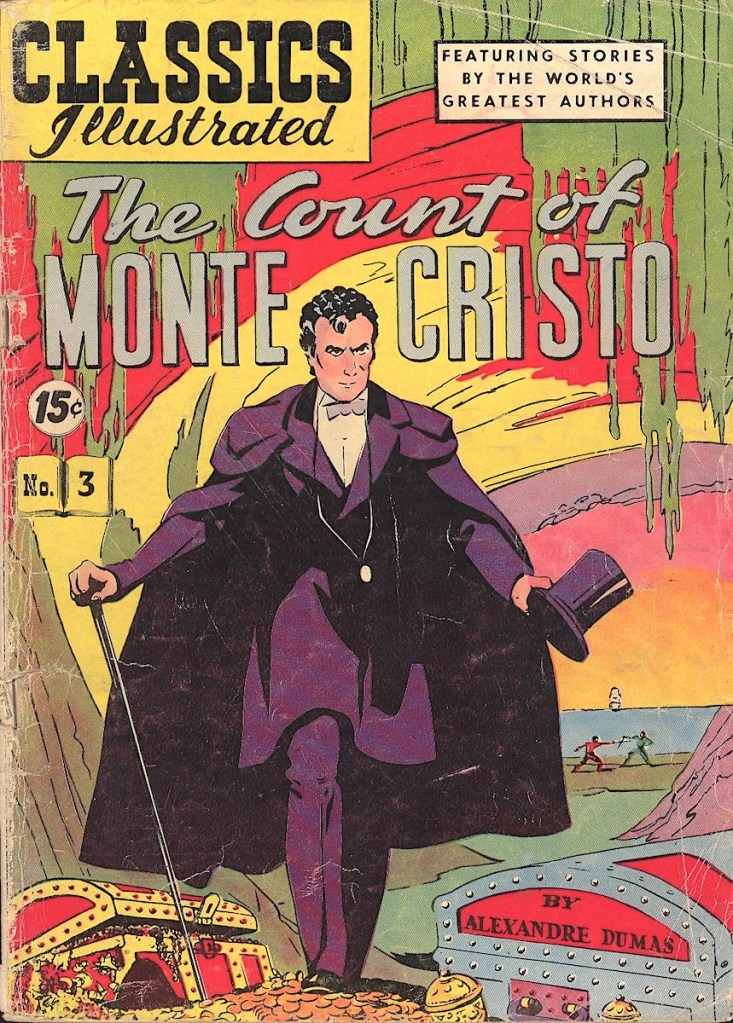
The Count of Monte Cristo by Alexander Dumas, “Classics Illustrated” Comics no. 3 (1941). Source: Andrew Wallace, Old-Fashioned Comics, November 8, 2017.
“The Diamond and Vengeance” is one of many stories recounted in Mémoires tirés des archives de la police de Paris (“Mementoes drawn from the Paris Police Archives,” 1838), attributed to Parisian lawyer, statistician, and archivist Jacques Peuchet.[1] Based on a supposedly true-crime anecdote from 1807, it’s a tale about an honest cobbler named François Picaud who is betrothed to the beautiful and modest Marguerite. Three of his lifetime friends — Gilles Loupian, Gervais Chaubard, and Guilhem Solari —are jealous of Picaud’s good fortune, however, and conspire to frame him for being an English spy. On the eve of his wedding ceremony, Picard is arrested by the police.
In court, the conspirators’ false charge of espionage is verbally corroborated by a paid accomplice named Antoine Allut. Picaud is found guilty and condemned to perpetual incarceration at an undisclosed location. Some claimed he was imprisoned in the Chateau de Fénestrelle in the Savoy. Others said he was languishing in the Chateau de l’Œuf in Naples. Within a few years, Picaud had vanished from public memory altogether, forgotten and presumed dead.
Then, rumors began to spread that Joseph Lucher, faithful servant to the son of a rich Milanese cleric, had received an inheritance of seven million francs upon the death of his benefactor. He also unearthed his patron’s stashed treasure of 12,000 diamonds, supplemented by cash assets in excess of three million in Milanese ducats, Venetian florins, Spanish quadruples, French louis, and English guineas. Lucher then traveled extensively across Europe and established multiple residences in London and various continental cities.
In 1815, a certain Abbot Baldini sought out Antoine Allut, now the owner of a derelict country inn where he lived in penury with his wife. Arriving at the couple’s shabby auberge, Abbot Baldini inquired whether the innkeeper had ever made the acquaintance of three individuals named Gilles Loupian, Gervais Chaubard, and Guilhem Solari. Allut’s memory was vague, but he believed them all to be living in Paris. The Abbot offered him a spectacular diamond, valued between 24,000 and 48,000 francs, in exchange for assistance in locating the trio. Allut agreed to the deal and set off immediately for Paris.
Once in the city, Allut quickly located Chaubard and Solari, and he set up a rendezvous for each of them with the Abbot. On the day of the first scheduled meeting, Allut was shocked to learn that the Chaubard’s corpse had been discovered at five o’clock that morning on the Pont des Arts, stabbed to death. A hand-printed note in capital letters was pinned to Chaubard’s arm, “NUMBER ONE.” A few days later, Solari arrived at a café on the Rue Saint-Antoine to keep his appointment. After quaffing a beer generously offered by his mysterious interlocutor, Solari went into a convulsive fit and died. Twelve hours later the empty beer glass was found outside Solari’s lodgings with a message posted to the door, “NUMBER TWO.”
Peuchet’s tale of vengeance reaches a climax in a series of misfortunes suffered by Gilles Loupian, now a rich coffee merchant. First, Loupian’s prized hunting dog was killed by poisoned biscuits, followed by his wife’s favorite parrot dying after eating bitter almonds. Next, Loupian’s sixteen-year old daughter was disgraced by an illegitimate pregnancy, the result of a false marriage to and abandonment by a purportedly refined and wealthy gentleman, who was actually an escaped convict. Then Loupian’s dissolute son was caught red-handed by police officers during a break-in at a liquor store. The police had been tipped off by a note written by “a brother,” and the young malefactor was condemned to prison for twenty years. Finally, the apartments above Loupian’s coffee shop burst into a raging fire. The entire residential block burned to the ground, and the businessman had to pay all civil and property damages.
Late one evening, in a darkened alleyway along the Tuileries Garden, a masked man approached the ruined Loupian. He revealed himself as Picaud, the murderer of Chabaud and Solari, before stabbing his adversary through the heart with a dagger. Sometime later, Loupian’s corpse was found among the garden bushes with a printed message pinned to his jacket, “NUMBER THREE.”

“Monte Cristo by Alexandre Dumas,” advertisement poster illustration by Louis Français (1846). Gallica: Bibliothèque nationale de France.
For anyone even vaguely familiar with the plot of Alexandre Dumas’s The Count of Monte Cristo, the parallels are obvious. Literary critics have long noted that “The Diamond and Vengeance” provided the inspiration for Dumas sprawling roman-feuilleton installment novel. François Picaud is transformed from the wrongly imprisoned Edmond Dantès into the avenging Count of Monte Cristo, Marguerite becomes Mercédès, and Allut the paid informer Caderousse. The betrayers Chaubard, Solari, and Loupian are transposed into the double-crossing financier Baron Danglars, Royal Prosecutor Villefort, and the retired General Count de Morcef, each fiendishly punished by the merciless Count of Monte Cristo. In contrast to Peuchet’s thirty-two-page short story, however, Dumas’s massive retelling ran over 5,000 pages in the original.[2]
In addition, The Count of Monte Cristo concludes very differently than “The Diamond and Vengeance.” In Peuchet’s tale, the co-conspirator Allut becomes a counter-avenger who captures the murderous Picaud, binds him in irons to a stone wall, and deprives him of food and drink. Allut verbally rages against his captive:
“For you, no doubt, vengeance is a pleasantry. But it’s not; it’s a raging madness. You ought to be horrified by your actions, but you don’t understand your demonic spirit! You have committed terrible crimes! You are lost! And in the end, you will follow me into the abyss!”
(Peuchet, p. 521; author’s translation).
Such moralizing sentiment is absent from Dumas’s massive roman-feuilleton, which dishes up countless atrocities designed and carried out by the Count of Monte Cristo, solely for the reader’s entertainment. The restorative motifs of contrition, confession, and punishment that concluded traditional tales about criminal rogues and bandits in Bibliothèque bleue chapbooks, theatrical melodramas, and even Peuchet’s short story, yield to whatever pleasures readers derive from the adventures of a dark avenger whose vengeance is entirely self-serving.
The Count of Monte Cristo metes out tens of thousands of lines of criminal schemes, tortures, brutalities, and killings, without any nod toward moral restitution or social justice. In the end, Edmond Dantès remains unpunished for his crimes. He leaves great fortunes to his personal friends, including Mercédès and her son, and slips out of the novel unscathed.
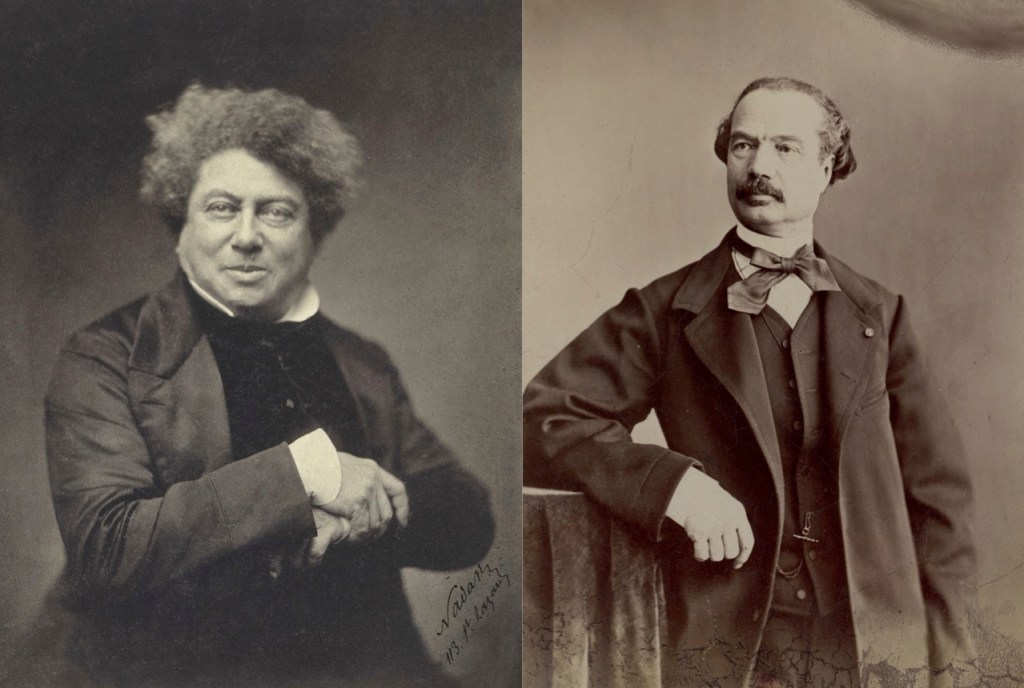
Photographic portraits of Alexandre Dumas (1855) and ghostwriter Auguste Maquet (1860) by Nadar. Wikimedia Commons: Gallica Digital Library.
Alexandre Dumas began his literary career as a playwright, the co-author of La Chasse et l’amour (“Pursuing and Capturing Love,” 1825), and had only recently started to write novels, beginning with the Gothic Romance, Pauline (1838). Looking for a breakthrough title, Dumas hit the jackpot with the historical cape and sword adventure novel, Les Trois Mousquetaires (“The Three Musketeers”), serialized in the newspaper Le Siècle from March through August, 1844.
That same year, Dumas signed a contract with Alfred-Auguste Cuvillier-Fleury, literary editor for Le Journal des débats. Cuvillier-Fleury was seeking a roman-feuilleton sensation to match the commercial success the newspaper had just achieved with Eugène Sue’s Les Mystères de Paris, published over the previous two years. Dumas agreed and embarked upon what became his second popular novel triumph, Le Comte de Monte-Cristo, published in 279 newspaper installments, 1844-1846.[3]
For his part, Dumas wanted to jump straight into the Count’s revenge story. But Auguste Maquet, his silent partner and the ghostwriter of this and many other Dumas novels, persuaded him that readers first had to sympathize with the innocent and pitilessly punished Edmond Dantès before they could swallow the profusion of cold-blooded and calculated crimes committed by the Count of Monte Cristo. Even with the inclusion of the backstory, Dumas allocated over eighty percent of his novel to nefarious crimes and killings meticulously planned and carried out by the parvenu Count and his accomplices.[3] Exacted entirely for reasons of personal retaliation, the preponderance of the Count of Monte Cristo’s innumerable crimes overwhelms the prelude of the innocent Edmond Dantès being framed and punished for an offense he didn’t commit.
Unlike other popular novelists and publishers who strove to cash in on Eugène Sue’s success, Dumas did not utilize the Mystères de… formula of delving into the criminal underworld of a famous city. For decades to come, this proved to be a successful commercial strategy for both publishers and authors, within France and internationally.[4] However, Dumas did follow Sue’s lead in making the protagonist of his adventure and crime novel an avenger. Yet the Count of Monte Cristo was not a noble prince-in-disguise, but a calculating vigilante. While Rodolphe and the Count of Monte Cristo are both avengers, justiciers in French, they are not the same type.[5]

“Les Mystères de Paris by Eugène Sue,” advertisement poster illustration by Jules Chéret (Éditions Jules Rouff, 1885). Gallica: Bibliothèque nationale de France.
Les Mystères de Paris operates according to the melodramatic logic of a moral struggle between Good versus Evil (le Bien contre le Mal), with the heroic avenger committed to social justice and moral redemption. The Count of Monte Cristo unfolds instead like a contemporary 1001 Nights, whose meaning is cached in the minutiae of events and only revealed episodically. Through a myriad of schemes, the Count exacts personal retribution against his enemies through social ruination, the massive destruction of property, and murder.
In the character of Rodolphe, Sue created the prototype for the prince-in-disguise social avenger. In actuality the Grand Duke of Gerolstein, the wealthy and insouciant aristocrat was ensnared into marriage by a conniving and libertine wife. Renouncing high society and adopting the alias Rodolphe, he becomes a caped avenger who devotes his wealth and energy towards helping those who have fallen into les dessous, the poverty-stricken gutters of the Paris underworld, most notably the redemption of the orphaned street urchin, Fleur-de-Marie. As a prince-in-disguise, Rodolphe traverses the criminal milieu with ease, and its miserable inhabitants fail to discern his true identity.
The trajectory of Dumas’s Edmond Dantès, by contrast, moves in the opposite direction. A ship’s mate from humble origins who works for a Marseilles maritime company, the wrongly incarcerated Dantès metamorphoses into the mysterious Count of Monte Cristo, passing incognito among Parisian high society and the financial elite. In disguise, the Count of Monte Cristo does not seek legal or political redress, but meticulously plans out and executes complex criminal schemes to exact brutal revenge against his personal enemies. These machinations require hundreds of pages to unfold, which sidelines any pursuit of justice that may have originally motivated Dantes’s quest for vengeance.
The figure of the dark avenger hero established in Count of Monte Cristo was recapitulated by popular novelists over the course the long nineteenth century, most spectacularly in the Rocambole novels by Pierre Alexis Ponson du Terrail, serially published in the third-quarter of the nineteenth century, and by Gaston Leroux in the criminal-avenger series Chéri-Bibi in the early twentieth. Publishers of romans populaires (“popular novels”) cultivated a mass reading audience for these dark avengers as well, by lowering the price of complete novels from 3.50 francs to 65 centimes and selling them by installment at 5 or 10 centimes per issue. For the everyday reader, revenge was both sweet and cheap.
NOTES
[1] Jacques Peuchet, “Le Diamant et la Vengeance. Anecdote contemporaine” (“The Diamond and Vengeance: A Contemporary Anecdote”), in Mémoires tirés des archives de la police de Paris, pour server à l’histoire et de la morale et de la police, depuis Louis XVI jusqu’à nos jours, vol. V (Paris: Bourmancé, 1838), pp. 197-228. Peuchet’s widow and publisher Bourmancé assembled the multi-volume collection of apocryphal stories in the Mémoires several years after the police archivist’s death in 1830.
[2] Alexandre Dumas, Le comte de Monte-Cristo, 18 vols. (Paris: Pétion, 1845-1846). My 5,000+ pages calculation is based upon this multi-volume edition, published contemporaneously with the feuilleton issued in Le Journal des débats (1844-1846). Also note: in French, the Count’s name is often hyphenated as “Monte-Cristo.” In this post, I have followed a more recent convention of dropping the hyphen, unless included in the original sources.
[3] See, Eugène de Mirecourt, Fabrique des romans. Maison Alexandre Dumas et compagnie (Paris: Chez tous les Marchands de Nouveautés, 1845), p. 39; s.v. “DUMAS Alexander,” in Dictionnaire des littératures policières, ed. Claude Mesplède, new edition, 2 vols. (Nantes: Joseph K., 2007); and, s.v. “MAQUET Auguste,” in Dictionnaire du roman populaire francophone, ed. Daniel Compère (Paris: Nouveau Monde, 2007).
[4] Dominique Kalifa, Les bas-fonds. Histoire d’un imaginaire (Paris: Seuil, 2013), pp. 133-135, and s.v. “MYSTÈRES URBAINS,” in Dictionnaire du roman populaire francophone (2007). Multiple knock-off novels stemmed from Les Mystères de Paris, for example: within France, Les Mystères de Londres by Paul Féval (1844), Les Mystères de Rouen by Octave Féré(1861), Les Mystères de Marseille by Émile Zola (1867), Les Mystères de Lille by Jean-Baptiste Najiac (1875), and internationally, The Mysteries of London by G.W. Reynolds (1844-1848), Los misteríos de Madrid by Juan Martínez Villergas (1844), The Mysteries and Miseries of New York by Ned Buntline (1848), Antonino y Anita ó los nuevos mysterios de Mexico by Edouard Rivière (1851), Os Mistérios de Lisboa by Camilo Castelo Branco (1854), and I Misteri di Roma contemporanea by Augusto F. Negro (1861-1863).
[5] Popular novel literary critic Jean-Claude Vareille lumps multiple prototypes together into the figure of the justicier: “le Trappeur… le Redresseur de torts, le Vengeur du roman populaire, Justicier, Gentleman et Surhomme” (“Tracker, Righter of Wrongs, Popular Novel Vigilante, Avenger, Gentleman Detective and Superman”), in L’Homme masqué: Le justicier et le détective (Lyon: Presses Universitaires de Lyon, 1989), p. 47.
RECOMMENDED READING AND VIEWING
Readers of abridged versions of The Count of Monte Cristo in novels and movies are denied the breadth and depth of the Count’s diabolical activities. Typically, these abridgements divide the story roughly in half: the conviction, imprisonment, and escape of Edmond Dantès from the Château d’If constituting the first part, and the revenge of the Count of Monte Cristo completing the second. As a result, the nefarious and outrageous activities of the Count, which constitute the bulk of Dumas’s novel, are underrepresented.
For reading and viewing options that more closely align with the original:
Alexandre Dumas, The Count of Monte Cristo, trans. Robin Buss (New York: Penguin Classics, 1996). Don’t be intimidated by the 1,200-page heft of this book, which is the only complete English translation of the novel currently on the market. Its dark delights satisfy.
Le Comte de Monte-Cristo, directed by Matthieu Delaporte, starring Pierre Niney (Pathé/M6 Films, 2024, 178 minutes). The best film adaptation, by far. The first two-thirds of the movie adheres closely to the events and spirit of the original novel. After, there are significant deviations and a happy ending.
Updated: June 14, 2025
Robin Walz © 2025
 Shady Detectives, Elegant Criminals & Dark Avengers
Leave a comment