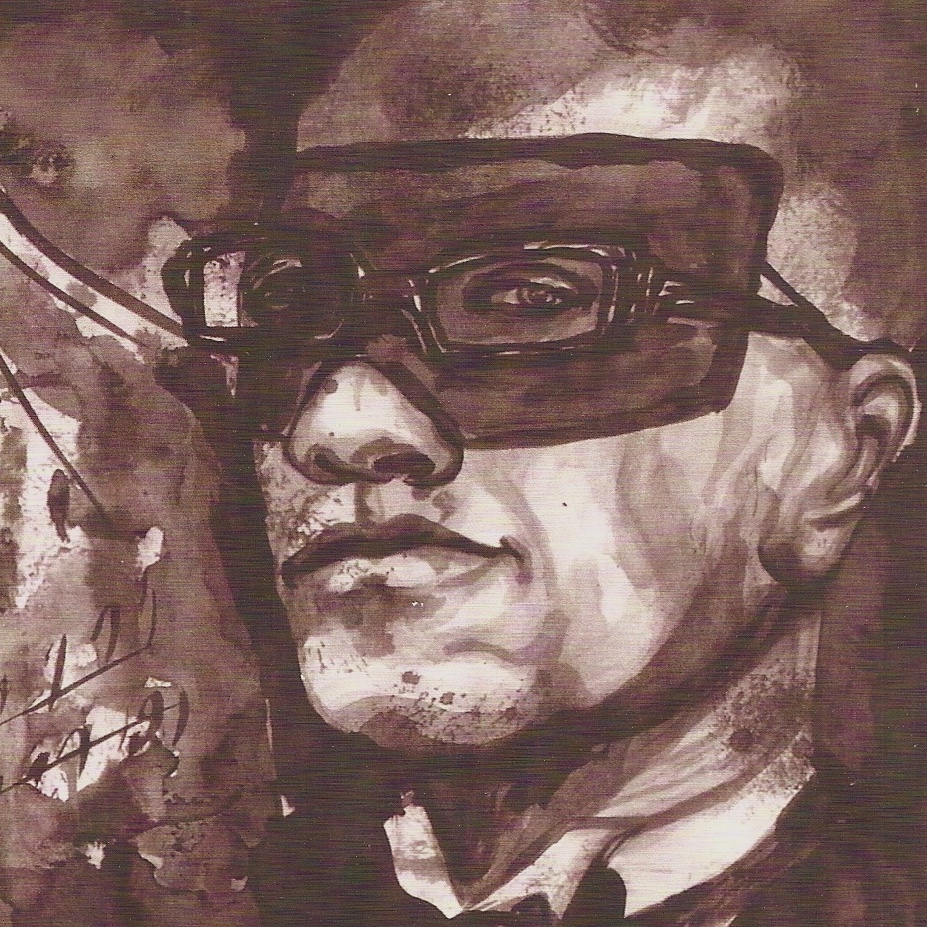
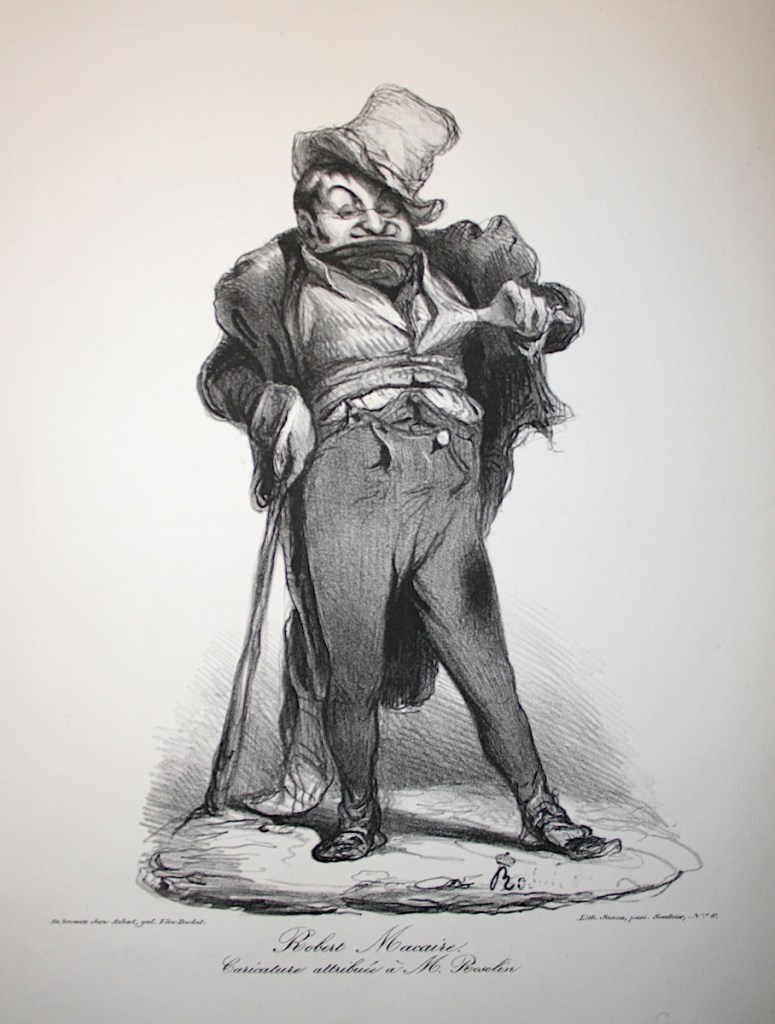
“Robert Macaire,” caricature of M. Rosolin by Honoré Daumier (1835). Collection: Armand Hammer Museum, Los Angeles.
In 1848, the melodrama Fualdès was staged in Paris at the Théâtre de la Gaité on the Boulevard du Temple, popularly known as the “Boulevard of Crime.”[1] Melodrama, pioneered by playwright Guilbert de Pixerécourt at the end of the eighteenth century, was a stock genre of sentimentalized theatrical drama characterized by overdrawn performances (akin to “tear jerkers” in romance movies today). In the early nineteenth century, crime plots emerged as the foundation for many successful melodramas — dramatic, romantic, and emotionally calculating. “Long live melodrama, where Queen Margo cried!” as Romantic dramatist Alfred de Musset satirically put it.[2] The breakout hit to bring all of this together was L’Auberge des Adrets (“The Adrets Country Inn”), which featured a highway bandit and murderer named Robert Macaire.
L’Auberge des Adrets premiered at the Théatre de l’Ambigu-Comique in Paris on July 2, 1823.[3] The mise-en-scène for the three-act melodrama is a country inn situated in the Rhône-Alps region of southeastern France. The play opens with a farmer named Germeuil who has arrived at the inn to conclude marriage negotiations between his daughter, Clémentine, and the innkeeper Dumont’s adopted son, Charles.
Around the same time, two scruffy travelers arrive, Rémond and Bertrand, disguised escapees from a Lyon prison who are seeking lodging. Rémond instantly recognizes a destitute beggar woman hanging around the inn as Marie, the wife he had abandoned eighteen years previously in Grenoble. However, she does not realize that he is her husband, Robert Macaire. Soon after, Dragoon Sergeant Robert arrives with his guards from Lyon in pursuit of the escaped convicts.
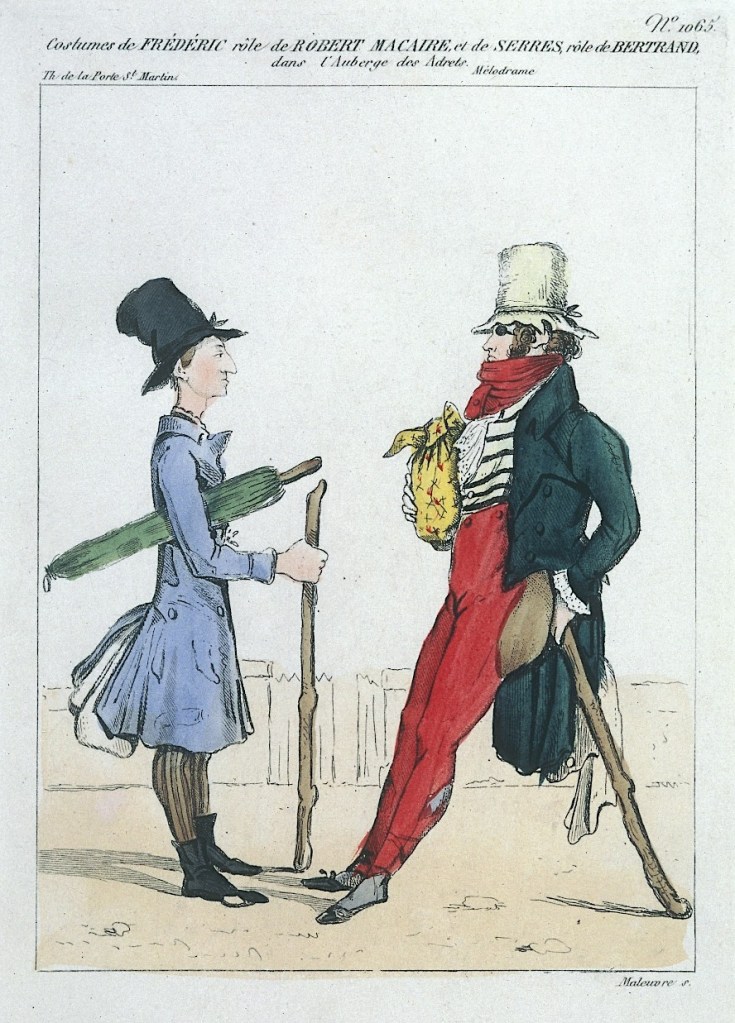
“Costumes of Frédéric [Lemaître] as Robert Macaire and Serres as Bertrade in L’Auberge des Adrets.” Colorized engraving, Atelier Maleuvre (Paris: Hautecœur Martinet, 1832). Gallica: Bibliothèque nationale de France.
The morning of Charles and Clémentine’s scheduled nuptials, the innkeeper and hired boy Pierre go to Germeuil’s room to rouse the farmer. Knocking at the locked door and hearing no response, they force their way into the room to discover that Germeuil has been murdered and robbed of his daughter’s dowry of 12,000 francs. The terrible news spreads quickly among the inn’s clientele. Rémond feigns outrage at the abominable crimes. He immediately casts aspersions upon Marie as the culprit, which convinces the bridegroom Charles of the beggar woman’s guilt.
However, Sergeant Robert has learned from the authorities in Lyon that Bertrand and Rémond are the aliases of escaped convicts Jacques Strobe and Robert Macaire. He also discovers that the beggar woman Marie and Macaire are Charles’s birth parents. Converting the inn into a makeshift prison, Sergeant Robert arrests Macaire and Bertrand.[4] Locked in a room together, they conspire to escape later that evening.
Caught in a trap, Macaire decides that returning prison is a better fate than losing his head to the executioner. Whispering through the door to the hostelry boy Pierre, he deceives the lad into believing that Bertrand is the one who has committed the theft and murder, not himself. Bertrand, however, has overheard Macaire’s conversation.
When Bertrand appears that evening with stolen horses for the planned escape, instead he fires a pistol at his traitorous partner. Mortally wounded, Macaire confesses before the gathered crowd at the inn that he and Bertrand are co-conspirators in the theft and murderer of Germeuil. He proclaims Marie’s innocence, begs her forgiveness, and expires.
While L’Auberge des Adrets was a fairly typical melodrama, revolving around a limited cast of characters and unveiling criminals who are ultimately punished, the play’s opening run received poor reviews from the critics. During the second run, however, the actor Frédérick Lemaître, who played Rémond/Macaire, began to interpret the villain as witty and comical, in addition to being shifty. His performance proved so popular with audiences that Lemaître and Macaire soon became synonymous. In 1835, Lemaître and co-authors revised and retitled the play as Robert Macaire, expanded to four acts. Now a celebrated actor, Lemaître reprised the role of Macaire on stage repeatedly for more than fifty years, until his death in 1876.

“Frédérick Lemaître (Auberges des Adrets),” photo-lithograph portrait by Etienne Carjat (Atelier Piallat, 1867). Collection: The Art of the Photogravure.
Macaire’s popularity increased over the coming decades through the serialization of his exploits in print media. His fictional character was even credited with writing a novelization of the play, The Adrets Country Inn: Manuscript by Robert Macaire found in the pocket of his friend, Bertrand (1833), in which the villain’s fate is left hanging in a balance with Marie praying for his soul.[5] Shortly thereafter, novelist Louis-François Raban wrote an entirely new series of adventures, Robert Macaire: Memoires and Recollections (1838), which ends with Macaire regretting his criminal past and pondering his pending execution, although the attributed self-authorship of the fictional autobiography leaves that ending ambiguous.[6]
Macaire found a popular Bibliothèque bleue readership as well, in chapbooks such as Robert Macaire in Hell, in which Macaire and Bertrand exchange conversations after their executions in verses set to popular tunes.[7] Such popular imprints circulated Macaire’s criminal exploits and comic reputation throughout France, to include readers in towns and villages who could not attend theatrical melodramas along the “Boulevard of Crime” in Paris. By century’s end, Robert Macaire’s life, adventures, and fate had multiplied in many and contradictory ways, but always as the comedic criminal.[8]
According to dramaturge Marion Lemaire, Macaire was the first criminal hero who simultaneously expressed and critiqued the bourgeoisie: “the bandit is also the dandy, educated and well spoken, operating outside the law and showing insolence towards its representatives” (p. 336; author’s translation).

“Robert Macaire, Philanthropist,” color lithograph by Honoré Daumier (1838). Sign: CLEANSING SOCIETY (clyster or enema detoxing). “See here, Bertrand. We are moral benefactors in action… actions at 250 francs apiece, you understand [a wordplay on actions in French, which are also stock transactions]. We’ll sign up shareholders free of charge; you clean them and I’ll bleed them.” Collection: Metropolitan Museum of Art, New York.
Macaire is a conniving, nasty, and despicable criminal, yet his comically inflated sense of self-esteem ridiculed bourgeois pretensions and resonated sympathetically in Parisian audiences through laughter. His devious criminal designs, physical violence, and disdain for law and order becomes acceptable through his humorous persona as a criminel mondain, the criminal as a déclassé bourgeois man-about-town. The image of Robert Macaire as a con man financier and philanthropist was circulated through more than one hundred caricatures by Honoré Daumier published in the nineteenth-century satirical magazine Le Charivari.
Given political and social instabilities of life under the Bourbon Restoration and July Monarchy through the 1840s, the fashionable criminal became a popular hero by exposing hypocrisies. Lemaire affirms, “Crime resides not only in the acts of Macaire, but also in a society that is essentially criminal” (p. 336; author’s translation). Through the inversion of the melodramatic formula of the triumph of good over evil, Macaire’s perpetual insolence takes aim at a status quo in which the rich are swindlers and the poor are left to suffer. Gentleman or not, the dandy Macaire remains a criminal menace.
In light of public fascination with the Fualdès Affair, in which imagined criminal scenarios superseded reality, and given the enduring popularity of the melodramatic and comical character Robert Macaire, the cultural groundwork had been prepared for Lacenaire’s imaginary persona as the “elegant criminal.” Readers of press coverage of court proceedings and causes célèbres about the Fualdès Affair expected more than reportage about the horrible details of crimes; they were eager to delve into the personalities of the culprits as well. In Lacenaire’s case, his failed exploits as a thief and murderer became less important to the public than his debonair appearance and witty performance in the courtroom, enhanced by his celebrity image in the press.
NOTES
[1] Charles Dupeuty and Eugène Grangé, Fualdès, drame en cinq actes et huit tableaux (Paris: Michel Lévy Frères, 1848).
[2] “Vive le mélodrame où Margot a pleuré.” S.v. “Mélos et drames,” in Dictionnaire du roman populaire francophone, ed. Daniel Compère (Paris : Nouveau monde éditions, 2007). Musset’s satirical reference is to Alexandre Dumas’s historical novel, La Reine Margot (“Queen Margot,” 1845), replete with poisonings, murders, and massacres, in a struggle between deceased King Henri II’s daughter Marguerite de Valois (“Margot”) and the widowed Catherine de Medici over who will next become Queen.
[3] MM. Benjamin Antier (pseudo. Benjamin Chevrillon), Saint-Amant (pseudo. Jean Amand Lacoste) et Paulyanthe (pseudo. Alexandre Chapponier), L’Auberge des Adrets, melodrama en trois actes à spectacle, réprésenté pour la première fois à Paris, sur le Théatre de l’Ambigu-Comique, le 2 juillet 1823 (Paris: Chez Pollet, 1823). The summary that follows is taken from this script.
[4] While Rémond becomes Robert Macaire in further adventures and visual depictions, his partner continues to be referred to as Bertrand.
[5] L’Auberge Ardets, manuscrit de Robert Macaire trouvé dans la poche de son ami Bertrand, 4 vols. (Paris, Baudouin, 1833). Author’s translation of the title.
[6] Louis-François Raban, Robert Macaire: Mémoires et souvenirs, 2 vols. (Paris et Girard, éditeurs, 1838). Author’s translation of the title. According to editor Michel Le Bris, five years earlier Raban had originally published the book as L’Auberge des Adrets: Histoire de Robert Macaire, 4 vols. (1833), in Assassins, hors-la-loi, brigands de grands Chemins: Mémoires et histoires de Lacenaire, Robert Macaire, Vidocq et Mandrin, (Bruxelles: Éditions Complexe, 1996).
[7] Robert Macaire aux enfers (Paris: Imprimerie de Chassaignon, 1836). Author’s translation of the title.
[8] Saint-Amand, L’Auberge des Adrets: Histoire véridique de Robert Macaire et de son ami Bertrand, préface de Jules Lermina, dessins d’Émile Cohl (“The True History of Robert Macaire and His Companion Bertrand,” Mousseau: Paris, 1887). The book is a compilation of various sources produced over the nineteenth century.
SOURCES
Noémi Carrique, “Le succès du crime sur scène avec Robert Macaire: modernité théâtrale et protestation sociale au XIXe siècle,” Criminocorpus, revue hypermédia: Histoire de la justice, des crime et des peines (Varia, 2012): https://doi.org/10.4000/criminocorpus.2218.
Marion Lemaire, Robert Macaire: La construction d’un mythe. Du personnage théâtrale au type social, 1823-1818 (Paris: Honoré Champion Éditeur, 2018),
Charles Philipon, ed., Les cent et un Robert-Macaire, illustrations by Honoré Daumier (Paris: Aubert et cie., 1840).
Updated: January 21, 2025
Robin Walz © 2025
 Shady Detectives, Elegant Criminals & Dark Avengers
Leave a comment