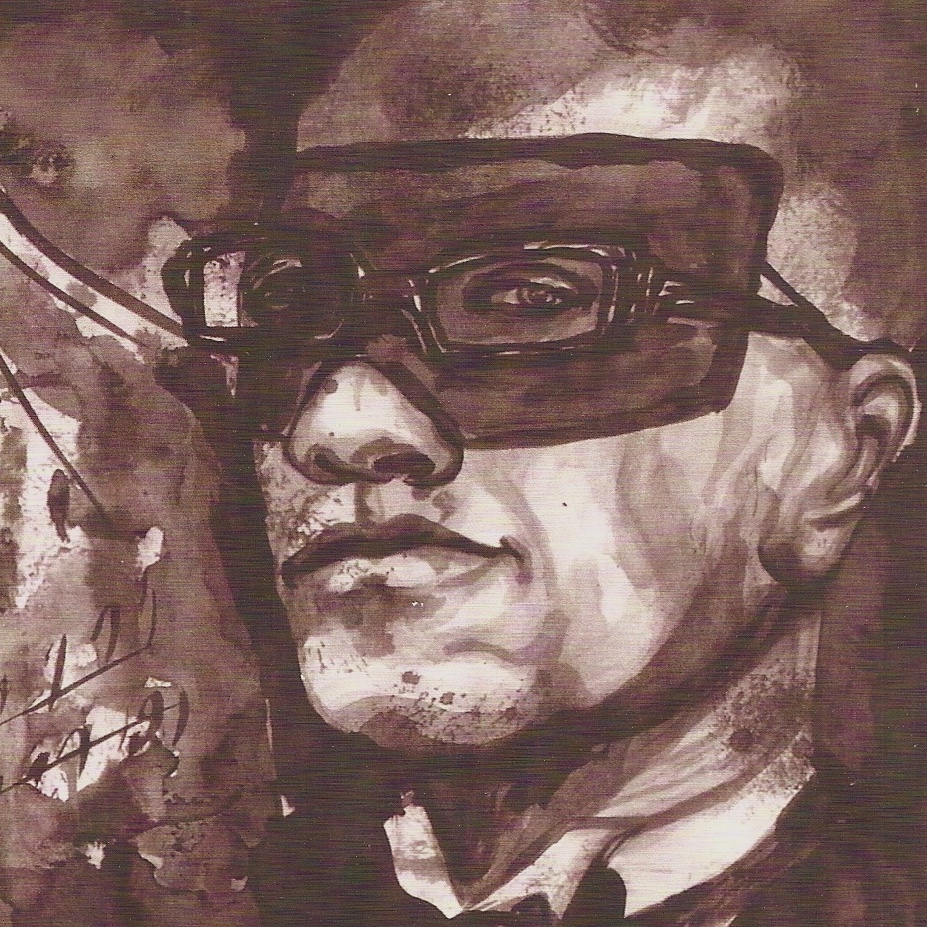

Dustjacket Cover of Vidocq: The Personal Memoirs of the First Great Detective, trans. Edwin Gile Rich (Cambridge, Mass.: Houghton Mifflin, 1935). Author’s Collection.
The primary value of Vidocq’s Mémoires lay in its formulation of the detective as a heroic character. As French historian Dominique Kalifa has convincingly shown, nineteenth-century published accounts of the Parisian bas-fonds underworld are riddled with confabulations, some features inherited from earlier crime writing, others infused with new attributes. Tales of imagined criminality and its underworld environs were avidly consumed by a growing reading public, which boosted sales for the publishers, provided incomes for newspaper journalists, and accorded celebrity status to the authors of serialized popular fiction. The invented and embellished encounters between Vidocq’s security police agents and criminals in the Mémoires laid the foundations for the nineteenth-century social imagination of crime, beyond any investigative methods Vidocq may have haphazardly pioneered.
Foremost was the introduction of the detective as a protagonist hero. In contrast to the enquête or formal police inquiry, typical of the classic detective story, Vidocq set out to capture already known criminals, which makes him more of a “tracker” than an investigator. In picaresque fashion, his detective is an interloper who surreptitiously mingles with the criminal milieu. According to Régis Messac, the first literary scholar of French detective fiction, Vidcoq’s Mémoires provided a rough draft of the mystery narrative:
The uniform schemata: There is a theft, and Vidocq is charged with the investigation. He disguises himself as a lowlife type, hangs out in a cabaret and straightaway starts talking about the crime, or orders one of his many stool pigeons to bring him information. Once the thief is known, Vidocq worms his way into his good graces and obtains a confession, or information that amounts to as much, such as the name and address of the front man, or where the stolen goods are stashed or hidden. Once obtained, the thief is arrested in dramatic fashion, and Vidocq moves on to the next case.
Messac, Le “Detective Novel”, p. 245. Author’s translation.
While lacking any sense of “whodunit,” nonetheless Vidocq’s Mémoires constituted an early version of the intrepid detective who goes to extraordinary lengths to pursue criminal suspects.
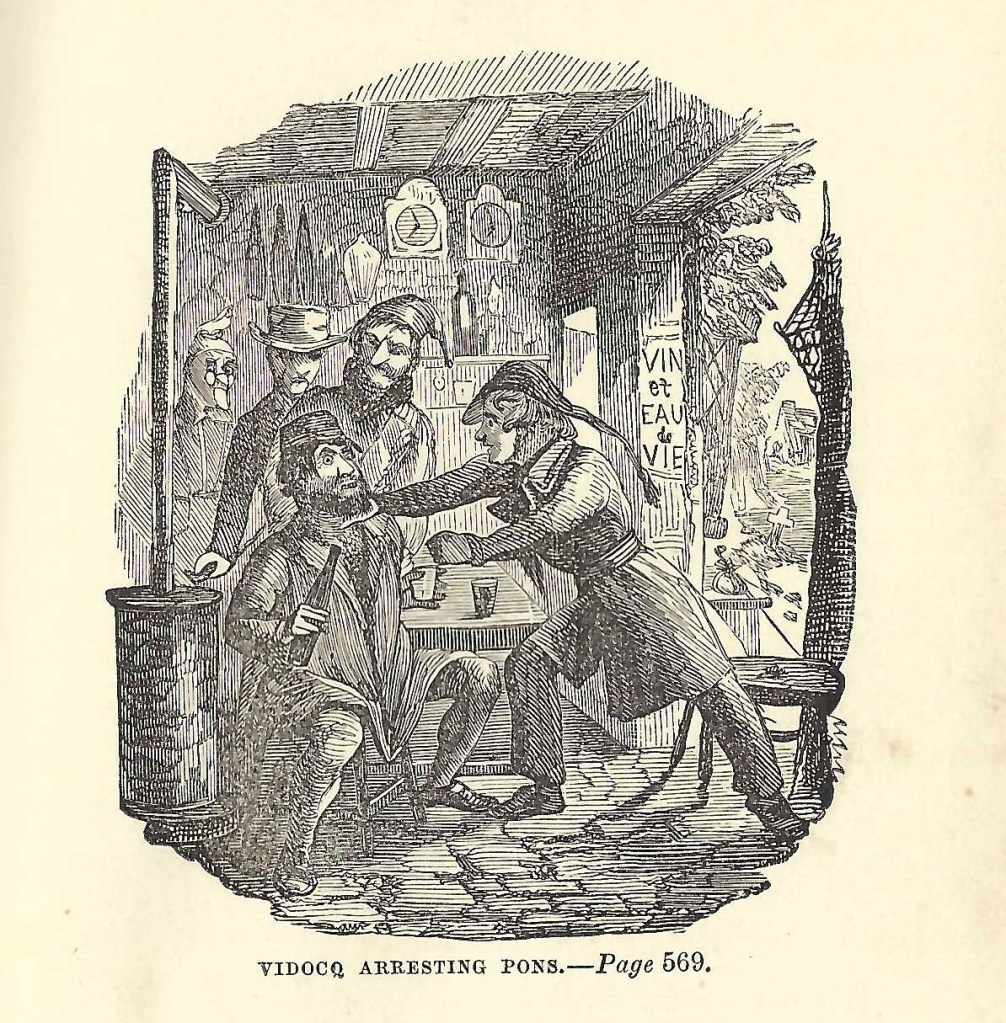
“Vidocq arresting Pons.” Engraved illustration attributed to Cruishank, in Memoirs of Vidocq: The Principal Agent of the French Police, Written by Himself (Philadelphia: T. B. Peterson, 1859). Author’s Collection.
With unparalleled knowledge of the underworld, undaunted courage, possessing a nearly magical ability to divine physiognomy, and endowed with the physical strength to overpower his enemies, Vidocq’s victory over criminals was guaranteed. But unlike his bandit forebears, such as the bandit Cartouche and the smuggler Mandrin, he employed these qualities on the side of the police toward upholding established society, rather than playing the marginalized tragic hero who seeks redress against injury and injustice. Vidocq became a modern hero by transforming the redoubtable brigand into the indefatigable detective, who transgresses social and moral boundaries in the name of upholding law and order.
Vidcoq also relied heavily on dissimulation to infiltrate the criminal milieu. A master of disguise and colloquial in speech and gestures, he surreptitiously slid from one social station to another with ease. According to the Mémoires, Vidocq first employed the arts of impersonation to escape from prison, variously disguised as a uniformed captain, city official, common soldier, sailor, and the nun “Sister Vidocq.” As a fugitive he lived under forged passports, as a sundry goods shop owner named Blondel and the navy gunner Corporal Lebel. As a detective, Vidocq most often disguised himself as a member of the underworld milieu.
One of his more more memorable identity transformations recounted in the Mémoires was as a prison escapee named Germain. While roughly the same age, the two men were entirely different in appearance. In contrast to Vidocq’s Herculean physique, Germain was small, skinny, had dark skin and hair color, and a tobacco drip at the end of his excessively long nose. Still, Vidocq emphasized, he rose to the challenge:
I had to work hard to play the role of Germain. The difficulty did not frighten me, however. My hair was cut short like a prisoner’s and dyed black, as was my beard, which I had let grow out for eight days. To darken my face, I washed it with a nutshell liquid extract and, to complete the illusion, garnished my nostrils with coffee grounds held on by actor’s gum to simulate the drip, which was not superfluous but provided me with Germain’s nasal accent…. I forgot nothing in achieving this realistic transformation, neither the shoes nor the shirt marked with the terrible letters GAL [galérien, a prisoner who rowed galley ships]. The costume was perfect; it only lacked the insects that populate those wretched places of loneliness, along with locusts and rains of frogs, which I believe belong among the seven plagues of ancient Egypt….
Mémoires, p. 310. Author’s translation.
Supposedly, Vidocq’s remarkable disguises completely fooled his underworld adversaries. But for readers of the Mémoires, the believability of the disguise was less important than the delight taken in imagining that Vidocq could metamorphose into any role, however improbable. Given the anxious passage from aristocratic to bourgeois society in the early nineteenth century, no doubt Vidocq’s mostly middle-class readers took comfort in the ability of the detective to infiltrate the criminal underworld and emerge victorious. This ability to assume any identity would remain popular in French crime fiction well into the early twentieth century, not only for heroic detectives, but for mastermind criminals and vigilante avengers as well.
When it came to gender relations, Vidocq was unquestionably a “man’s man,” a gallant seducer who dominated women. Throughout the Mémoires, Vidocq boasts of his victories in battles between the sexes, highlighting his amorous conquests and abandoning his mistresses. He depicted the general character of women as slow-witted and gullible, such as the hunched woman who led him to a storefront for stolen goods. When it came to clever and crafty women, he bragged about outwitting female criminals, notably Madame Noël, who provided safe haven to escaped convicts, and Adèle d’Escars, the prostitute leader of thieves.
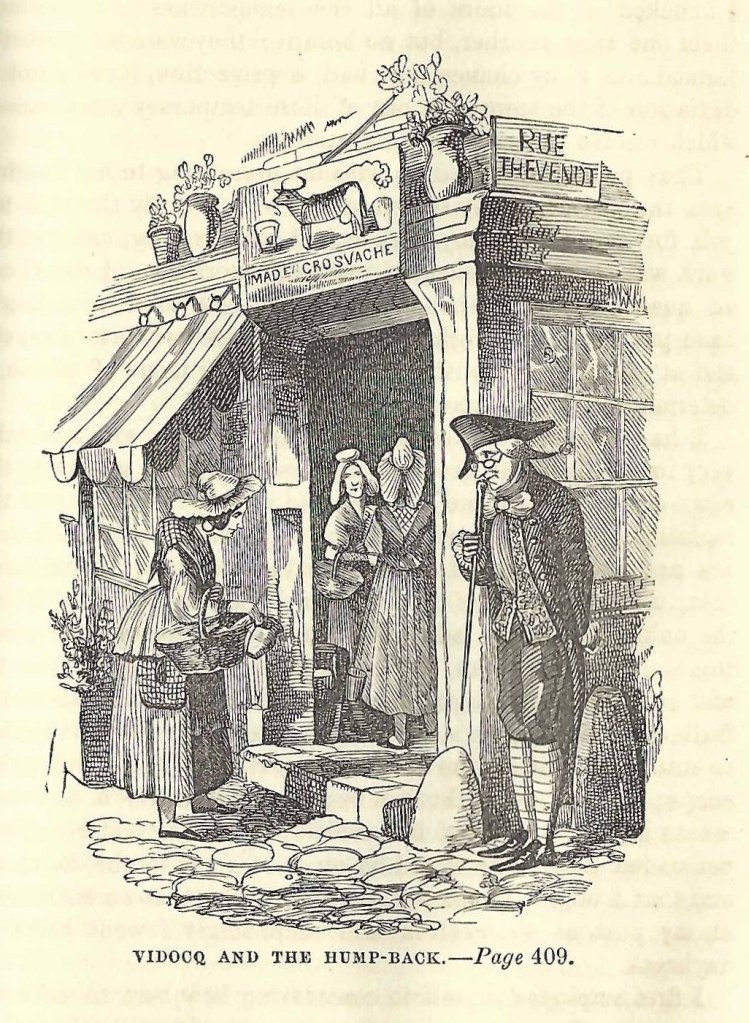
“Vidocq and the Hump-Back.” Engraved illustration attributed to Cruishank, in Memoirs of Vidocq: The Principal Agent of the French Police, Written by Himself (Philadelphia: T. B. Peterson, 1859). Author’s Collection.
Vidocq viewed consorting with women, however, as a source of emasculation. This attitude comes through most directly in his description of beau garçon Coco Lacour, a former criminal and member of his security squad, whom he regarded “a sad example of the dangers of a bad upbringing” (Mémoires, p. 331; author’s translation). According to the Mémoires, Coco was orphaned as a youth and raised by courtesans in the “Palace of Equality.” In childhood, he was pampered with feminine caresses, adopted coquettish manners, and was captivated by the glitter of jewelry. The courtesans mentored his apprenticeship in the arts of seduction and swindling, which set him on the criminal path that eventually led to becoming a member of Vidocq’s security squad.
In Vidocq’s estimation, Coco’s effectiveness as a security agent was marred by his enervated physiognomy — pallid with pale blue eyes and a narrow forehead, blonde and balding, and the tip of his nose slightly red from wine. Vidocq was also bothered by Lacour’s flamboyant appearance, adorned with jewelry and chain necklaces. Upon Vidocq’s decommission in 1827, the leadership of the security squad passed briefly to Coco Lacour. Police contemporaries agreed that Lacour was an effeminate dissimulator who was not really the man for the job, which came to an end in 1829 when Paris Prefect Debelleyme dissolved the brigade de sûreté.
The Mémoires also evoke an atmosphere of mystery by textually traversing the imagined murky terrain, language, and the customs of the criminal milieu. In this regard, the Mémoires share a continuity with Bibliothèque bleue tales of banditry and jargon dictionaries, already popular with reading audiences for three centuries. Vidocq peppered the Mémoires with criminal argot, highlighting slang terms in italics with French translations following. For example, when highwaymen tortured isolated farmers to get them to reveal where money and valuables were hidden, Vidocq wrote:
Criminal argot: “Si j’avais refroidi tous les garnafiers que j’ai mis en suage, je n’en aurais pas le taf aujourd’hui.”
Vidocq’s French translation: “Si j’avais tué tous les fermiers auxquels j’ai chauffé les pieds, je n’en aurais pas peur aujourd’hui.”
My translation: “If I had killed all the farmers whose feet I put in the fire, I wouldn’t be afraid of doing jobs today.”
Mémoires, p. 153.
The Mémoires contain hundreds of argot terms, yet they are rarely repeated, which of course they would be if used in everyday conversation. Over the course of the nineteenth century, feuilleton authors who serialized crime stories in magazines and newspapers continued to invoke criminal argot in their fiction. While retaining the convention of rendering argot in italics, with or without French translations, the number of slang terms were generally reduced and worked more smoothly into narrative dialogue.
Subsequent to the Mémoires, Vidocq published additional books on the language and customs of criminals: Les Voleurs, physiologie de leurs mœurs et de leur langage (“Thieves, a physiology of their customs and language,” 1837), Les Vrais Mystères de Paris (“The True Mysteries of Paris,” 1844), and Les Chauffeurs du Nord, souvenirs de l’an IV à l’an VI (“Highwaymen of the North: Memories of the Revolutionary Years IV-VI,” 1845).[1] These titles were not mass marketed, but aimed at a bourgeois clientele, as the average price of books in the early-nineteenth century lay beyond the means of working and middling-income Parisian readers. Still, Vidocq reached popular reading audiences through Bibliothèque bleue chapbooks that included apocryphal versions of the Mémoires and argot dictionaries attributed to him.[2] By publishing his exploits and promising insider knowledge of the criminal milieu, Vidocq’s wider reputation as a virtuoso detective hero captured the imagination of readers across all social levels.
Updated: December 11, 2024
NOTES
[1] Les Voleurs, physiologie de leurs mœurs et de leur langage, 2 vols. (Paris: Chez l’auteur, 1837) ; Les Vrais Mystères de Paris, 7 vols. (Paris: Cadot, 1844); and, Les Chauffeurs du Nord, souvenirs de l’an IV à l’an VI, 5 vols. (Paris: Au comptoir des imprimeurs unis, 1845).
[2] Nouveau Dictionnaire d’argot par un ex-chef de brigade sous M. Vidocq (Paris: Chez les marchands de nouveautés, 1929); Histoire de Vidocq, chef de la police de sûreté depuis 1812 jusqu’en 1827 par G… (Paris: Chassaignon, 1830); and, La vie, les exploits et les aventures de D. Cartouche; mémoires nouveaux, suivis du dialogue des morts, entre Cartouche et Mandrin, du dictionnaire d’argot, et du traité de la langue des voleurs; par M. Vidocq (Paris et Bruxelles: Landois et Cie, 1836).
SOURCES
Histoire de Vidocq, écrite d’après lui-même par M. Froment du Cabinet particulier du Préfet 1829, reprint edition (Paris: Robert Laffont, 1967).
Didier Blonde, Les voleurs de visages: Sur quelques cas troublants de changements d’identité: Rocambole, Arsène Lupin, Fantômas & Cie (Paris: Métalié, 1992)
Dominique Kalifa, Les bas-fonds: Histoire d’un imaginaire (Paris: Seuil, 2013); Vice, Crime, and Poverty: How the Western Imagination Invented the Underworld, trans. Susan Emanuel, intro. Sarah Maza (New York: Columbia University Press, 2019).
Régis Messac, Le “Detective Novel” et l’influence de la pensée scientifique (1929), revised edition, ed. Jean-Luc Buard et al. (Paris: Les Belles Lettres/Encrage, 2011).
Eugène-François Vidocq, Mémoires. Les voleurs, Collection “Bouquins” (Paris: Robert Laffont, 1998).
Robin Walz © 2024
 Shady Detectives, Elegant Criminals & Dark Avengers
Leave a comment