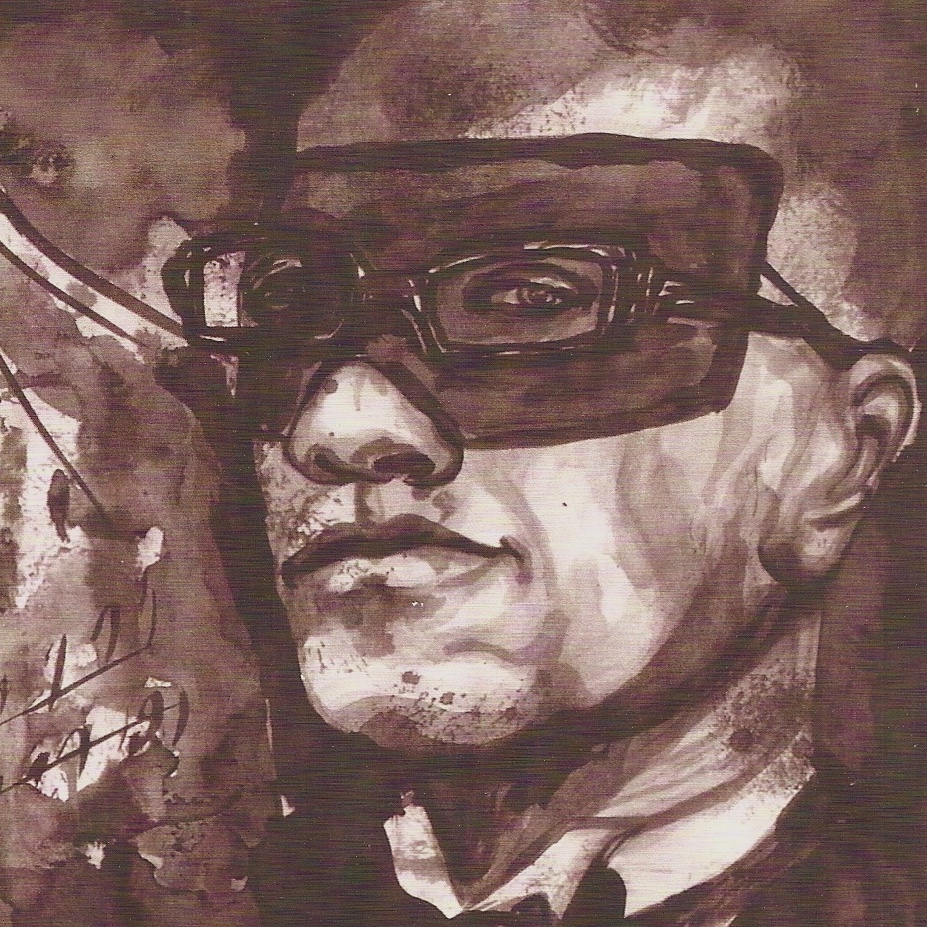
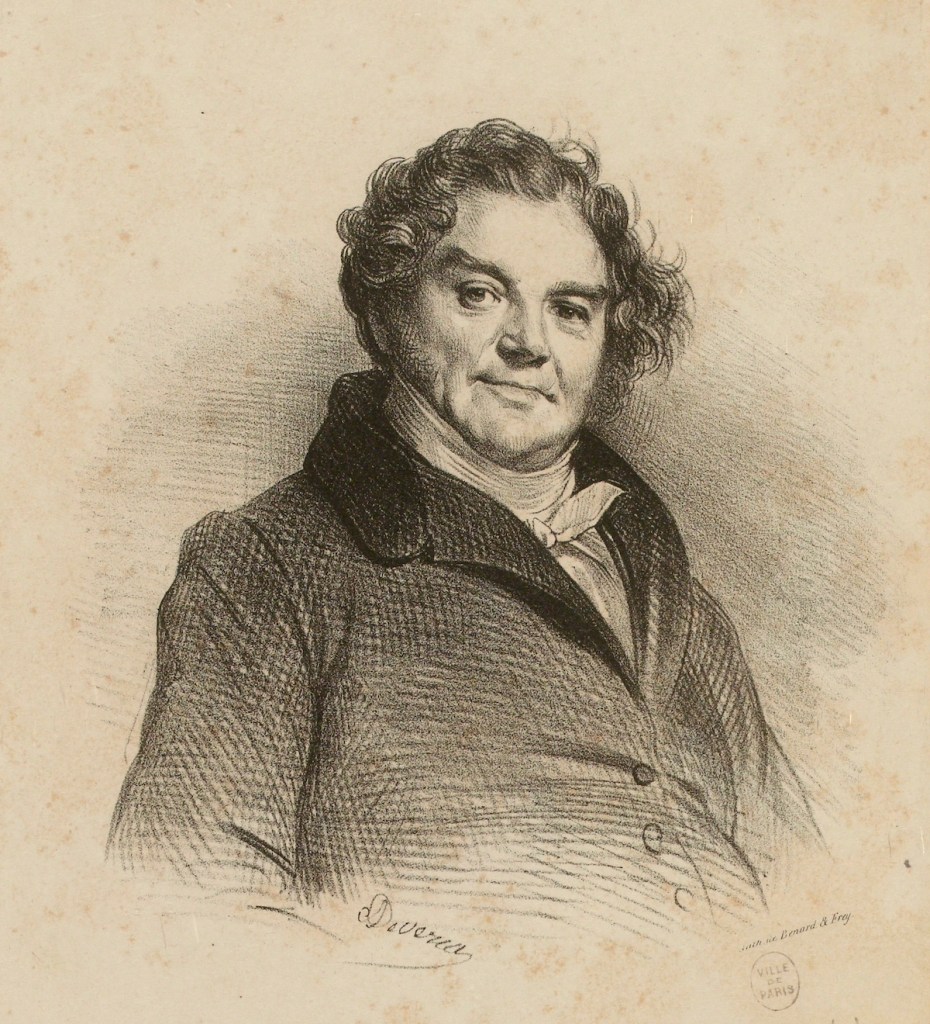
“Portrait of Eugène Vidocq, Adventurer and Security Police Chief,” by Achille Devéria, c. 1828. Wikipedia Commons: Musée Carnavalet, Paris. Note the caricature embellishments.
In June 1827, Vidocq resigned from his position as security squad chief, ostensibly because he disagreed with how the Paris Prefecture of Police was being run. Others from within the Prefecture were concerned about mismanagement as well, for various reasons. Under the Restoration of the Bourbon Monarchy, Paris Police Prefects Élie Decazes, Jules Anglès, and Guy Delavau had come under public attack in published pamphlets as opportunists who used spies and informants for personal and political gain, rather than to uphold the law.[1]
Closer to home for Vidocq, Henry’s handpicked successor for his position as Second Division Chief, Parisot, was replaced in 1827 by a high-minded, ambitious, and disciplined police commissioner named Duplessis, who had little patience for the suspect methods of the security squad. Shortly after Dupleissis’s appointment, Vidocq resigned and bequeathed his position to one of his agents, the flamboyant Coco Lacour. In 1829, recently appointed Paris Prefecture of Police Louis-Maurice Debelleyme dissolved the brigade de sûreté, and its duties were assigned to regular agents within the Second Division.
With the Prefecture and the Second Division putting its house in order, the chaotic conditions that had given Vidocq and his men free rein for fifteen years rapidly drew to a close. After his resignation, Vidocq struggled to find a new métier. Initially, he became the owner of a paper and cardboard factory in Saint Mandé, located on the eastern periphery of Paris. In this business effort, Vidcoq presented himself as a moral benefactor who provided former convicts a path towards becoming honest men by employing them in his factory. He also claimed to have invented an improved method of printing counterfeit-proof paper money. Despite such entrepreneurial boasting, Vidcoq’s business venture was a commercial failure.
A brief return to police service ended badly for him as well. In an effort to suppress political opposition during the tumultuous political regime transition to the Bourgeois Monarchy of Louis Philippe, in March 1832 newly appointed Paris Police Prefect Henri Gisquet reappointed Vidocq as chef de la police de sûreté, the leader of a newly created “security police” force. Once again, Vidocq’s reinvigorated security team was composed of former convicts. During the street riots in Paris on June 5-6, Vidocq’s agents so vigorously and violently assaulted protesters that they were openly criticized in the press as agents provocateurs and murderers.[2]
Vidocq’s renewed ambitions as security police chief completely ran aground in September 1832, during the trial of a criminal gang arrested for grand theft in Fontainebleau. Vidocq’s agents had led the police raid that foiled the heist earlier in March. During the trial, however, it came out that one of the members of the security police, named Léger, had participated in planning the robbery. Found guilty, Léger was sentenced to two years of imprisonment as an accomplice to the grand theft. Setting aside whether he acted independently or had conspired with his colleagues to pull off the caper, Police Prefect Gisquet decided the security police was a public embarrassment and political liability. Rather than recruit former criminals as police agents, Gisquet concluded it would be more prudent simply to hire the occasional services of mouchards, “fly-on-the-wall” informers from the milieu, as police snitches. Under both press and official pressure, Vidocq resigned from police service for a second time that November.
In 1833, Vidocq struck upon a more lucrative venture by opening a private detective agency, Le Bureau de Renseignements Universels dans l’intérêt du commerce (“Office of General Information Useful to Businesses”). Located in the fashionable Gallerie Vivienne arcade in the center of Paris, for an annual subscription of twenty francs per year Vidcoq’s agency would prepare files for clients on known crooks and fraudulent businessmen — information gathered by-in-large from documents Vidcoq had collected during his time at the Prefecture. While such private information agencies had existed in Paris since the late-eighteenth century, Vidocq augmented the scope of his firm by offering his clients private police services. Subscribers could hire Vidocq’s agents to conduct inquiries not only into confidential business dealings, but into the realms of private life as well, including background checks pertaining to marriage (ancestry, health, morality, finances) and divorce (adultery).

Statues of Vidocq’s Renseignements Universels Private Detective Agency. Reproduced in Vidocq, Mémoires. Les Voleurs, “Bouquins” (Paris: Robert Laffont, 1998).
The Paris Prefecture looked askance at Vidocq’s private investigation agency, regarding it an illegitimate counter-police force. On December 19, 1837, Paris Police Prefect Gisquet ordered a raid on Vidocq’s business offices, resulting in the seizure of over 3,500 files and a substantial amount of personal and business correspondence. On the basis of the confiscated documents and finance records, Vidocq was arrested and charged with attempted fraud, bribing government officials, usurping police functions, the misappropriation of documents, and usury. Three months after his arrest, however, the interrogating magistrate dismissed the charges against Vidocq.[3] It is doubtful whether his innocence was a significant factor in making that decision. More likely, the quantity of evidence seized from Vidocq’s offices contained sensitive, humiliating, and incriminating information on the detective agency’s aristocratic and bourgeois clientele, best not aired in a public trial.
In 1843, a former agency employee, Pierre Champaix, brought a blackmail case against Vidocq, a charge that resulted in his criminal conviction. According to court testimony, after Champaix and accomplices had committed a burglary, as a private detective Vidocq banged on his apartment door and demanded, “Open up, in the name of the law!” Champaix stated that Vidocq had kidnapped, sequestered, and blackmailed him to the tune of 2,000 francs, as well as lesser sums demanded of the accomplices. In his defense, Vidocq insisted that he had committed none of these acts, and if any malfeasance against Champaix had occurred it had been at the hands of agency agents acting independently, not by himself. Still, the court found Vidocq guilty of impersonating a police officer and of fraudulent activities. Yet once again, he was granted a reprieve as the judgment was overturned on procedural grounds. While retrial preparations were under way, however, Champaix recanted his original testimony, so the case was dropped.
Vidocq responded to both court proceedings by publishing self-vindicating handbills, Liberté ! ! (“Liberty” with double exclamation points, 1838) and Résurrection ! (1843).[4] Taking his message directly to the public, Vidocq declared:
“Now that I am free and at the head of my private enterprise, which has not been and never will be closed, however much crooks, fraudulent businessmen, and envious backstabbers may wish it, as always I will mercilessly unmask and subject to ridicule those who exploit the public trust, no matter what social position they may occupy.”
Vidocq, Liberté ! ! (1838)
Each flyer concluded with the agency’s business motto, “CONTEMPT FOR CROOKS, UNLIMITED LOYALTY TO BUSINESS!” As literary critic Jean-Christophe Delmeule has noted, it wasn’t enough for Vidocq to clear his name; he also felt compelled to claim victim status for himself and to accuse the police of malfeasance. Glossing over the illegality of his own actions, Vidocq delivered a strong message: only his private detective agency, not the police, could provide honest society with the protection it deserved against the criminal element.
Despite overwhelming evidence of his shady business dealings and illegal uses of force, years of publications glorifying Vidocq’s virtuosity as a detective had earned him a fair measure of public support. In the introduction to Procès de Vidocq (“The Vidocq Trial,” 1843), reporter Eugène Roche equated testimony in the court proceedings with descriptions of the criminal underworld in Eugène Sue’s sensationalist novel Les mystères de Paris (“The Mysteries of Paris”), which had been serialized over the past year in the Journal de débats (June 1842-October 1843). Vidocq also cut a powerful image in court and among members of the press. From his character description in the Bulletin des tribunaux (“Bulletin of Court Cases”):
This man has been endowed by God with astonishing features: a fierce and prodigious intelligence, an unflappable spirit, an athletic appearance, a strong will, talent, and courage… At seventy years, he retains the robust vigor of a mature man. His visage bears the ravages of time, creased by deep wrinkles, but also an expression that is calm and tormented, energetic and proud — the face of a lion.
Quoted in Procès de Vidocq, p. 4. Author’s translation.
The crowd is awestruck by Vidocq’s audacity, boldness, dexterity and forcefulness, this reporter observed. Yet it is reluctant to accord him full admiration and sympathy. For his is the kind of celebrity both inspires and terrifies, he cautioned.
Which raises the issue: what sort of detective was Vidocq, really?
NOTES
[1] Notably, La Police sous MM. les duc de Cazes, comte Anglès et baron Mounier (Paris: Chez l’Auteur, 1821).
[2] Gisquet later defended Vidocq’s actions in suppressing the July 1832 street protests at length. See Mémoires de M. Gisquet, ancien préfet de police, écrits par lui-même, vol. 2 (Paris: Éditeur du Magasin Théatral, 1840), pp. 248-255.
[3] See Perrin, pp. 265-282.
[4] Both “Liberté ! !” (1838) and “Résurrection !” (1843) are reproduced in Eugène-François Vidocq, Mémoires. Les voleurs, Collection “Bouquins” (Paris: Robert Laffont, 1998). The quotations that follow are ranslated by the author. Emphases in the originals.
SOURCES
Jean-Christoph Delmeule, “Mensonges biographiques, vérités littéraires,” Nord’, revue de critique et de creation littéraires du Nord/Pas-de-Calais, Dossier “Vidocq,” no. 46 (November 2005): 21-29.
Dominique Kalifa, Histoire des détectives privés en France (1832-1942). Second edition. (Paris: Nouveau Monde éditions, 2007).
Eric Perrin, Vidocq (Paris: Perrin, 1995).
Procès de Vidocq au Tribunal de police correctionnelle et devant la Cour Royale, vol. XI Extrait des Archives Judiciaires (Paris: Au Bureau de l’Observateur des Tribunaux, 1843).
Jean Tulard, Chapitre IX “1815-1848: Discrédit et renouveau,” in Histoire et dictionnaire de la police du Moyen Âge à nos jours, ed. Michel Aubouin, Arnaud Teyssier and Jean Tulard, Collection “Bouquins” (Paris: Robert Laffont, 2005).
Updated: December 2, 2024
Robin Walz © 2024
 Shady Detectives, Elegant Criminals & Dark Avengers
Leave a comment