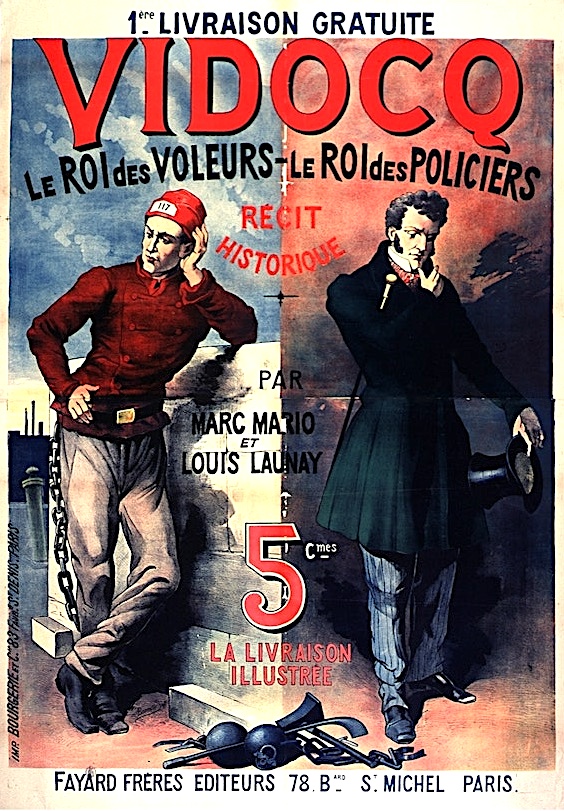
Serialized novel cover for Vidocq, King of Thieves–King of Detectives (Paris: Fayard, 1882). Public Domain.
Historian Paul Metzner argues that the social and political instability of the restored Bourbon Monarchy in the early nineteenth century, following French Revolution and the collapse of Napoleon’s Empire, was particularly favorable to opportunistic virtuosos, self-centered individuals who excelled at “spectacle-making, the cultivation of technical skill, [and] self-promotion,” among them Vidocq (The Crescendo of the Virtuoso, p. 9). Beyond an individual’s actual talents, the publication of articles and performance reviews in newspapers and magazines, as well as full-length books, reached a wide audience and secured an enduring legacy for the virtuoso. In the case of Vidocq, his actual virtuosity as a detective is open to debate; contemporaries held mixed opinions about his character and talents. More certain is that mass publicity about Vidocq, not only the Mémoires but also trial transcripts, exposés, and pseudo-authored publications, secured his reputation as a larger-than-life detective hero.
Vidocq opens his memoir:
I was born in Arras: given my multiple identities, my ability move easily across multiple levels of society, my singular aptitude for disguise, and to settle some uncertainties about my age, permit me to declare that I came into the world on the twenty-third of July 1775, next door to the house where Robespierre had been born sixteen years earlier. It was the middle of the night: rain poured down in torrents, thunder rumbled. A close relation, who combined the functions of midwife and sibyl, concluded I would have a stormy career.
Mémoires, “Bouquins,” p. 9. Author’s translation.
While there is little doubt about the social and political turbulence of the times, the Romantic notion of a sympathetic resonance between Vidocq’s life and historical destiny is literary invention.
According to the Mémoires, Eugène-François’s delinquencies began in childhood, skimming the till from his father’s bakery. He became a strapping, improvident, and intemperate youth, nicknamed “Vautrin,” sanglier or wild boar in local patois.[1] During the early years of the French Revolution, Vidocq joined the infantry and light cavalry in 1791, fighting on behalf of the revolutionary army, switching sides to join counterrevolutionary Austrian forces, and then back on the French side again. The early chapters of the Mémoires also highlight Vidcoq’s romantic liaisons with women, marked by jealousies and betrayals. An altercation with a rival suitor over a mistress landed him in prison for the first time in January 1794. After his release, Vidocq’s new mistress feigned pregnancy to trick him into marriage. Upon discovering the deception, Vidocq abandoned her to join the armée roulante, a “roving army” of imposter officers, who took advantage of the chaotic military situation during the later stages of the revolutionary war to scour countryside estates and con displaced aristocrats.
Over the next two decades, Vidocq rotated in and out of prison. The cycle began in earnest in 1795 when he was imprisoned in Lille for having beaten a military officer, yet another rival suitor for his then current mistress. During this incarceration, Vidocq forged release papers for another prisoner, named Boitel, who was serving six months for having stolen wheat to feed his family (the circumstance later romanticized as the bread theft crime for which Jean Valjean was unjustly condemned in Victor Hugo’s Les Misérables). Shortly after, Vidocq broke out of prison. But he was soon recaptured and now faced double charges; escaping from prison and being an accomplice in a forgery conspiracy (as Boitel, also apprehended, had given him up).[2] From that moment forward, Vidocq became caught up in a vicious cycle of imprisonment, escape, and re-arrest, with additional years added to his sentence in each instance.
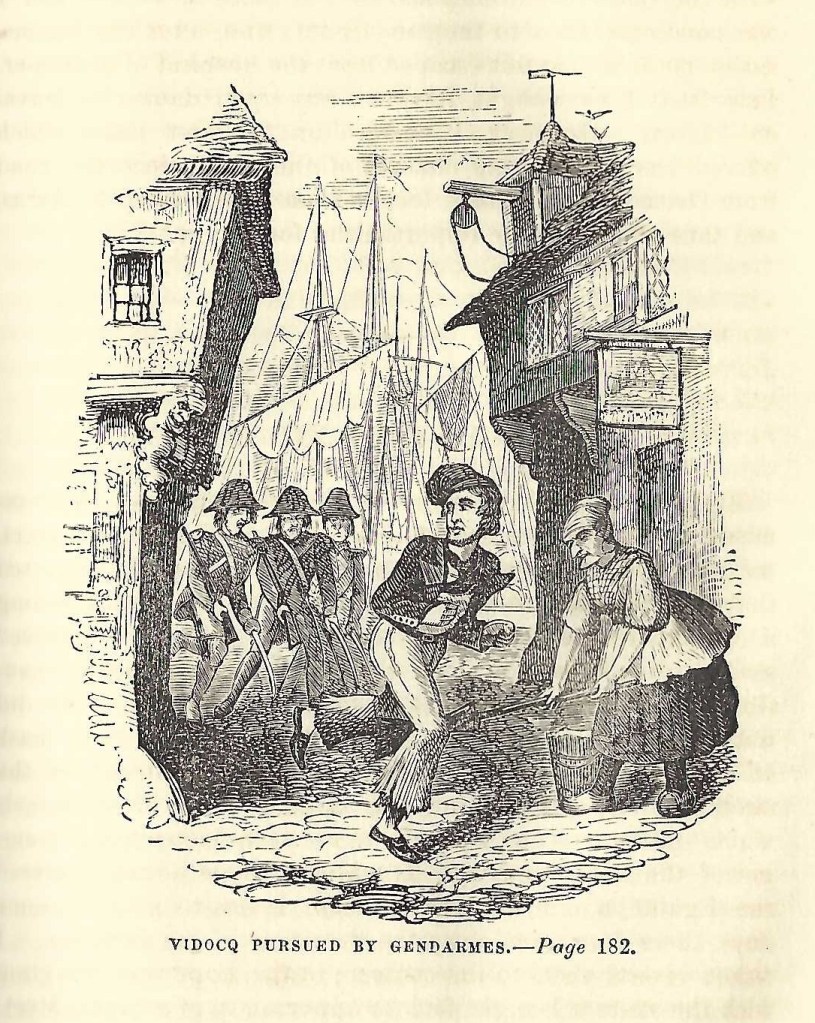
“Vidocq pursued by Gendarmes.” Engraved illustration attributed to Cruishank, in Memoirs of Vidocq: The Principal Agent of the French Police, Written by Himself (Philadelphia: T. B. Peterson, 1859). Author’s Collection.
During those years, Vidocq was incarcerated in some of the most dreadful bagnes or hard-labor prisons in France, including Bicêtre, Douai, and Toulon. These internments constituted Vidcoq’s apprenticeship in criminality, as he fraternized with some of the most hardened members of the milieu and learned their argot or criminal jargon He also became adept at contriving ruses, such as chained prisoners concealing sawed links or replacing metal manacle pins with wooden ones to assist each other during a break out. When Vidocq escaped from prison, he would assume the name of someone whom he knew to be dead, forged a passport under that identity, settled down as a town resident, and took up a regular occupation. Inevitably, though, he was found out and returned to prison. By the time of Vidocq’s final arrest in 1809, the compounded forgery conviction that had dogged him since 1795 had been augmented by eight additional years of hard labor in heavy chains. It was more punishment than he could bear.
“The names of Baron Pasquier and M. Henry will never be erased from my memory. These two generous men were my liberators! What gratitude I owe them!”
Mémoires, p. 280. Author’s translation.
In early nineteenth-century France, turning a police detective into a hero was a remarkable cultural achievement, one that requires some explanation. Since the medieval period, policing had been a general oversight responsibility of city government. In mid-seventeenth-century Paris, with a population of one-half million, better organization was required to address massive urban challenges, including a rapidly growing population of vagabonds, beggars, and decommissioned soldiers. In 1666, the Office of the Lieutenant-General (Lieutnance) was established to secure the safety of the city’s residents, which included the authority to monitor and suppress illicit assemblies, riots, seditious acts, and other public disturbances.
To fulfill these duties, a cadre of forty-eight police commissioners were charged with upholding the law across Paris. These commissioners employed agents to solicit grievances from neighborhood residents, conduct investigations, interrogate persons suspected of committing crimes, and arrest those already charged with crimes. The Lieutenant-General’s office also relied upon an extensive network of police spies — ranging from the professional social ranks of government officials, priests, and lawyers, to the more informal and disreputable realms of courtesans, tavern owners, and domestic servants — who were sometimes paid to gather information.
By the late eighteenth century, the working poor of Paris had come to despise the police as an arbitrary and capricious force. As broadsheets about misères or the hardships of everyday life attest, living conditions for humble Parisian city-dwellers had become desperate. Particularly vulnerable were street peddlers who hawked vegetables, fish, eggs, water, brooms, and other odds-and-ends products, as well as the casual laborers of petits métiers or “small trades,” such as bean shellers, knife sharpeners, and gardeners. Increasingly, these impoverished workers were harassed by the police, who regularly fined them for not having proper permits. Not surprisingly, the Parisian working poor came to view the police as criminals, a sentiment conveyed in the colloquial use of the word enlèvement, abduction or kidnapping, for police arrests (Lebigre, p. 215). It is small wonder that Cartouche and other brigands with generous hearts, skilled at evading and outwitting the police, became popular heroes in Bibliothèque bleue chapbooks.
On the eve of the French Revolution of 1789, the police were further reviled for the widespread use of spies, the infiltration of “conspiratorial groups,” and above all for the abuse of lettres de cachet, arrest warrants bearing the King’s seal that condemned individuals to direct imprisonment without trial. In October 1792, the National Convention established a Committee on General Security and Surveillance, more generally known as the sûreté générale, to compile arrest reports and keep judicial records. The committee was also empowered to imprison and interrogate anyone suspected of conducting criminal activities. Amid the excesses of the Terror during the most radical phase of the Revolution, in the public imagination the sûreté générale became inseparable from the dreaded Public Safety Committee, which sent political enemies and dissidents to the guillotine. Following the Terror, the duties of the sûreté largely returned to surveillance and record keeping.
As part of the bureaucratic reforms under Napoleon’s Consul and Empire, the Paris Prefecture of Police was established on 28 Pluviôse, Year VIII (February 17, 1800), which regulated population circulation in and out of Paris, kept public order, and oversaw the material condition of the city. The Prefecture’s Second Division handled criminal matters such as murder, theft, swindling, counterfeiting, begging, and vagrancy. The division chief was Jean Henry, a police functionary hired in 1785 during the twilight of the Old Regime, who continued to work for the Paris police throughout all phases of the French Revolution, the Napoleonic era, and the Bourbon Restoration. He was called père Henry (“Father Henry”) by police agents under his command, and l’ange malin (“the Devil”) by the criminal milieu. To supplement police surveillance, Henry paid informers to identify at-large criminals and encouraged his agents to use rough methods to subdue them, which earned him a reputation for ruthless efficiency.
While on the lam in March 1809, Vidcoq requested an appointment with Henry at the Paris Police Prefecture to propose that, in exchange for from having to serve out the remainder of his prison sentences, he would assist the police in identifying escaped convicts. Henry turned down the offer. But after Vidocq’s recapture that July, the division chief put him to work as an indicateur or police spy within La Force prison in Paris. Vidocq performed the role admirably, in one instance divulging the details of a prison breakout conspiracy, and in another identifying a vicious murderer who was passing under an alias while incarcerated. In early 1811, Henry convinced newly appointed Paris Police Prefect Pasquier that Vidocq could be put to better use outside of prison to help track down at-large criminals in the city. During a transfer between La Force and Bicêtre prisons in 1812, Vidocq was permitted to “escape,” and Henry immediately appointed him chef de la brigade de sûreté, the head of a newly created “security squad” that was not part of the regular police, but reported directly to him.
Vidocq handpicked the members of his squad, originally four men and eventually thirteen. All were formerly convicted criminals whom he had met in prison. The security squad’s charge was to assist the police in locating and identifying at-large criminals hiding out in Paris, although only regular police agents were allowed to make arrests. While some at the Paris Prefecture questioned the legitimacy of Vidocq’s band, Henry brushed off criticisms so long as the security squad produced results. According to the highly embellished Mémoires, Vidocq’s men delivered the goods, contributing annually to the arrest of dozens of notorious criminals and gang leaders, as well as some 500 minor offenders.[3]
Whatever benefits the brigade de la sûreté had for the Second Division, Vidocq profited handsomely as its chief. By 1825, he had accumulated personal assets valued at over 400,000 francs, far in excess of his official salary of 250 francs per month.[4] Despite accusations within the Prefecture that Vidocq and his security squad were engaging in illegal activities, Henry’s patronage shielded him from scrutiny.
For the time being…
Updated December 1, 2024
NOTES
[1] According to biographer Eric Perrin, colloquial meanings of sanglier differ: in the regional patois of Arras where Vidocq was born, it means “wild boar,”’ while in criminal argot it means “the priest.” Both meanings apply to Balzac’s fictional character Vautrin: in Le Père Goriot (1835) he is the rough and brutal convict from the wild boar mold, while in Splendeurs et Misères des courtisanes (1838-1847) he is a criminal disguised in a cassock as the priest Carlos Herrera. See: Régis Messac, Le “Detective Novel” et l’influence de la pensée scientifique (1929), Collection “Travaux” no. 55 (Paris: Encrage/Les Belles Lettres, 2011), pp. 256-260.
[2] In the Mémoires, Vidocq denies having been a forger. In 1818, after having already served the police as a prison spy and becoming as the head of the Paris “security squad” (brigade de sûreté), he received a royal pardon from Louis XVIII that absolved him of the crime. Nonetheless, as biographer Eric Perrin convincingly demonstrates through archival documents and other published materials, Vidocq was in fact guilty of having committed the forgery. See Perrin, Vidocq, pp. 53-57.
[3] Most certainly, Vidocq was padding the numbers. Of the 811 arrests in 1817 reported in the Mémoires (“Bouquins,” p. 329), only a fraction were for the kinds of crimes charged to the security squad, such as murder, aggravated assault, tracking down escaped convicts and parole violators, and unmasking swindlers. The overwhelming majority of the arrests were for common infractions such as petty theft and vagabondage, routinely handled by the regular police. Vidocq likely added arrests made by the regular police to those of the security squad to produce generate enormous numbers. More accurate details about Vidocq’s security squad’s contributions to police arrests, 1812-1827, are presented in Perrin, Vidocq, Chapters 7-9.
[4] Louis Canler, Mémoires de Canler, ancien chef du service de sûreté (1882), ed. Jacques Brenner (Paris: Mercure de France, 1968), p. 114. See also, Perrin, pp. 111-12.
SOURCES
Arlette Lebigre, “La genèse de la police moderne” and Georges Carrot, “La police et la Révolution,” in Histoire et dictionnaire de la police du Moyen Âge à nos jours, ed. Michel Aubouin, Arnaud Teyssier and Jean Tulard, Collection “Bouquins” (Paris: Robert Laffont, 2005).
Paul Metzner, Crescendo of the Virtuoso: Spectacle, Skill, and Self-Promotion in Paris during the Age of Revolution (Berkeley: University of California Press, 1998).
Eric Perrin, Vidocq (Paris: Perrin, 1995).
Eugène-François Vidocq, Mémoires. Les Voleurs, Collection “Bouquins” (Paris: Robert Laffont, 1998).
Robin Walz © 2024
 Shady Detectives, Elegant Criminals & Dark Avengers
Leave a comment